Pomegra
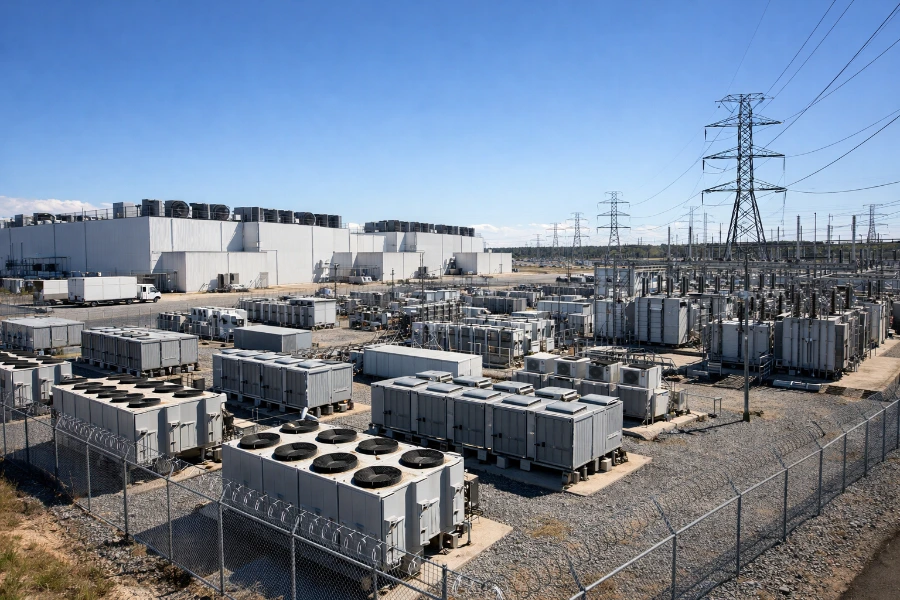
Amazon and Alphabet shares fell about 4% and 3% after Trump threatened a tremendous tax on overseas data centers, with no rate, date or legal mechanism given.
- Trump said the US will not let American companies build data centers abroad and threatened a "tremendous tax" and heavy penalties.
- Amazon fell 4.1% and Alphabet 2.7% on Friday; Microsoft lost 2.8%, and data center landlords fell harder.
- No rate, start date, target list or legal mechanism was specified.
Lead
President Donald Trump said on Friday, November 20, that US companies will not be allowed to build data centers outside the country. He threatened a "tremendous tax" on those that do. He made the remarks at a White House news conference and gave no rate, effective date or list of affected companies. He also acknowledged he had not yet briefed his own officials on the plan.
On the Nasdaq, Amazon (AMZN) closed down 4.1% at $246.82. Alphabet (GOOG) fell 2.7% to $265.29, and Microsoft (MSFT) lost 2.8% to $484.52. The moves came in a session already weighed down by a sell-off in AI stocks.
What Did Trump Actually Say?
Trump said the US would not allow data centers to be built in other countries and that violators would face a heavy tax and penalties. He framed the policy as a competitiveness issue with China, arguing that overseas facilities risk ending up in Chinese hands.
The statement named three possible tools: an outright ban, a tax and penalties. It did not say which would apply, whether foreign subsidiaries or only US parent companies would be covered, or whether leased capacity counts as much as owned buildings. It also did not say whether existing overseas sites would be exempt.
Why Did Data Center Stocks React So Sharply?
Investors sold because the threat targets a core part of the AI spending plans of the largest US technology companies. Alphabet, Amazon, Microsoft, Meta (META) and Oracle (ORCL) all operate or are building capacity abroad.
Recent commitments are large. Microsoft pledged $25 billion in April for AI infrastructure in Australia, and Amazon announced a $20 billion plan there in June. Google committed $15 billion to data centers in Finland in September.
Listed landlords fell further than the cloud providers. Digital Realty (DLR) dropped 6.6%, and Equinix (EQIX) lost 4.9% to $968.22. Both lease capacity to the hyperscale cloud companies.
Can a Tax on Overseas Data Centers Actually Be Imposed?
Not without a legal path that has yet to be identified. Taxes are set by Congress, so a levy would require legislation or a contested use of executive authority such as tariffs or sanctions-style penalties. The announcement offered no statutory basis.
Companies also build abroad for operational reasons. AI inference, the work of serving live user requests, runs best close to customers. Data residency laws in many countries require certain data to stay within national borders. A US restriction could put American cloud providers at a disadvantage against foreign rivals in those markets.
Political Context
The proposal lands as data centers become a domestic political issue. Polling shows nearly two-thirds of Americans oppose data center construction in their own communities, citing electricity demand, water use and environmental concerns. The facilities were a contested topic in this year's midterm races. A policy that pushes capacity back onto US soil carries its own local resistance.
Outlook
The immediate market effect was driven by uncertainty rather than by any defined cost. Without a rate, a start date or a statutory basis, investors cannot size the impact on capital spending plans, and the threat adds to pressure on AI-linked shares. The next signals will be whether the administration publishes a legal framework, whether Congress takes up legislation, and how the large cloud providers adjust announced overseas commitments.
Mentioned tickers: AMZN, GOOG, MSFT, META, ORCL, DLR, EQIX