Pomegra

Futures price roughly a 90% chance of a December Fed rate hike to 4.00%-4.25%, and Governor Waller says sticky inflation could justify a half-point move.
- Futures put the odds of a December hike at about 92% after Friday's close, up from roughly 76% a month earlier.
- Waller says a 25 basis point increase may fall short if core inflation stays near 0.3% a month.
- The S&P 500 and Dow are in correction after an AI-led selloff, which complicates the tightening case.
Lead
Traders are pricing about a 90% probability that the Federal Reserve raises its benchmark fed rate by a quarter point at its Dec. 8-9 meeting, lifting the target range from 3.75%-4.00% to 4.00%-4.25%. Governor Christopher Waller said on Nov. 10 that he leans toward a December increase and that stubborn inflation could warrant a larger half-point step. The pricing has held even as U.S. equities suffered their sharpest weekly decline in more than five years.
How Likely Is a Fed Rate Hike in December?
A December hike is close to fully priced: CME FedWatch futures showed about 92% odds at Friday's close. Most of that probability sits on a 25 basis point move. After the October consumer price report on Nov. 11, futures assigned roughly 89% to a quarter-point hike and about 11% to a half-point hike.
Minutes from the October meeting, released Nov. 18, support that pricing. The committee held rates at 3.75%-4.00% last month, but nearly all participants said further increases would likely be appropriate. Some officials favored a hike in October, and two said the Fed should consider more than a quarter point in December if inflation readings disappoint. A vast majority of the 19 policymakers worried that inflation could persist even if gasoline prices keep falling and the effects of tariffs and the AI infrastructure buildout fade.
Why Does Waller Want a Bigger Move?
Waller wants a bigger move because recent inflation prints show little sign of cooling. In remarks in London on Nov. 10, he said he was leaning toward a 25 basis point increase if monthly inflation improved in October. He added that core readings near 0.3% a month, or higher, could call for a stronger response, and that hiking too little would put the Fed's credibility at risk.
The October data landed on the wrong side of that threshold. Headline consumer prices rose 0.4% and core prices rose 0.3%, both above forecasts. The Bureau of Labor Statistics did not publish an annual rate because last year's government shutdown disrupted data collection. Core services prices climbed faster than goods, with energy costs and AI-related pricing cited as contributors. The October jobs report also showed strong hiring and a lower unemployment rate, which supports the view that demand is not cooling on its own.
Waller has also argued that clearer communication matters. Without it, markets cannot tell whether a December move would be followed by another in January. Fed Chair Kevin Warsh has largely avoided forward guidance, saying it binds the central bank to a predetermined path.
How Are Markets and Interest Rates Reacting?
Markets are reacting with a sharp repricing of interest rates and a broad equity selloff. After the October inflation report, the two-year Treasury yield rose 15 basis points to 4.69% and the 10-year yield rose 9 basis points to 4.96%.
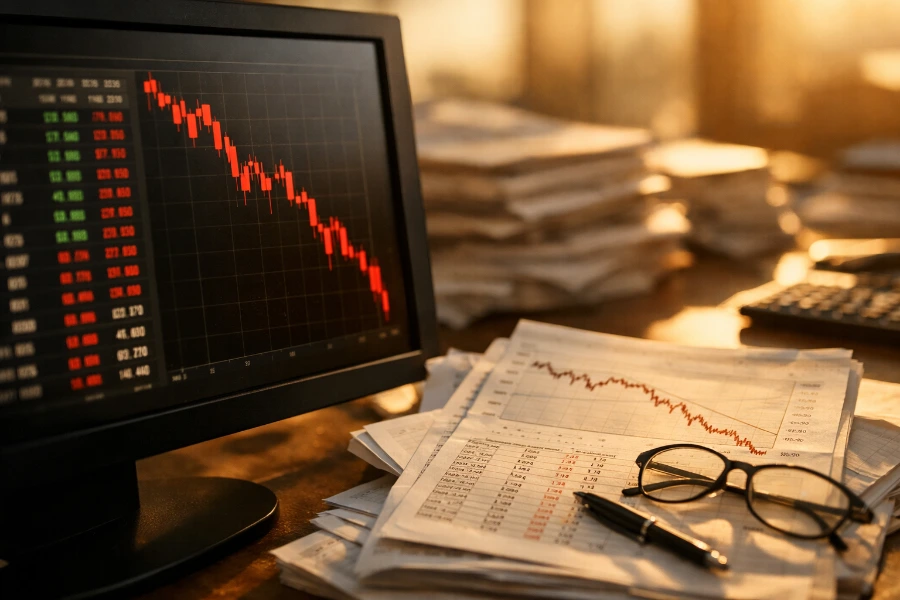
Stocks have since fallen hard. On Friday the S&P 500 dropped 3.70% to 6,910.39, the Nasdaq Composite lost 5.28% to 22,617.73, and the Dow Jones Industrial Average fell 1.93% to 48,147.33. For the week, the Nasdaq fell about 10%, its worst weekly showing since March 2020. The S&P 500 lost 8.6% and the Dow lost 8%. Both of those indexes are now in correction, and the Nasdaq has erased its 2026 gain.
Nvidia (NVDA) had its worst session since the DeepSeek selloff after a report that the SEC is examining its accounting, and that deepened the technology rout. The VIX volatility gauge closed at its highest level since March, and Treasury yields fell sharply as investors sought safety.What Does the Selloff Mean for the Fed's Next Move?
The selloff has not changed December pricing so far, but it adds a second variable to the decision. Tighter financial conditions can slow growth and inflation without help from the Fed. A 10% weekly drop in the Nasdaq also erodes household wealth, which has supported consumer spending.
Policymakers have so far treated the market decline as separate from their inflation mandate. Governors including Waller and Lisa Cook reinforced the case for a December increase this week, citing strong economic growth. A disorderly deterioration in credit markets would change that calculation, but no such stress has surfaced in funding markets.
Strategic Context
The Fed is tightening into an economy with an unusual mix of pressures: tariff pass-through, energy costs and heavy corporate spending on AI data centers. A hike would extend a tightening cycle that has already taken the policy rate to 3.75%-4.00%. The committee is weighing price stability against a market whose gains have leaned heavily on a small group of AI-linked companies.
Outlook
A quarter-point increase on Dec. 9 is the base case, with a half-point move a minority scenario that depends on how inflation data compare with the 0.3% core threshold Waller set. The equity correction is the main counterweight, and a further slide could raise questions about the pace of tightening in early 2027. Until then, futures pricing, Treasury yields and the next inflation report will set expectations for the Fed's final meeting of 2026.
Mentioned tickers: NVDA