Pomegra
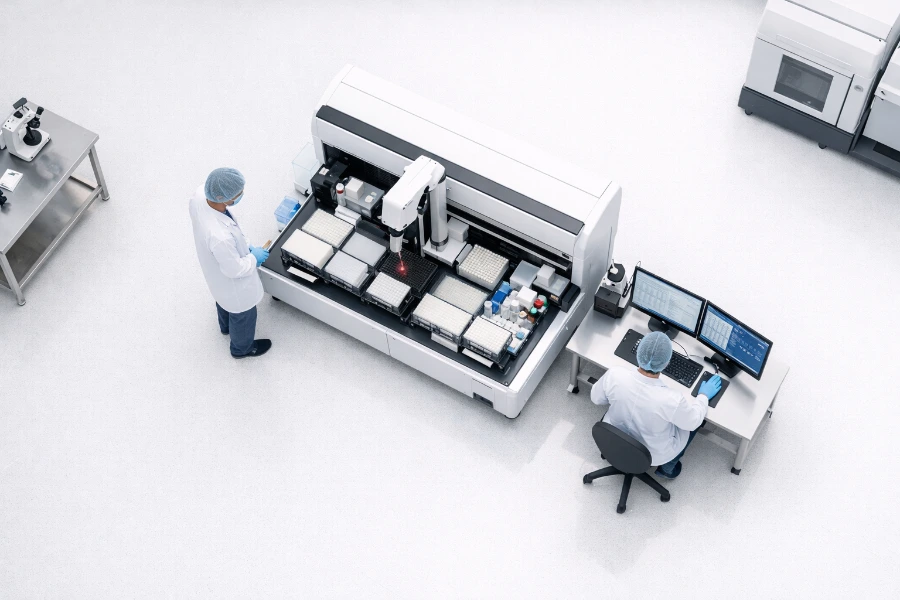
London-based Boltz closed a $110M Series A led by Bessemer Venture Partners, less than a year after leaving stealth, to scale its open-source biomolecular AI models.
Key Takeaways
- Boltz raised $110M in a Series A led by Bessemer Venture Partners, bringing total funding to $138M.
- Usage of its paid molecular tokens grew 50-fold since June 2026; its open models passed 5 million downloads.
- The company did not disclose its valuation. It has about 40 AI researchers in London's King's Cross.
Lead
Boltz, a London-based AI drug-discovery startup spun out of MIT, announced a $110M Series A in the week of 18 November 2026. Bessemer Venture Partners led the round. It comes less than a year after the company emerged from stealth with a $28M seed round in January 2026, which puts total funding at $138M. Boltz did not disclose a valuation.
The company builds models that predict how proteins and drug candidates bind, estimate the strength of that binding, and propose new molecules designed to attach to a given target. Its pitch is that this work, long the preserve of large pharma computing teams, can be sold as software to any lab.
Who Else Invested in the Round?
Existing backers Andreessen Horowitz, Amplify Partners, Zetta Venture Partners and Obvious Ventures all returned. New investors include Greycroft, F-Prime Capital, Hummingbird and Benchling, the life-sciences software company.
The investor mix matters. Returning seed funds took part in an oversized follow-on, which is the usual signal that early traction justified a higher price. Benchling's presence points to a distribution channel as well as capital, since its software sits inside many biotech workflows.
What Does Boltz Actually Sell?
Boltz sells access to its models through Boltz Lab, a commercial platform with proprietary models, and prices usage in molecular tokens. Its open-source releases, Boltz-1 in late 2024 and Boltz-2 since, form the free tier and the top of the funnel. Those open models have been downloaded more than 5 million times and are used by more than 100,000 scientists.
The commercial side shows early signs of demand. Token usage among paying customers has grown 50-fold since June 2026, though the company has not published revenue or a customer count beyond partnerships with six of the world's 20 largest pharmaceutical companies. A 50-fold jump from a small base is a growth rate, not a revenue figure, and the round's pricing will depend on what that base looks like.
Why Did the Company Move to London?
Boltz relocated its headquarters from the US to London, where about 40 AI researchers now work in King's Cross. The company is structured as a public benefit corporation. Its founders are Gabriele Corso, who serves as CEO, Jeremy Wohlwend and Saro Passaro. The original models came out of MIT's Jameel Clinic and CSAIL.
The choice of London fits a pattern in European AI biology, where talent from DeepMind-adjacent groups and nearby universities is available at lower cost than in San Francisco or Boston. It also gives the company proximity to UK pharma customers. The trade-off is that the largest pools of growth capital and drug-development partners remain in the US, which is why US investors led and filled this round.
How Does Boltz Compare With AlphaFold3?
Boltz's open models match the performance of DeepMind's AlphaFold3 on structure prediction, according to the company's own benchmarks. AlphaFold3 shipped with restrictive terms on weights and code, and that opening is where Boltz built its developer base. Free, permissively licensed models let academic labs and pharma teams adopt the tool without procurement delays.
The harder claim is affinity prediction, which is where drug programs spend money. Predicting whether a molecule binds is easier than predicting how tightly, and the second number decides which compounds go to the bench. Boltz-2 targets that problem directly, but wet-lab validation across diverse targets will determine whether the models change hit rates or merely speed up screening.
What Will the Money Fund?
Boltz plans to spend on compute and data infrastructure and to expand its team. That is a conventional use of proceeds for a model developer, and compute costs will take a large share. Its stated goal is to bring AI-powered biomolecular design to every scientist, and the company's own framing is that it is at the start of an exponential trajectory in model capability.
The skeptical reading is that open-source distribution and paid usage can pull against each other. If the free models are good enough, customers may not pay for tokens, so Boltz needs its proprietary models in Boltz Lab to stay visibly ahead of what it releases publicly.
Outlook
Boltz has moved from stealth to a $138M funding total in under a year, with Bessemer leading and every seed investor returning. The open-source base gives it reach, and six large pharma partnerships give it credibility. The open questions are revenue scale, the valuation the round implied, and whether its affinity predictions hold up in independent lab tests. The next 12 months of customer disclosures and model releases should show whether token growth converts into recurring contracts.