Pomegra
Zipline raised $1.5B at a $21.5B valuation led by Paradigm, WCM and Layer Global to build out its Walmart drone network across 300 more US store sites.
Key Takeaways
- Zipline raised $1.5B at a $21.5B valuation, led by Paradigm, WCM Investment Management and Layer Global.
- The valuation is about 2.8 times the $7.6B set in January 2026.
- Walmart agreed to add 300 Zipline delivery sites, up from 21 active today.
Lead
Zipline, the autonomous drone delivery company, announced on November 5, 2026 that it had raised $1.5 billion at a $21.5 billion valuation. Paradigm, WCM Investment Management and Layer Global led the round. Valor Equity Partners, Fidelity Management & Research Company, Uber, Tiger Global, J.P. Morgan, ARK Invest and Salesforce Ventures also participated. The company plans to spend the money on U.S. manufacturing capacity and hiring to support a nationwide delivery network.
How Fast Has Zipline's Valuation Moved?
Zipline's valuation has risen from $7.6 billion to $21.5 billion in roughly ten months. The company raised $600 million at the $7.6 billion mark in January 2026 and added $200 million in March. Counting those two tranches, it has taken in $2.3 billion this year.
A near-tripling in under a year says more about the pace of commercial rollout than about any change in the underlying technology. Drone delivery has been a promise for a decade. The new price reflects investor belief that it has become a scheduled, repeatable retail service. It also reflects a willingness to pay for scale before profitability is visible, since Zipline has not disclosed revenue or margins.
What Does the Walmart Agreement Change?
The Walmart agreement multiplies Zipline's retail footprint. Under a new multiyear national deal, Zipline will operate from 300 additional Walmart sites. The two companies currently run 21 active locations together, and their partnership dates to 2021. Walmart's drone program has passed 2 million deliveries across its providers.
The rollout targets more than 270 locations across nearly 20 metro areas by 2027, with Seattle and Denver among the planned launches. Austin service began last month. Walmart also works with Alphabet's Wing, which opened five Central Florida locations in July, so the retailer is hedging between two operators rather than committing to one.
How Does the Technology Work in Practice?
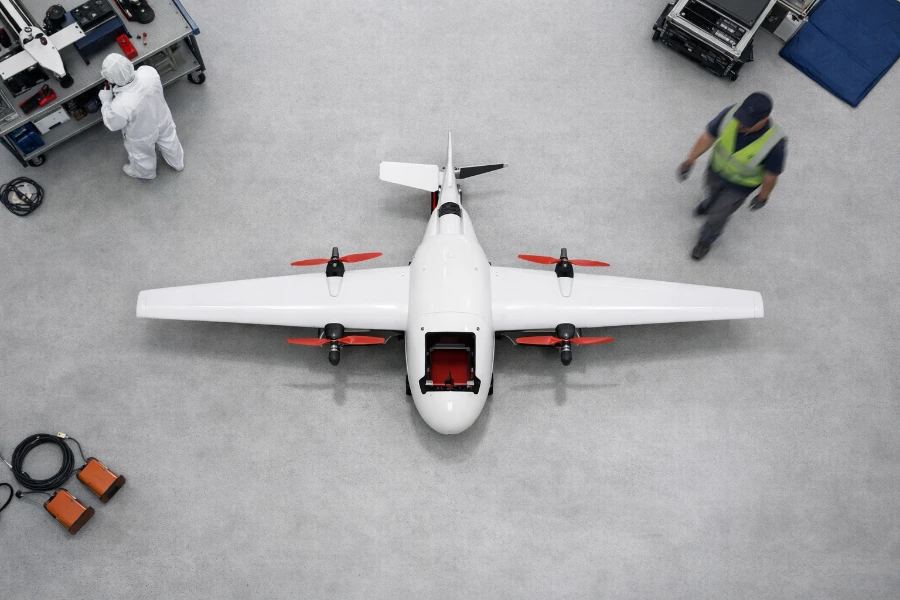
Zipline's current Platform 2 aircraft carries up to 8 pounds over a 10-mile radius. The drone hovers at about 330 feet and lowers a tethered pod to the customer's yard, which keeps the aircraft away from people and rooftops. Deliveries can arrive in as little as 30 minutes for everyday items.
The older Platform 1 fixed-wing design covers a 120-mile round trip and underpins the company's medical work. Zipline serves more than 5,000 hospital locations, operates in five African countries and Japan, and has partnered with the Cleveland Clinic and Mayo Clinic in the U.S. It holds a Part 135 air carrier certificate from the FAA, granted in 2022, and is authorized for beyond-visual-line-of-sight flights.
Who Competes With Zipline?
Zipline competes mainly with Wing and with Amazon's Prime Air. Wing serves Walmart, DoorDash and Lowe's. Amazon is targeting 500 U.S. communities by year-end, which would reach roughly 30 million people.
Uber is both an investor and a distribution partner. It has set a goal of one million drone deliveries per day through the Zipline relationship by 2029. That target is far above anything the industry has flown, and the gap between it and the current Walmart count of 2 million cumulative deliveries is the main execution risk.
What Risks Sit Behind the Number?
Manufacturing throughput, airspace rules and unit economics are the open questions. Each added Walmart site needs aircraft, docks, trained operators and local approvals, and the 300-site target depends on all four arriving on schedule. Federal rules for routine beyond-visual-line-of-sight operations remain a gating factor for any operator.
Unit economics are the harder issue. Zipline has not disclosed cost per delivery or order volume per site. A valuation of $21.5 billion assumes those figures improve sharply as density rises, and the January round priced in less of that assumption than this one does.
Outlook
Zipline now has capital, an anchor retail partner and a regulatory certificate that few rivals match. The test over the next 12 months is whether 21 sites become 270 or more, and whether Seattle and Denver launch on the 2027 schedule. If volumes follow, the round will look like an early bet on infrastructure. If rollout slips, a valuation that rose 2.8 times in ten months leaves little room for a reset.