Pomegra
Warsaw's WaterSense raised a €5.75M pre-seed led by b2venture and Movens Capital to forecast river pollution 72 hours ahead with disposable biosensors.
Key Takeaways
- WaterSense closed a €5.75M pre-seed on November 26, 2026, co-led by b2venture and Movens Capital, with Vastpoint also investing.
- €3.5M of the total is non-dilutive grant money from Poland's NCBR, which leaves roughly €2.25M in equity.
- The company reports about $450,000 in annual recurring revenue and plans 140 stations by the end of 2026.
Lead
WaterSense, a Warsaw-based water intelligence startup, has raised €5.75M in pre-seed funding to scale its river monitoring network across Europe. b2venture and Movens Capital co-led the round, and Vastpoint also participated. The company did not disclose a valuation.
The headline figure mixes two kinds of money. Poland's National Centre for Research and Development (NCBR) supplied €3.5M as a grant that requires no equity. That leaves about €2.25M raised from investors, a modest cheque for a hardware-heavy business.
What Does WaterSense Actually Sell?
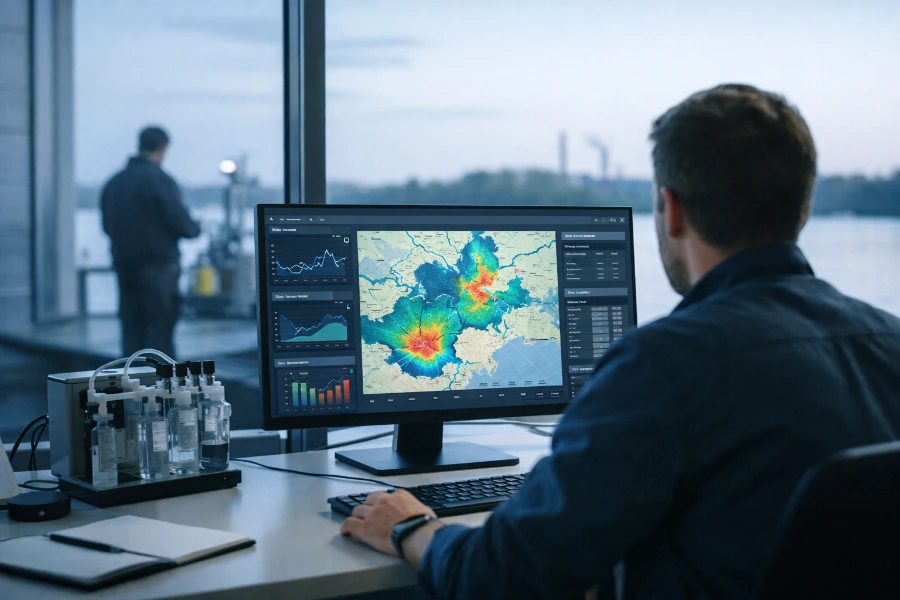
WaterSense sells subscriptions to water quality data and forecasts, not hardware. Each automated station carries about 300 small, replaceable biosensors in place of one durable probe. The system swaps them out automatically, which targets the fouling and drift that degrade conventional sensors in rivers.
Station readings are combined with satellite imagery in a set of deep learning models. These predict changes in water quality up to 72 hours ahead. The company puts forecast error at 5-8%, and 6-8% at the 72-hour mark.
Who Is Buying, and How Much Revenue Is There?
The customer base is more than 30 organizations in Germany, Switzerland, Austria and Poland, covering over 80 monitored locations. The first customers were Warsaw Waterworks and a Warsaw city agency. Commercial operations began in May 2024.
Annual recurring revenue stands at roughly $450,000. That is thin against a team of 20 to 23 people and a plan to deploy 140 stations by the end of 2026. The grant money cushions the gap, and it also explains why the equity portion of the round is small.
The round was oversubscribed threefold and closed in about six weeks, per the company. Oversubscription in a pre-seed is cheap to claim and hard to verify, but the close time suggests investor appetite for climate-data infrastructure in Central and Eastern Europe.
Why Did the Oder Disaster Shape the Company?
The company traces its origin to the 2022 toxic algal bloom in the Oder River, which killed about 360 tonnes of fish. Founder Filip Budny began his PhD at Warsaw University of Technology that year. He has personally installed 45 to 50 stations.
The Oder is now the first full river system WaterSense intends to cover, across about 1,600 km. Monitoring a whole river rather than isolated points is the product's main claim. Single-site sensors can flag a problem only after it arrives, while a networked system can in principle track a pollution plume as it travels downstream.
Why Did b2venture Back a Hardware-Plus-Data Startup?
b2venture backed WaterSense because the company owns the process that generates its data. Anna Bosch of b2venture said WaterSense "stood out because they control how its data is generated." That matters because data startups that buy readings from third parties struggle to defend margins or accuracy.
The tradeoff is capital intensity. Each station needs installation, maintenance visits and consumable sensors, and a subscription model must cover all of that over time. The ratio of grant money to equity in this round shows how much of the build-out is still being underwritten by the public sector.
How Crowded Is the Field?
The field is small and thinly funded. Named competitors include Hypersoniq of the Netherlands, which has raised €1.1M, and Riverkin of Switzerland, which has raised CHF 1.7M. WaterSense now has several times the funding of either, though it is still a pre-seed company with less than $500,000 in recurring revenue.
The company also plans to move beyond forecasts toward recommending actions to operators. Operators such as utilities and municipal agencies tend to adopt such advisory tools slowly, so that step depends on the accuracy numbers holding up across more rivers and seasons.
Outlook
WaterSense has enough money to build out its Oder network and test whether utilities and agencies will pay recurring fees for 72-hour forecasts. The €3.5M grant lowers dilution risk but ties the plan to public-sector priorities. The next markers are the 140-station target, revenue growth beyond $450,000, and evidence that forecast accuracy survives outside the pilot sites. A seed round would be the first real valuation test.