Pomegra
Tutor Intelligence raised a $75M Series B led by a16z to expand its rent-by-the-hour warehouse and factory robots, with valuation and revenue undisclosed.
Key Takeaways
- Tutor Intelligence raised a $75M Series B led by Andreessen Horowitz on November 2, 2026.
- Total funding reaches $117M. Union Square Ventures and Neo also invested.
- The company targets 1,000+ robots under contract by the end of 2027.
Lead
Tutor Intelligence, a Watertown, Massachusetts robotics company, announced a $75M Series B on November 2, 2026. Andreessen Horowitz led the round, and earlier backers Union Square Ventures (Series A lead) and Neo (seed lead) also participated. Total capital raised now stands at $117M. The company did not disclose its valuation or revenue.
The money will pay for training the company's robot foundation model and for building and deploying its two robot workers, Sonny and Cassie. Tutor says it is on track for more than 1,000 robots under contract by the end of 2027, all built in the US.
What Does Tutor Intelligence Actually Sell?
Tutor sells robot labor rather than robots. Customers pay by the hour or by the pick, with no upfront purchase and no long-term contract, and the company advertises rates starting at $14 an hour. Tutor handles deployment, maintenance and remote software updates itself.
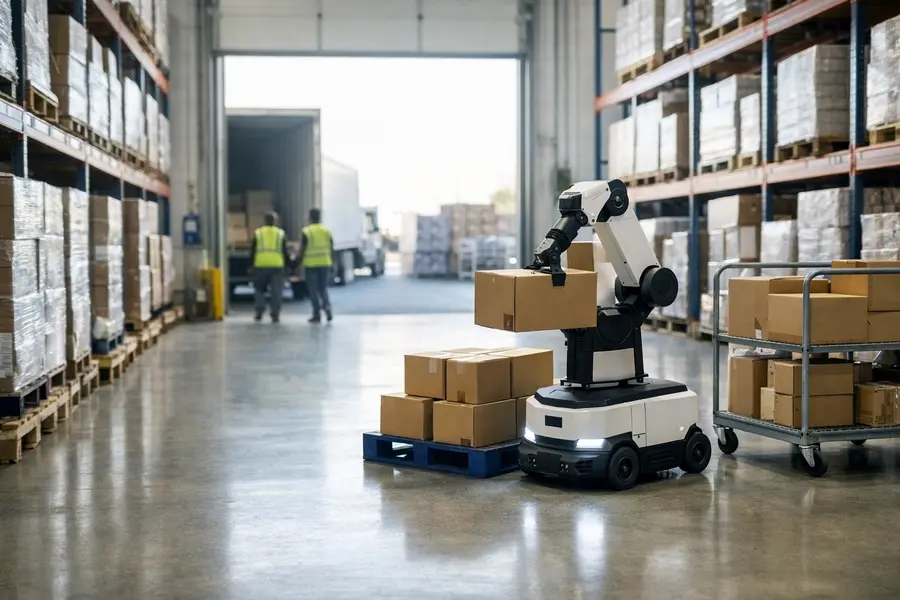
Sonny is a two-armed, semi-humanoid robot that picks individual items for e-commerce fulfillment. Cassie is a single-armed mobile manipulator that handles case picking and palletizing. Both run Tutor's own models and work with goods such as cereal, snacks, candy, cosmetics, home goods and toys.
The company spun out of MIT CSAIL in 2021. CEO Josh Gruenstein founded it with Alon Kosowsky-Sachs.
How Do the Robots Handle Tasks They Cannot Solve?
When a robot gets stuck, a remote human operator, which Tutor calls a "tutor," steps in and guides it over the internet. The completed task then becomes training data for the model, so the same situation is less likely to stall the next robot.
This detail matters for the economics. A $14 hourly rate only works if one human can supervise many robots, and that ratio depends on how often the models need help. Tutor has not published how many robots each operator handles or how that figure has changed.
Why Does a16z's Lead Matter for a Robotics Startup?
A $75M check from a top-tier firm gives Tutor capital to build hardware at a pace the company says it is struggling to meet. Gruenstein has said Tutor can "hardly build robots fast enough."
The round also raises a question the announcement does not answer. Hourly pricing keeps robots on the vendor's balance sheet, so every new unit consumes capital before it earns revenue. With $42M raised before this round, the Series B is a bet that deployed robots will pay back faster than they are built. Without disclosed revenue or utilization figures, outsiders cannot test that claim.
Growth Signals
Tutor reports twice as many robots operating in nearly four times as many facilities as a year earlier. The facility count grew faster than the robot count, which suggests many new sites start with small deployments. About 33% of new customers were existing clients adding more robots, a sign that pilots are converting into larger installs.
Those figures lack an absolute base. "Four times as many facilities" could mean a modest number of sites, and the company has not named its customers or given a robot count.
Strategic Context
Warehouse and factory automation has long split into two camps. One sells expensive fixed-purpose machines that require integration work and multi-year commitments. The other sells general-purpose robots that still need extensive engineering for each site.
Tutor sits in between, selling a flexible robot as a metered service and relying on human supervision to cover the gaps. That model lowers the barrier for mid-sized manufacturers and logistics operators that lack automation teams. It also exposes Tutor to the cost of the human layer, which does not shrink unless the models improve.
What Comes Next?
Over the next 14 months the company has to turn funding into hardware at scale. Reaching 1,000 robots by the end of 2027 means a steep manufacturing ramp from its current base, which it has not disclosed.
The signals to watch are the ratio of robots to remote operators, the share of tasks completed without intervention, and whether customers expand beyond their first sites. A later priced round or disclosed revenue would also reveal what a16z paid for the stake.
Outlook
Tutor Intelligence now has $117M in total funding and a lead investor with deep pockets for robotics and AI. Its hourly pricing and remote-assisted learning loop have drawn growing demand, but the unit economics remain undisclosed. The 2027 target of 1,000 robots will show whether the model scales or whether supervision costs cap it.