Pomegra
Stellios Technologies exited stealth on October 20, 2026 with an oversubscribed $5 million pre-seed round for high-power microwave, directed-energy and compact-fusion hardware, backed by $2 million in signed purchase orders.
- Stellios raised $5 million in pre-seed funding, with no single lead investor named and no valuation disclosed.
- The Austin, Texas startup says it signed $2 million in customer purchase orders before raising outside capital.
- First product is Stellios Shield, a high-power microwave counter-drone system with a claimed nine-month pilot timeline.
Lead
Stellios Technologies, an Austin, Texas startup founded in 2026, announced on October 20 that it has emerged from stealth with a $5 million pre-seed round. The company builds vacuum-electronic devices, high-voltage power generation and control systems, and the other core hardware that high-power microwave systems require. It says the round closed above its initial target within weeks. The money is meant to carry the company through delivery of its first contracted systems and the build-out of domestic R&D and pilot manufacturing space.
Who Backed the Round and at What Valuation?
The round drew Sofreh Capital, Wave Function Ventures, Cubit Capital, Mana Ventures, Atoms & Bits, Output Capital and angel investor Erik Bruckner, along with other strategic investors. Stellios did not name a lead, and it did not disclose a valuation or the equity sold. For a pre-seed, the missing valuation is routine.
The more unusual detail is the revenue-side signal. Stellios says it held $2 million in signed customer purchase orders before the round began, which means 40% of the raised amount was already matched by contracted demand. That is a stronger position than most hardware companies hold at this stage. The company has not named the customers, and it has not said whether the orders are firm deliveries or conditional on technical milestones.
What Does Stellios Actually Build?
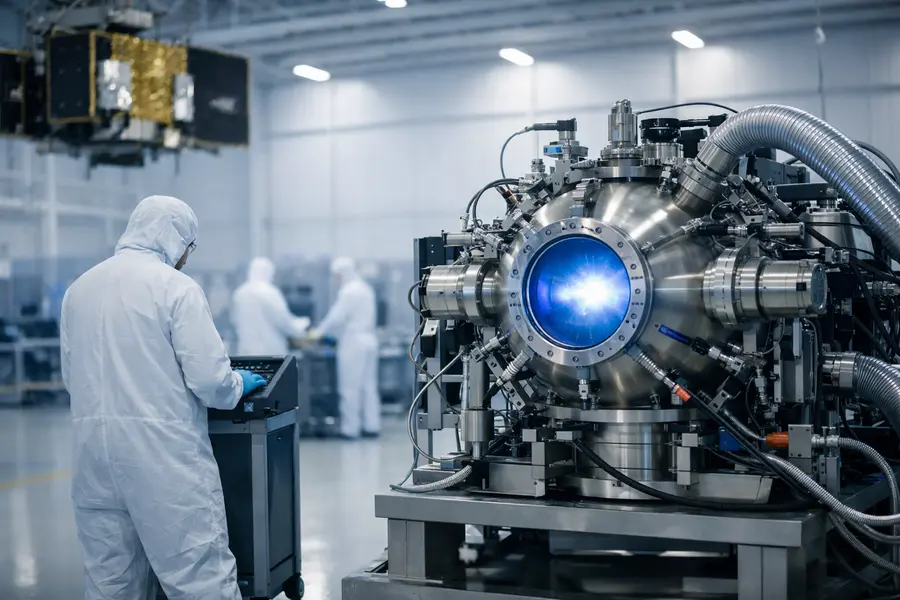
Stellios develops megawatt-class high-power microwave (HPM) systems, starting with defense and industrial buyers. Defense uses include counter-electronics and counter-drone missions. Industrial uses the company lists include geothermal drilling, advanced materials processing and plasma heating for fusion research.
The first product is Stellios Shield, a directed-energy platform for air defense. The company describes it as a "speed-of-light, non-kinetic engagement" system and claims a nine-month pilot deployment timeline. It would compete with kinetic interceptors, which cost far more per shot than a microwave pulse, though Stellios has published no performance data on range, dwell time or cost per engagement.
The company also develops Stellios Genesis, an AI-native engineering and digital-twin platform for hardware design. Its stated use is to shorten design cycles for the microwave and power hardware.
Why Pair Microwaves With Compact Fusion?
Stellios treats HPM as the entry point to a longer roadmap: counter-drone systems first, then compact aneutronic fusion, then fusion-driven propulsion. The logic is that the same vacuum-electronic and high-voltage components underpin all three. Microwave sources can heat plasma, and fusion research programs need that capability.
That is a plausible technical thread, and the sequencing is sensible, since defense purchase orders can pay for the work that fusion cannot yet fund. Aneutronic fusion remains unproven at commercial scale across the industry, however. Stellios offers no timeline for fusion milestones, and the near-term business is the microwave hardware.
Who Is Behind the Company?
Founder and CEO Dr. Richard Starson holds a Caltech Ph.D. and previously co-founded Escape Dynamics, a startup whose team designed and operated a 100-kW-class gyrotron. A gyrotron is a high-power vacuum tube that generates millimeter-wave microwaves, the kind of hardware at the center of Stellios's pitch.
Dr. Edl Schamiloglu of the University of New Mexico, a known high-power microwave researcher, serves as an advisor. He said that rebuilding this capability in America is critical to national security and industrial leadership. Philip Carson of Cubit Capital said the company is building a commercially grounded business.
Starson framed the company's purpose in national terms. "Now is the time to rebuild that capability in America, addressing urgent defense needs today while laying the foundation for compact fusion and entirely new propulsion systems," he said.
How Will the Money Be Used?
Stellios plans to spend the round on four items:
- Production and delivery of its first contracted HPM systems.
- Domestic R&D and pilot manufacturing facilities.
- Engineering and leadership hiring, plus support for government customer programs.
- Further development of the Genesis platform.
At $5 million, the budget is thin for a company that intends to manufacture megawatt-class hardware. Pilot manufacturing space, high-voltage test equipment and vacuum-tube fabrication are capital-intensive, and the $2 million in purchase orders will partly offset those costs only if deliveries land on schedule. A seed round within the next 12 to 18 months looks likely if the Shield pilots proceed.
What Comes Next?
The nine-month pilot claim sets the first test. If Stellios delivers working systems to its initial customers by mid-2027, the company will have evidence for a larger raise and for its position in a counter-drone market where demand is rising. If delivery slips, the unproven fusion and propulsion roadmap will have little to stand on.
Outlook
Stellios enters the market with early contracted demand, a founder with direct gyrotron experience, and a roadmap that ties near-term defense revenue to long-horizon fusion work. The open questions are customer identity, performance data and whether $5 million can fund the manufacturing build-out. Pilot results over the next year will settle most of them.