Pomegra
Munich startup Starforge raised a €6.6M pre-seed led by AENU and First Momentum to build compact, factory-made fusion reactors for utilities by the 2030s.
Key Takeaways
- Starforge closed a €6.6M (about $7.2M) pre-seed round, led by AENU and First Momentum Ventures.
- Founded in March 2026, the company targets mid-2030s commercial operation and about €0.05/kWh at fleet scale.
- The round is meant to carry Starforge through 24 months of design work and first customer commitments. Valuation is undisclosed.
Lead
Starforge, a Munich-based fusion developer founded in March 2026, launched on November 26 with a €6.6M pre-seed round. AENU and First Momentum Ventures led it. Auxxo, Kvanted, Silicon Roundabout Ventures, UnternehmerTUM Funding for Innovators and Arcas also participated. The company says it closed the round in eight weeks. It has not disclosed a valuation.
Starforge designs compact spherical tokamak reactors meant to be built repeatedly in a factory rather than assembled one at a time on site. It plans to sell them to utilities, governments and private infrastructure owners. The target for commercial operation is the mid-2030s.
Who Is Behind Starforge?
Dr Ana Koller is CEO. She previously worked at Commonwealth Fusion Systems, MIT and the Max Planck Institute for Plasma Physics. Jonathan Janssen is COO and co-founder. He is a former executive at air-taxi maker Lilium and at GE.
The pairing is deliberate: a plasma physicist plus an operator who has seen manufacturing scale-up go well and badly. Lilium's trajectory is a cautionary reference for any hardware company promising serial production. Investors in a pre-seed round are betting on that combination of skills, since there is no hardware yet to evaluate.
What Is Starforge Actually Building?
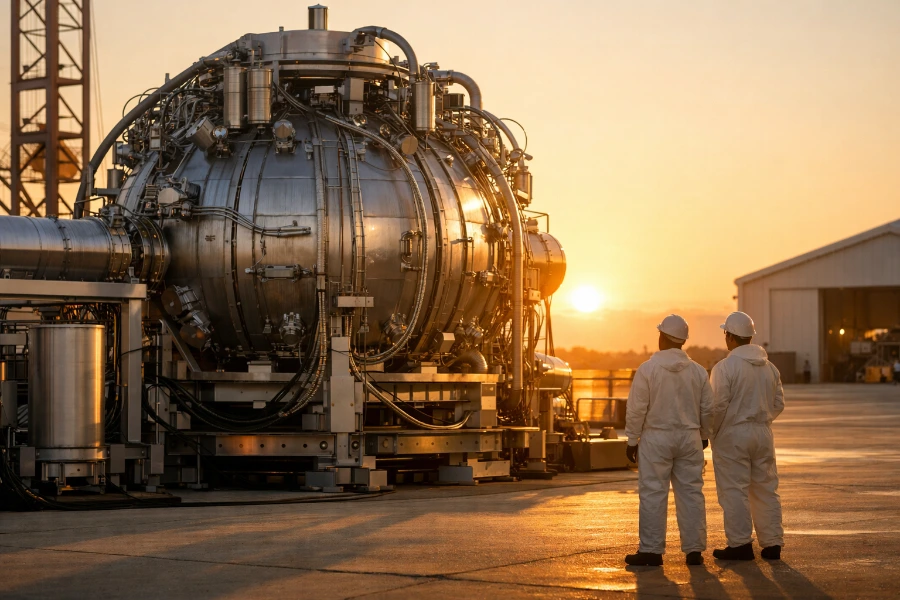
Starforge is building a spherical tokamak, a compact doughnut-shaped machine that uses superconducting magnets to confine superheated plasma. Its design includes disassemblable magnets so the field coils can be maintained rather than replaced wholesale. The first planned product, Unit One, is specified at 200 to 300 megawatts of electrical output with a service life above 40 years.
The company does not plan to run power plants. It wants to act as a reactor manufacturer, a role comparable to Westinghouse or Framatome in fission. Its stated markets are national grids, data centers, industrial heat and remote defense sites.
How Realistic Are the Cost Targets?
Starforge targets roughly €0.05 per kilowatt-hour at fleet scale, assuming a 15% cost reduction for each doubling of production volume. That figure is a modeling assumption, not a measured result. No fusion device anywhere has yet delivered net electricity to a grid.
The learning-curve claim is the weakest link. Solar and batteries followed such curves because their units were small, numerous and quickly iterated. A 200 to 300 MW reactor with superconducting magnets ships in far smaller quantities, so the feedback loop is slower by orders of magnitude. The company's own phrasing is that it wants to make fusion "boring: a utility people drive past without a second thought." That is an ambition, and the round funds only the first step toward it.
What Will the Money Pay For?
The €6.6M is meant to last 24 months. Starforge will expand its team, mature the core reactor technologies, complete the conceptual design of Unit One and secure initial commitments from European customers. It will not build a reactor on this money. Nothing in the announced plan involves plasma operation within that window.
For a pre-seed, the size is large by European standards, and the eight-week close suggests demand from deep-tech investors. It also implies a much larger follow-on round. Fusion hardware programs typically need hundreds of millions of euros before a demonstration device runs, so this round buys credibility and a design rather than a path to power.
Why Does Munich Matter for Fusion Funding?
Munich has become Europe's densest fusion cluster. Proxima Fusion, based in the city, completed a €411M round that set the regional record. Germany also launched a €500M fusion startup program in October 2026. Seventeen fusion companies worldwide have now raised $100M or more.
Starforge enters a field where capital is concentrated in a few well-funded leaders. Its pitch differs from theirs in emphasis: it leads with manufacturability and fleet economics rather than plasma performance records. Whether investors reward that framing depends on whether the design survives scrutiny from utilities that have to buy it.
What Comes Next for Starforge?
Over the next 24 months, the milestones are concrete and checkable: a finished conceptual design for Unit One, a larger team and signed customer interest from European buyers. Letters of intent are cheap, so binding commitments or deposits would carry more weight than announcements.
The main risks are technical and financial. Superconducting magnet performance, tritium handling and materials durability remain unsolved at commercial scale across the industry. Starforge will also need a seed or Series A round well before any hardware exists, likely in a market where the biggest fusion rounds keep going to the largest players.
Outlook
Starforge has a credible founding team, a clear manufacturing thesis and €6.6M to turn a reactor concept into a design that customers can assess. It has no prototype, no disclosed valuation and a cost target that rests on assumptions. The next 24 months will show whether European utilities treat factory-built fusion as a procurement option or as a research topic.