Pomegra
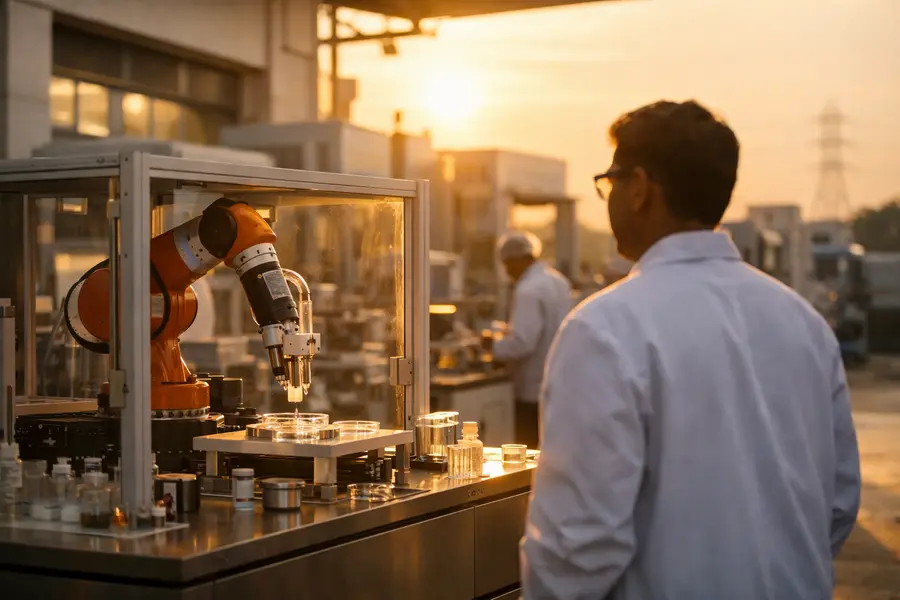
Bengaluru's Scimplify raised $25M in a strategic round led by Hitachi Ventures, with customers Henkel and Teknor Apex joining, to build US materials capacity in 2026.
Key Takeaways
- Scimplify raised $25M led by Hitachi Ventures; the post-money valuation is $250M, up from $150M in March 2025.
- Henkel and Teknor Apex invested as customers; Teknor Apex will also manufacture for Scimplify in the US.
- Total equity funding reaches $80M; the company reports a $200M annualized revenue run rate.
Lead
Scimplify, a Bengaluru-based maker of specialty chemicals and advanced materials, raised $25M in an all-equity strategic round announced on October 14, 2026. Hitachi Ventures led. Two industrial customers, Henkel and Teknor Apex, joined as new investors, while Accel India, Bertelsmann India Investments, Omnivore and 3one4 Capital returned. The round values the company at $250M post-money, up from $150M after its $40M Series B in March 2025, and lifts total equity raised to $80M.
What Does Scimplify Actually Do?
Scimplify develops and sources specialty chemicals and critical materials for customers, then routes production to a network of more than 500 partner factories. About 90% of that manufacturing sits in India today. The company runs research sites in Bengaluru and Hyderabad and has roughly 340 employees, about 70 of them scientists.
Its pitch is speed and supply diversification. Co-founder Sachin Santhosh has said the company can deliver finished materials in about two months, against the 12 to 18 months typical for custom projects. A proprietary AI platform called Scinode, built around task-specific software agents for research, manufacturing and quality control, is meant to compress that timeline. About $2M of the new money is earmarked for Scinode.
The model displaces traditional chemical traders and Chinese contract suppliers, which have long supplied many of these inputs to Western buyers.
Why Did Henkel and Teknor Apex Invest?
Both companies buy from Scimplify, and the investment ties them closer to a supplier they want to keep. Teknor Apex, a US polymer compounder, will act as manufacturing partner for Scimplify's American build-out. That gives the startup a domestic production base without building every plant itself.
Customer-investors cut both ways. They offer committed demand and credibility with other buyers. They also raise questions about pricing leverage and independence, since the company's backers are also its customers. Hitachi, which the company names as a customer alongside TDK and BASF, fits the same pattern.
How Big Is the Business Behind the Valuation?
The company reports an annualized revenue run rate of $200M, roughly triple the prior year, and a 2026 target of $400M. Its US run rate is $60M, up from $10M, and international sales now exceed 50% of revenue, from under 5% eighteen months ago. It serves more than 1,000 customers in over 40 countries.
The company says it has been EBITDA-positive for two months and is targeting tax profitability this month. These are company-stated figures and have not been independently audited. A run rate also differs from recognized revenue. Specialty chemical sourcing is a lower-margin, volume-driven trade, so the multiple at $250M is the number to watch: about 1.25 times the claimed run rate.
The step-up from $150M to $250M in 19 months is moderate against the claimed tripling of revenue. Part of the explanation is that the round is strategic, sized at $25M, and priced with customers at the table rather than set by a competitive financial auction.
Where Will the Money Go?
About $7.5M is planned for US expansion, covering research, processing and manufacturing capacity for materials used in semiconductors, defence, energy and AI infrastructure. Japan is the second target over the next year. Defence, energy and electronics now account for 45% to 50% of revenue, up from under 15%.
That mix explains the investor list. Governments and manufacturers in the US and Japan are trying to reduce dependence on Chinese supply for gallium-type inputs, battery chemicals and electronic-grade materials. Scimplify sells India as the alternative source.
What Comes Next?
The test is whether a 90% India-based production footprint can meet US defence and semiconductor qualification requirements, which often demand domestic or allied-country sourcing and long audit cycles. The Teknor Apex arrangement is the first answer. A second is the pace at which the US run rate keeps climbing from $60M.
Scale also brings execution risk. Managing 500 partner plants for quality consistency is harder than managing a few, and the AI layer will be judged on whether it cuts project timelines for paying customers rather than on demos. A larger round would probably follow if the 2026 target of $400M holds.
Outlook
Scimplify enters its next phase with $80M raised in total, a $250M valuation, and strategic backers who are also its buyers. The claimed growth is steep, but the figures come from the company, and profitability has been reached only recently. The US build-out with Teknor Apex will show whether India-made advanced materials can win defence and semiconductor work.