Pomegra
SafeWorld, a Carnegie Mellon spinout, emerged from stealth in October 2026 with a $12.2 million seed round to simulate dangerous robot-human encounters before deployment.
Key Takeaways
- SafeWorld raised a $12.2M seed round, co-led by Shine Capital and a16z Speedrun, and announced it on October 5, 2026.
- The Palo Alto startup sells browser-based 3D simulation that tests robots against rare, dangerous scenarios involving people.
- Early pilots are running with automotive manufacturers, warehouse-automation firms and medical-device makers. Valuation is undisclosed.
Lead
SafeWorld, a Palo Alto software company building robot safety simulation, came out of stealth on October 5, 2026 with $12.2 million in seed funding. Shine Capital and a16z Speedrun co-led the round. The company says its platform lets enterprises test how robots behave around people in rare and unexpected situations without putting anyone at risk. It is already running early pilots with automotive manufacturers, warehouse-automation companies and medical-device makers.
Who Is Behind SafeWorld and Who Funded It?
SafeWorld was founded by Kyle Wong, Ding Zhao and Simo Rachidi, and the round was co-led by Shine Capital and a16z Speedrun. Wong is CEO; he previously founded Pixlee, which was acquired, and ran the StartX accelerator. Zhao directs the Safe AI Lab at Carnegie Mellon University, worked at Google DeepMind and holds an NSF CAREER Award. Rachidi is a former principal security and machine learning engineer on Salesforce's Einstein team.
Other investors include Box Group, the Carnegie Mellon University Endowment, Innovation Endeavors, SV Angel, Ovo Fund, Valkyrie, Zelda Ventures, Alpha Square Group, Founders Future and Brave Capital. Angels from Nvidia, Google DeepMind, Waymo, Meta, DoorDash, Salesforce and Together AI also took part. The round was oversubscribed. SafeWorld did not disclose a valuation, a headcount or how it will split the money between hiring and compute.
What Does SafeWorld's Software Actually Do?
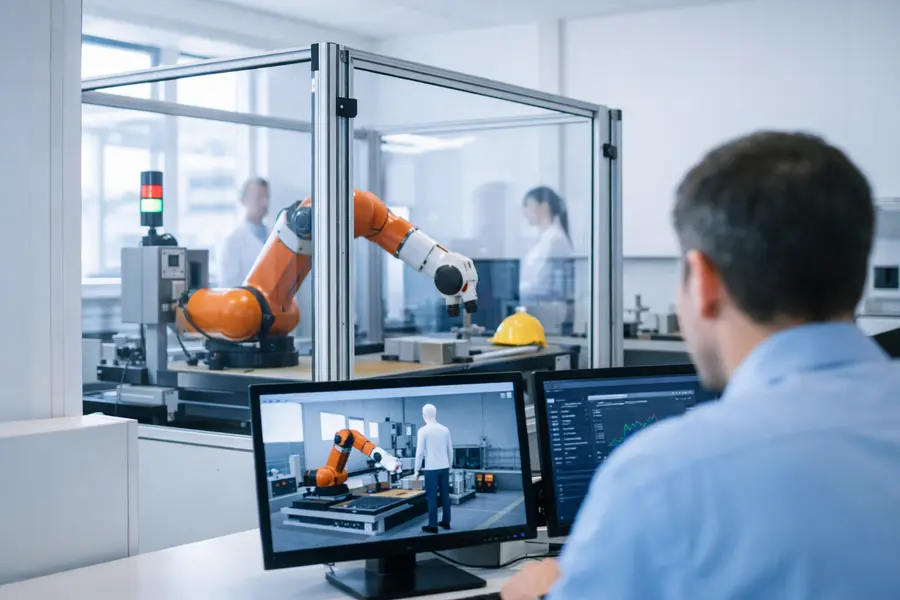
SafeWorld's product generates 3D scenarios in which a robot meets simulated humans, then runs thousands of variations and scores the robot's safety performance. Users build scenarios in a browser from past incidents, safety standards and robot logs, using natural-language prompts. No simulation expertise is required, according to the company.
The platform also revalidates a robot after each software update. That matters because modern robot behavior is increasingly driven by learned models that change with every training run, so a safety check passed in March says little about a build shipped in June. The human models are meant to move realistically and react to the robot, which is the harder part of the problem. Generic physics engines handle collisions well and human unpredictability poorly.
Why Does Robot Safety Testing Need Its Own Software?
Robot safety testing needs dedicated software because physical trials cannot cover the rare cases that cause injuries. A warehouse robot may run millions of hours without meeting a child, a person on crutches or a worker who steps backward at the wrong moment. Staging those encounters with real people is slow and ethically fraught.
Autonomous-vehicle developers faced the same wall and turned to simulation years ago. SafeWorld is betting that humanoids, mobile manipulators and factory arms need an equivalent, and that Zhao's two decades of autonomous-systems safety research gives it a credible head start. The company's likely rivals are in-house simulation teams at large robot makers and general-purpose simulators from chip and platform vendors. SafeWorld's pitch is that a neutral, third-party tool is easier to put in front of a customer, insurer or regulator than a vendor grading its own robot.
What Do Customers Say?
Thomas Tang, CEO of Anyware Robotics, said safety has been foundational from day one and that tools like SafeWorld give his company a scalable way to test. Zhao framed the logic more bluntly: as robots move into factories and warehouses, simulation lets teams test dangerous situations before real-world deployment. Neither statement discloses contract values, and the pilots are not yet identified by customer name beyond Anyware.
What Does This Round Imply?
The round implies investors see safety validation as a separate purchase from robot hardware and models. A $12.2 million seed is large for a company with no named paying customers. The co-leads span a growth-stage fund and an accelerator-linked program, and the cap table includes university money and angels from robotics, autonomy and AI labs, which suggests the buyers and builders SafeWorld targets are also its backers.
The skeptical read is that pilots are not revenue, and that safety buyers move slowly. Automotive and medical-device customers work under established certification regimes, and a simulation score only matters if auditors accept it. SafeWorld has not said whether any regulator or standards body has recognized its outputs.
What Comes Next for SafeWorld?
The next test is converting pilots into paid, repeating contracts and showing that simulated failures predict real ones. If SafeWorld can publish validation results that match field incidents, it gains a defensible position as robot deployments grow. If large simulator vendors add comparable human-behavior modeling to their own toolkits, the company will have to compete on scenario libraries and certification credibility rather than on the technology itself.
Outlook
SafeWorld enters a market where robot capability is moving faster than the tools that prove robots are safe. Its $12.2 million seed, early pilots in three safety-sensitive industries and an academic founder with a long record in the field give it a credible start. The open questions are valuation, revenue and whether auditors will accept simulated evidence. Those answers will decide if SafeWorld becomes standard infrastructure or a feature inside someone else's platform.