Pomegra
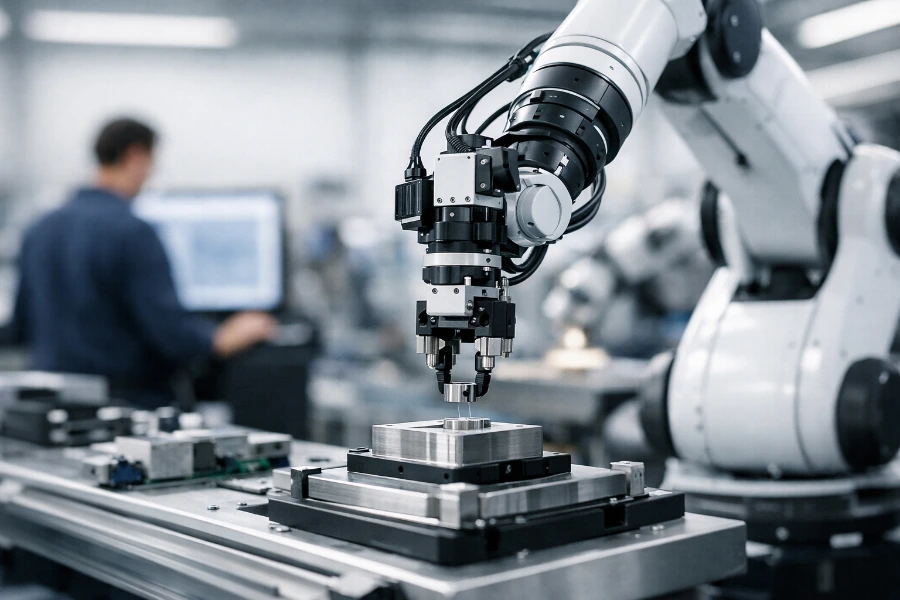
Rhoda AI left stealth in March 2026 with a $450M Series A led by Premji Invest, valuing the video-trained robotics startup at $1.7B including the new capital.
Key Takeaways
- Rhoda AI raised $450M in a Series A led by Premji Invest at a $1.7B valuation.
- Its Direct Video Action model trains on internet video, needing as little as 10 hours of teleoperation data.
- Khosla Ventures, Temasek and John Doerr joined the round after 18 months in stealth.
Lead
Rhoda AI, a Palo Alto robotics company, came out of stealth on March 10, 2026 with a $450M Series A. Premji Invest led the round, and the valuation of $1.7B includes the new money. The implied pre-money figure is roughly $1.25B, a high mark for a company that had shown no product publicly until the announcement.
The startup spent 18 months building before launch. It also unveiled FutureVision, a foundation model it plans to license as the intelligence layer for robots from different makers. The company says it will also build its own humanoid robots.
Who Is Behind Rhoda AI and Who Funded It?
Rhoda AI was founded in 2024 by Jagdeep Singh, the founder of battery maker QuantumScape, and Stanford professor Gordon Wetzstein. Singh serves as chief executive.
Beyond Premji Invest, the investor list includes Khosla Ventures, Temasek, venture capitalist John Doerr, Capricorn Investment Group, Leitmotif, Matter Venture Partners, Mayfield, Prelude Ventures and Xora. The company did not disclose any earlier funding, so a $450M first institutional round arrives with no visible seed or prior valuation to compare against.
How Does Rhoda's Video-Predictive Approach Work?
Rhoda trains its models on hundreds of millions of internet videos, then adapts them to robot control through an architecture it calls Direct Video Action (DVA). The model recasts a robot policy as video generation. It predicts what should happen next and updates its behavior every few hundred milliseconds as conditions change.
The company argues this closed-loop design handles shifting materials, layouts and workflows better than open-loop systems that generate a plan and execute it. Video pretraining gives the model a prior on motion and physics. New tasks then reportedly need as little as 10 hours of teleoperation data, far less than approaches built mainly on teleoperated trajectories.
Singh gave one example of why the data source matters: with conventional methods, a change in a phone's orientation might be enough to make the model fail. Exposure to varied video, the company says, improves generalization to such changes.
What Has Rhoda Actually Demonstrated?
Rhoda has shown results in high-volume manufacturing, where its system completed component-processing workflows in under two minutes per cycle. It ran those tests with an automotive company using off-the-shelf hardware. The customer's name, the number of pilots and any contract terms are undisclosed.
That is thin evidence for a $1.7B price. A single-customer manufacturing trial says little about reliability across sites, and the company has not published failure rates, uptime or throughput comparisons against human workers or competing systems. The valuation rests on the architecture's promise more than on commercial traction.
Why Are Investors Paying Up for Physical AI?
Capital is flowing to physical AI because robot foundation models promise to cut the cost of programming each new task, which has limited industrial automation for decades. Rhoda is one of several startups chasing that goal, and rivals have mostly leaned on teleoperation data or simulation. Rhoda is betting that video is a cheaper and larger source of training signal.
The counterargument is practical. Video shows what happens but not the forces, contact and failures involved when a gripper meets an object. Teleoperation data carries that information directly, and the 10-hour figure suggests Rhoda still needs some of it. Whether video pretraining closes the gap at production scale is unproven.
What Will the Money Be Used For?
Rhoda plans to spend the $450M on research and engineering, wider industrial deployments and customer pilots, and hiring across generative AI, computer vision and robotics. The dual plan to license software and build humanoid hardware is expensive, since it combines a model business with a manufacturing one. The company has not said how it will split spending between them.
Outlook
Rhoda enters the market with a large balance sheet, an experienced founder and a technical thesis that differs from most of its peers. The next test is whether pilots with industrial customers turn into repeat deployments and named contracts. Until then, the $1.7B valuation prices an architecture, with commercial proof still to come.