Pomegra
Reflect Orbital raised $73.5M in a Series B to build orbital mirrors that beam sunlight to solar farms after dark, with a demo mission set for Q2 2027.
Key Takeaways
- Reflect Orbital announced a $73.5M Series B on November 10, 2026, lifting total funding above $100M.
- Sequoia Capital, Lux Capital and Starship Ventures returned. Salesforce Ventures joined as a new investor.
- No lead investor or valuation was disclosed. The first demo mission is scheduled for Q2 2027.
Lead
Reflect Orbital, a Hawthorne, California startup, announced a $73.5M Series B on November 10, 2026. The company is developing satellites with large reflective mirrors that redirect sunlight to chosen spots on the ground after sunset. The round pushes its total funding past $100M, up from a $6.5M seed in September 2024 and a $20M Series A in May 2025.
Existing backers Sequoia Capital, Lux Capital and Starship Ventures participated. New investors include Buckley Ventures, Convective Capital, The Uncommon Group and Salesforce Ventures. The company named no lead investor and did not disclose a valuation.
What Does Reflect Orbital Actually Build?
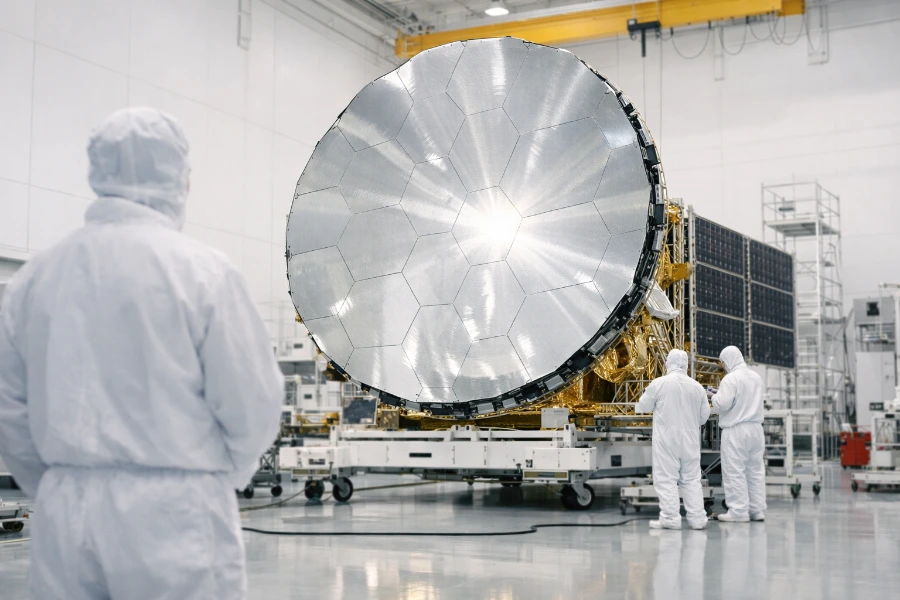
Reflect Orbital builds low-Earth-orbit satellites that each carry a square mylar mirror about 60 feet across. The reflective film is described as 28 times thinner than a human hair. Each satellite can light a spot roughly five kilometers wide at about full-moon brightness.
A single satellite stays overhead for only about four minutes per pass. That short window is why the business depends on a very large constellation. Founder Ben Nowack, a former SpaceX engineer who started the company in 2021, has set a goal of as many as 50,000 satellites by 2035.
The initial pitch is to extend output at solar farms during twilight hours. Search-and-rescue and disaster-relief lighting are secondary uses. The company has not named paying customers.
Why Does the Round Matter?
The round matters because it funds the first hardware test of a concept that has so far existed mostly in filings and renderings. The company says the money will pay for initial launches, continued reflector development and commercial partnerships in the energy and lighting sectors.
The funding also shows investor patience. A Series B with no disclosed lead, no valuation and no revenue means the existing backers are carrying much of the risk. Sequoia and Lux were both in the previous round, and their return suggests the Series A milestones were met. Those milestones are regulatory progress and a launch contract, not commercial traction.
What Is the Launch and Regulatory Status?
Reflect Orbital has booked two dedicated launches with India's Skyroot Aerospace, announced on October 14, 2026. The first will fly on the Vikram-1 rocket and the second on the larger Vikram-1U. The company says it has secured additional launch opportunities for 2027.
The FCC has licensed a single demonstration satellite, Eärendil-1. It has declined to rule on the full constellation. The inaugural demonstration mission, scheduled for Q2 2027, will test how the reflectors deploy and perform in orbit. Approval for the large fleet remains a separate and unresolved step.
What Are the Objections?
Astronomers are the most visible opponents. The American Astronomical Society has expressed dismay at the plan, citing the effect of bright orbiting reflectors on night-sky observation. A constellation numbering in the tens of thousands, each unit capable of casting moonlike light, raises questions about light pollution and ecological disruption that the demo satellite alone will not settle.
The economics are also unproven. Four minutes of illumination per satellite pass means a solar farm needs a steady relay of spacecraft to produce meaningful extra output. Whether the added energy is worth more than the cost of building and launching those spacecraft is a question the company has not publicly answered with figures.
What Comes Next?
The Q2 2027 demo is the near-term test. If the mirror unfolds and holds its shape, the company can argue the physics works at flight scale. A failure to deploy would put pressure on a startup that has no revenue and a regulatory path that is only partly cleared.
A second scenario involves the FCC. Any decision on a larger constellation would likely draw formal objections from the astronomy community, which could slow expansion even if the demo succeeds.
Outlook
Reflect Orbital has added $73.5M to a war chest above $100M, with launches booked and one satellite licensed. Its Series B investors are funding a hardware demonstration, not a business with customers. The Q2 2027 mission will show whether orbital sunlight is an engineering reality, and the FCC's eventual ruling on the full fleet will show whether it can scale.