Pomegra
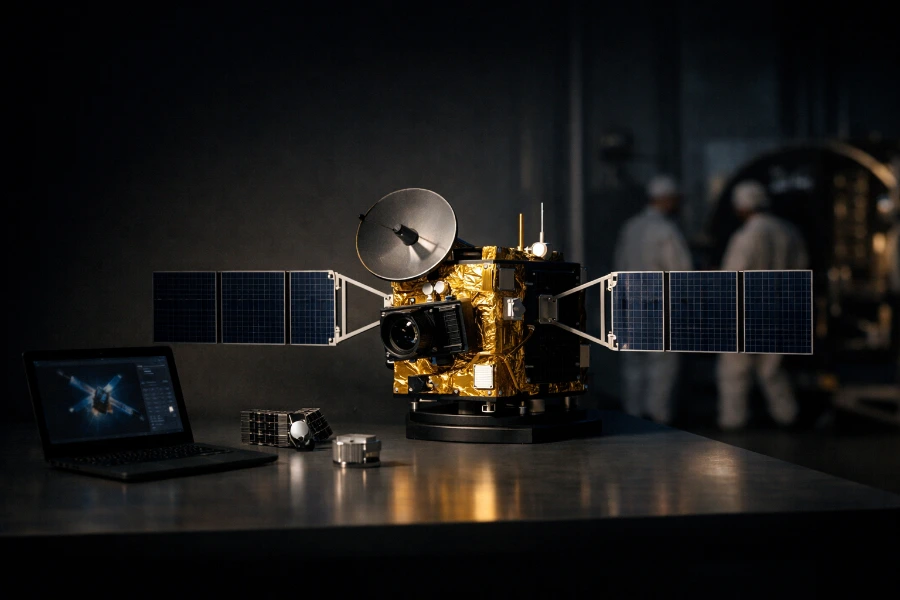
Warsaw-based Asynchronics closed a $3.1M seed round led by b2venture to build a marketplace of digital aerospace-component models and satellite-simulation tools.
Key Takeaways
- Asynchronics raised a $3.1M seed round led by b2venture, with Movens Capital, Heartfelt and Hard2beat; valuation undisclosed.
- The catalog is to grow from 4 digital twins to 50 within 24 months.
- Headcount is planned to roughly double, from about 12 to about 22-24 people.
Lead
Asynchronics, a Warsaw startup founded in 2023, announced a $3.1M seed round on November 17, 2026. b2venture led. Movens Capital, Heartfelt and Hard2beat also took part. The company did not disclose a valuation.
The money goes to a marketplace of executable digital models of spacecraft hardware, plus software tools for building and simulating satellite systems. The pitch is that engineers can test components in software before the physical parts arrive.
What Does Asynchronics Actually Sell?
Asynchronics sells licences for digital twins of individual satellite components, which customers plug into their own development environments. These are executable software models that simulate how a part behaves, not 3D renderings.
The models run on NeXosim, an open-source simulation engine the company built in Rust. It spreads simulation workload across processor cores. The engine is free; the commercial product is the library of component models built on top of it.
The catalog is thin today. It holds four twins of hardware from NewSpace Systems: a reaction wheel, a magnetometer, a GPS receiver and a sun sensor. The company wants 50 within two years, with targets including reaction wheels, solar array drive assemblies and power-control units.
Who Is Behind It, and Who Uses It?
The company was founded by CEO Adam Chikha and CTO Serge Barral, who together have more than 30 years of aerospace experience. Chikha previously led simulation work at Metrea and worked at an Airbus subsidiary in Poland. Barral holds a PhD in aerospace engineering.
Named customers and partners include Infinite Orbits of Toulouse, which has used the technology for more than two years, along with K2 Space and NewSpace Systems. That is a short list, and a seed-stage marketplace depends on both sides showing up: component makers willing to publish models and satellite builders willing to pay for them.
Why Does Simulation Matter for New Space Programs?
New space missions fail far more often than traditional ones, and software and integration problems drive many of those failures. The company cites a failure rate of about 7% for traditional missions against roughly 45% for new-space missions, and attributes the gap to software, integration and validation issues rather than hardware defects.
Large primes such as Airbus, Thales and Lockheed Martin run in-house simulation tools that smaller operators cannot match. Chikha has said that smaller and mid-sized companies lack access to this kind of tooling. His stated goal is for a digital twin to become "as standard as the documentation that comes with a spacecraft component."
How Crowded Is the Field?
The field is not empty. Siemens Xcelerator supports startups in European Space Agency programs, and ESA maintains its own SIMULUS simulator. Asynchronics is not competing on the simulator alone, since NeXosim is open source. Its bet is that vendor-supplied models of real hardware become the scarce asset.
That bet carries a risk. Component manufacturers hold the data that makes a twin accurate, and they may prefer to ship their own models rather than route them through a third party. The NewSpace Systems relationship shows one path, but four models are a proof of concept, not a network.
What Does the Round Say About Polish Deep Tech?
The $3.1M cheque sits in roughly the 94th percentile of 1,369 Polish seed rounds tracked historically, so it ranks among the larger seed deals in the country. For a pre-revenue-scale hardware-adjacent software company, the size reflects investor interest in European space infrastructure more than any disclosed traction metrics. No revenue figures were released, and an earlier pre-seed round preceded this one.
Use of Funds
The company plans to grow from about 12 people to roughly 22 within six months. It also plans a Toulouse office within 12 months and a US office within 24 months. Product work includes a graphical interface for building models and checking results, and an AI tool meant to cut the time to create a digital twin from months to days.
Outlook
Asynchronics has capital, a working open-source engine and a handful of credible early customers. The test over the next 24 months is catalog growth: reaching 50 licensed models would show that component vendors will cooperate, while a stalled count of four would suggest the marketplace is still a consulting business with a library attached. Toulouse and US offices would place the team near European and American satellite builders, where adoption will be decided.