Pomegra
Project Omega closed an $80M Series A led by B Capital to build a used-fuel recycling plant in Rhode Island and sell strontium-90 power systems.
Key Takeaways
- Project Omega raised an $80M Series A led by B Capital, announced November 10, 2026.
- The round follows a $12M seed in February 2026, bringing disclosed funding to about $92M.
- Series A valuation is undisclosed; the seed was reportedly priced at $48M.
Lead
Project Omega, a Newport, Rhode Island nuclear recycling company founded in 2025, announced an $80M Series A on November 10, 2026. B Capital led the round. The proceeds will fund construction of the first stage of a used nuclear fuel recycling facility and the manufacturing of the company's X Series power products.
The company did not disclose a valuation. Participants include noa VC, 645 Ventures, Starship Ventures, Mantis Ventures, Decisive Point, Virta Ventures, Pace Ventures, Essential Capital and Washington Harbour Partners. Jeff Johnson of B Capital joins the board.
What Does Project Omega Actually Do?
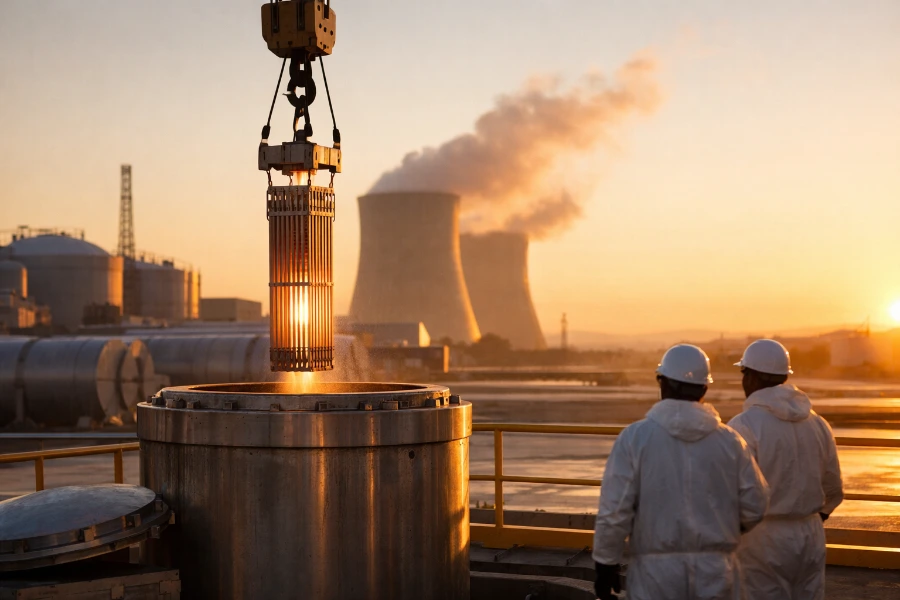
Project Omega runs a non-aqueous pyroprocessing platform that separates used reactor fuel into its component materials. The company says the process cuts waste volume by up to 90% and recovers isotopes such as strontium-90.
That isotope feeds the second business line. Radiovoltaic systems convert radioactive decay directly into electricity, for sensors, autonomous systems, spacecraft and undersea platforms. CEO Stafford Sheehan framed the demand in terms of location: "you cannot swap batteries on the ocean floor."
The X Series is the nearer-term product. It combines batteries, generators and intelligent controls, and currently supports solar and wind integration. Isotope-based power is planned for later versions.
How Does This Round Compare With the Seed?
The Series A is roughly 6.7 times the $12M seed that Starship Ventures led in February 2026, only nine months earlier. Starship, Mantis and Decisive Point returned for the larger round, which suggests existing backers held their positions rather than exiting at a markup.
The step-up is large, but the company has produced no commercial revenue from recycling and has not built the facility. Investors are paying for a permitting and construction path and for government relationships, not for operating results. The undisclosed valuation makes it hard to judge how much risk the new money absorbed.
Why Is Spent Fuel Attractive Feedstock?
The US holds nearly 100,000 metric tons of used nuclear fuel, about 90,000 of it from commercial reactors, and no permanent repository has opened. Sheehan argues that this stockpile is a domestic fuel source for a sector that depends on foreign supply. Johnson of B Capital made a similar point, saying American power demand is "colliding with a nuclear fuel cycle that remains dependent on foreign supply."
The pitch has historical weight and a historical problem. US policy has barred commercial reprocessing since the 1970s on proliferation grounds, and the technology has struggled with cost. Pyroprocessing is often presented as more proliferation-resistant than older aqueous methods, though that claim will face regulatory scrutiny.
Government Ties
Project Omega works with Idaho National Laboratory under the ARPA-E CURIE program, and with Pacific Northwest National Laboratory. It also collaborates with DARPA's Rads to Watts program, which positions the strontium-90 products toward defense buyers such as remote installations and subsea systems.
That orientation matters commercially. Defense customers pay premiums for long-life power that needs no resupply, which can fund the early plant before utility-scale recycling economics are proven.
What Comes Next for Project Omega?
The next milestone is construction of the first-stage facility, with further deployment details promised in the coming months. Licensing is the main variable. A commercial recycling plant requires approvals from the Nuclear Regulatory Commission and state authorities, and the timeline for those decisions is not public.
Competition in adjacent fuel-cycle and microreactor businesses is crowded, with companies such as X-energy and Last Energy pursuing different routes to nuclear supply. Project Omega's distinct claim is the back end of the cycle. If it delivers fuel-grade material and isotopes at cost, it fills a gap those builders also face. If not, the round will look like an early bet on policy that has not yet changed.
Outlook
Project Omega has raised about $92M in nine months, with B Capital now steering a company that has yet to build its core asset. Construction progress, regulatory filings and the first deliveries of X Series units will show whether the recycling thesis holds up outside the lab. A priced follow-on round would also reveal how the market values the company.