Pomegra
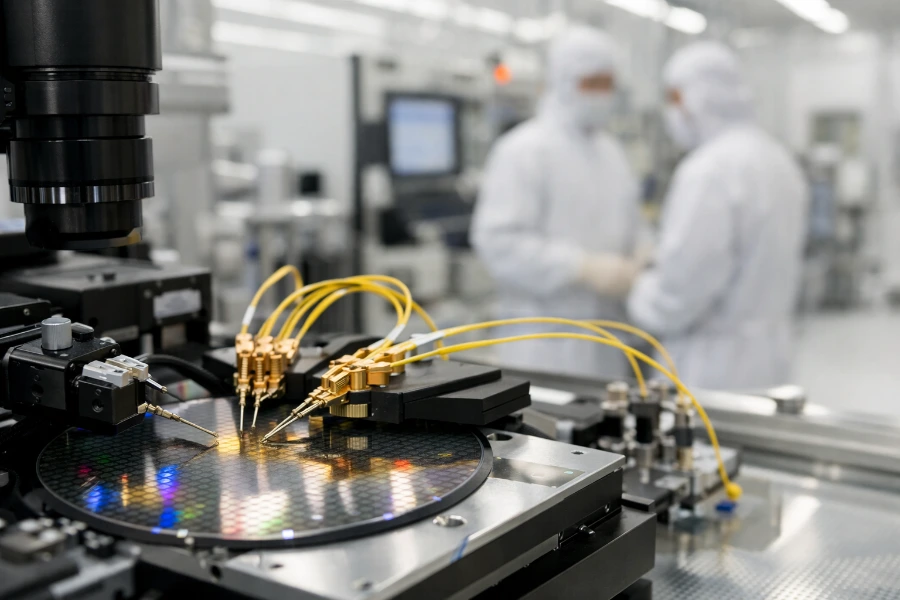
Qiming Photonics, a Beijing optical interconnect startup, closed a pre-Series A of more than RMB 100 million, led by Guoxin Fund and Huakong Fund, to scale comb-based light sources for AI data centers.
Key Takeaways
- Qiming Photonics closed a pre-Series A above RMB 100 million on November 24, 2026.
- Guoxin Fund and Huakong Fund co-led. Existing shareholders also added money.
- Valuation is undisclosed. The company was founded in July 2024.
Lead
Qiming Photonics (Beijing) Technology Co., Ltd. announced on November 24, 2026 that it completed a pre-Series A round of more than RMB 100 million. Guoxin Fund and Huakong Fund led the round. Tongge Ventures, Huagai Capital, Yicun Capital and Guozhong Capital joined, along with existing investors. The company did not disclose a valuation or the exact amount.
The startup makes chip-scale multi-wavelength light sources built on optical frequency comb technology. These sources are meant for co-packaged optics (CPO) and optical I/O (OIO), the approaches that move data between GPUs, switches and memory using light instead of copper.
What Does Qiming Photonics Actually Build?
Qiming builds integrated optical frequency comb light sources, which produce many evenly spaced wavelengths from a single chip. The company's core chip outputs 34 equally spaced wavelengths. In optical interconnects, one laser source feeding many wavelength channels can cut the number of discrete lasers a package needs, which matters for power and board space.
The technology comes out of the Advanced Integrated Photonic Chip Laboratory at the electronics school of Peking University. The company was incubated through the university's Shanghai Lingang center and registered on July 12, 2024. Its legal representative, Zhang Lei, holds a doctorate from the Institute of Semiconductors at the Chinese Academy of Sciences and did postdoctoral work at Peking University, with a background in silicon photonics research and commercialization.
How Will the Money Be Used?
The company will spend the proceeds on three things: next-generation CPO and OIO development, internal and external testing of its comb light sources with a production ramp, and joint validation with leading wafer foundries, GPU vendors and data center customers. It did not name those partners.
That last item is the one to watch. Light source suppliers in this segment win business by passing qualification with chip and system makers, a process that typically runs for many months. A pre-Series A of this size funds that qualification work but does not prove any customer has committed to volume.
Why Is This Round Larger Than a Typical Pre-A?
The round is large because it follows a rapid sequence of earlier financings and reflects state-linked capital moving into optical interconnects. Qiming previously completed seed, angel and angel-plus rounds. In August 2025 it closed an angel round of tens of millions of yuan led by CAS Star (Zhongke Chuangxing), and the Beijing New Materials Industry Investment Fund is also among its backers. Moving from tens of millions to more than RMB 100 million in roughly 15 months signals a step up in investor appetite, though without a disclosed valuation the size of the markup cannot be measured.
The lead investors matter as much as the amount. Guoxin Fund and Huakong Fund are both institutional funds with state-linked backgrounds, and their presence fits the pattern of Chinese capital backing domestic supply chains for AI computing hardware. Optical interconnect has drawn similar interest this year, including an RMB 100 million angel round for rival Xinguangjie in August, led by Qiming Venture Partners (an unrelated firm despite the shared name).
Why Does Optical Interconnect Draw This Much Money?
Optical interconnect draws funding because copper links struggle to carry AI cluster traffic at acceptable power and distance as bandwidth per GPU rises. Moving optics next to or inside the processor package, as in CPO and OIO, shortens the electrical path and lowers energy per bit. The light source remains a bottleneck, since lasers are sensitive to heat inside a package and are a frequent failure point.
That is the gap comb sources aim to fill. A single comb chip can replace a bank of individually tuned lasers, and it can be placed away from the hot processor. The approach still faces open questions on output power per wavelength, wavelength stability across temperature and manufacturing yield, none of which the company has publicly quantified.
What Comes Next for Qiming Photonics?
The next test is foundry and GPU-vendor validation, followed by a first volume order. A Series A would likely hinge on named customers, yield data and a pilot production line. Competitors range from established laser makers to other Chinese startups pursuing silicon photonics and CPO engines, and large overseas vendors are building their own light source products.
Two scenarios are plausible. If validation goes well, the company could position itself as a domestic supplier of external light sources for Chinese AI clusters, a market with strong procurement incentives. If validation stalls on power or reliability, the round would buy time but not a commercial footing.
Outlook
Qiming Photonics has raised more than RMB 100 million to take a university-born frequency comb chip into customer validation and early production. The state-linked lead investors point to policy support for domestic AI hardware, but the undisclosed valuation and unnamed partners leave the commercial case unproven. Qualification results with foundries and GPU makers over the next 12 months will show whether the comb approach holds up outside the lab.