Pomegra
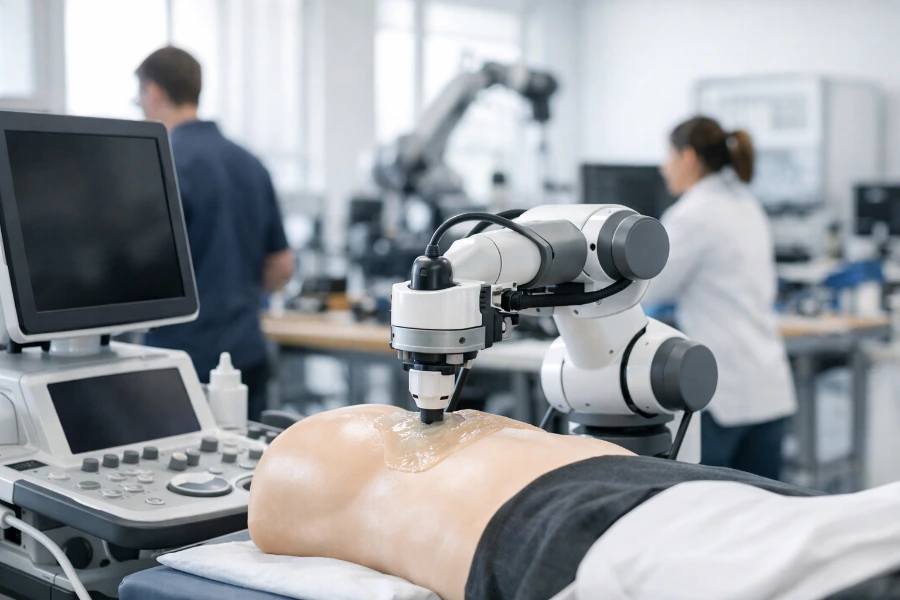
Apricity Robotics raised a $16.1 million Series A led by JumpStart Ventures to build a robotic arm that holds the ultrasound probe for sonographers and cuts the physical strain of scanning.
Key Takeaways
- Apricity Robotics closed a $16.1M Series A led by JumpStart Ventures, announced November 23, 2026.
- Total funding reaches $19.1M, including seed money and National Science Foundation grants. Valuation is undisclosed.
- The Robotic Ultrasound Assistant is investigational and cannot be sold in the United States.
Lead
Apricity Robotics, a Dublin, Ohio startup, announced a $16.1 million Series A on November 23, 2026. JumpStart Ventures led the round. The company is building a Robotic Ultrasound Assistant (RUA) that attaches to an existing ultrasound cart, holds the probe and moves it while a sonographer directs the exam. Apricity has now raised $19.1 million in total, counting its seed round and NSF grants. It did not disclose a valuation.
Who Else Backed the Round?
The O.H.I.O. Fund, Orlando Health Ventures, JobsOhio Ventures and University Hospitals Ventures joined JumpStart. Two of those names are health systems' venture arms, so the syndicate includes likely customers as well as financial investors.
That mix matters in a hardware medical device raise. Hospital-affiliated capital often brings access to clinical sites and procurement teams, and it can also tie a startup's early product to a few institutions' workflows. The round does not say whether any of the strategic investors have purchase commitments.
What Does the Robotic Ultrasound Assistant Do?
The RUA mounts to ultrasound carts from any manufacturer. It holds and positions the transducer under the sonographer's direction, and the company says it is designed to reduce physical strain and improve image consistency. AI helps locate requested cardiac views, but the sonographer stays in the room, stays in control and remains responsible for clinical decisions.
That design choice separates Apricity from the pitch of fully autonomous scanning. The device assists a human operator and does not replace one. It also avoids a new capital purchase, since it works with the scanners hospitals already own.
Why Are Sonographers the Target?
Sonographers are a target because musculoskeletal injury is common in the job. A 2024 study estimated that 75.8% of sonographers had experienced work-related musculoskeletal disorders. Holding a probe at a fixed angle against a patient, often for hours, loads the shoulder, wrist and neck.
Demand is also outrunning supply. U.S. ultrasound exam volume grew 55% between 2011 and 2021, while the sonographer workforce grew 44%. Each exam still needs a trained person in the room with the patient, so injured or departing staff directly reduce capacity.
Apricity's chief executive, Aaron Crookes, has said the product came from a customer request. Sonographers at a partner health system "were wearing out, and every exam still required one in the room with the patient," he said, and they asked the company to turn its robotic platform into an assistant. A University Hospitals executive said health systems face a growing challenge in meeting demand for diagnostic ultrasound while protecting skilled sonographers.
What Does the Round Imply About Progress So Far?
The round implies the company is still pre-commercial. Apricity plans to use the money to finish its hardware and software platform, expand clinical evaluations with health system partners, support regulatory submissions, hire and build commercial infrastructure. The device is investigational, and no FDA clearance has been announced.
A $16.1 million Series A is modest for a robotics company that has to clear regulators and then sell into hospitals. The $3 million of earlier capital, derived from the gap between the Series A and the $19.1 million total, suggests a lean seed stage supplemented by federal grants. The Series A therefore funds the expensive transition from prototype to regulated product. A University Hospitals evaluation in Cleveland is the main clinical work disclosed so far.
What Comes Next for Apricity?
The next test is regulatory. Apricity has not published a submission date or a target clearance pathway, so the timeline for U.S. sales remains open. Expanded clinical evaluations should produce the data a submission needs, particularly on image consistency and sonographer ergonomics.
Commercial questions follow clearance. Hospitals will want evidence that the arm shortens exam time or reduces injury claims, not just that it works. Competitors in robotic and tele-operated ultrasound are pursuing related goals with different levels of autonomy, and Apricity's bet is that a cart-mounted assistant sells more easily than a standalone system.
Outlook
Apricity has capital to carry the RUA through clinical evaluation and regulatory filings, with a syndicate that includes two health system investors. The gaps are a disclosed valuation, an FDA timeline and any commercial commitments. The next 12 to 18 months of evaluation data and regulatory progress will show whether an ergonomic assistant can become standard equipment in ultrasound departments.