Pomegra
Paris-based Orakl Oncology closed a $34M Series A co-led by Norrsken VC and Singular to test cancer drugs on lab-grown tumors before trials begin.
Key Takeaways
- Orakl Oncology raised a $34M oversubscribed Series A on November 12, 2026, co-led by Norrsken VC and Singular.
- Total funding now stands at $50M. Valuation was not disclosed.
- The 90% accuracy claim rests on an April preprint of 23 retrospective colorectal and pancreatic trials.
Lead
Orakl Oncology, a Paris startup spun out of the Gustave Roussy cancer centre in 2023, announced a $34M Series A on November 12, 2026. Norrsken VC and Singular co-led the round, which brings the company's total funding to $50M. Orakl did not disclose a valuation.
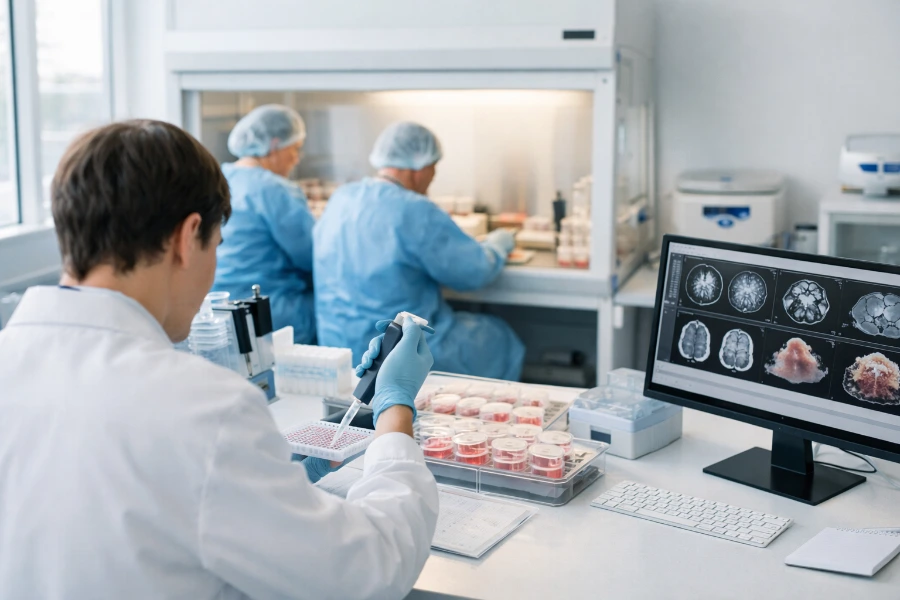
The company grows patient-derived tumor organoids in the lab, combines them with clinical records and multi-omic data, and builds what it calls virtual patient cohorts. It then runs drug candidates against those cohorts to forecast how a therapy would perform in a real trial. The pitch to drugmakers is simple: fewer expensive oncology trial failures.
Who Is Backing Orakl Oncology?
The round drew new money from InfraVia, Serena, the Patient Autonome Fund managed by Bpifrance, teampact.ventures and Plug and Play. Existing investors Verve Ventures, Speedinvest and HCVC returned. Angels include Thomas Wolf, Stan Polu, Jacques Boitreaud and Mostafa El Sayed.
Singular also led the company's earlier seed round, a €11M financing in December 2024. The Series A therefore adds a second lead to an existing one rather than replacing it, and the round was described as oversubscribed. That is a mild signal of continued insider conviction, though the company has not said how much of the $34M came from existing backers.
How Does Orakl's Technology Work?
Orakl cultivates real patient tumors in the lab as organoids, tests drugs on them at scale, and feeds the results into AI models trained alongside longitudinal patient records. The output is a prediction of treatment response, including which patient subgroups respond and which resistance mechanisms appear.
The company currently covers colorectal and pancreatic cancers. Lung and gastric cancers are the next planned additions. CEO Dr. Fanny Jaulin leads the company, with Dr. Gustave Ronteix as CTO and Dr. Diane-Laure Pagès as COO. The team has more than 40 employees.
Does the 90% Accuracy Claim Hold Up?
The figure is real but narrower than the headline suggests. It comes from an April preprint, not yet peer-reviewed, covering 23 colorectal and pancreatic cancer trials. In that analysis the model's progression-free survival forecasts were off by 0.82 months on average, and it picked the better treatment in seven of eight comparisons.
Two limits matter. The test was retrospective, run on trials that had already read out. And most of those trials involved standard chemotherapy rather than newer targeted agents or immunotherapies, which is where drug developers most want predictions. Whether the platform holds up on novel mechanisms remains unproven.
What Commercial Traction Does Orakl Have?
Orakl says 18 of the world's 20 largest pharmaceutical companies are in its commercial pipeline, and that it is converting early engagements into multiyear collaborations. "Pipeline" is the operative word: the company has not disclosed revenue, contract values or customer names beyond one.
That one is Sanofi. In July 2026, Orakl won exclusive rights to four undisclosed oncology assets in a collaboration with the French drugmaker. The company also signed five hospital partnerships during 2026 and is in discussions with more than 15 cancer centres across Europe, North America and Asia.
What Will the Money Fund?
Orakl plans to produce roughly five times more laboratory data, extend into lung and gastric cancers, and open teams in the US and the UK. The hospital partnerships matter because tissue access limits how many tumor models any company can build.
Organoid-based drug screening is not new, and several startups and academic groups have pursued it. Orakl's differentiation is the pairing with clinical outcome data, which is also the hardest part to scale. Each additional cancer type requires a new set of validated models.
Outlook
Orakl now has $50M in total funding, a named pharma deal with Sanofi, and a preprint that shows promise on historical trials. The next test is prospective: forward predictions on novel drugs, published and peer-reviewed, and converted from pipeline conversations into disclosed revenue. The expansion into lung and gastric cancers and the US and UK build-out will show whether the model generalizes beyond two tumor types.