Pomegra
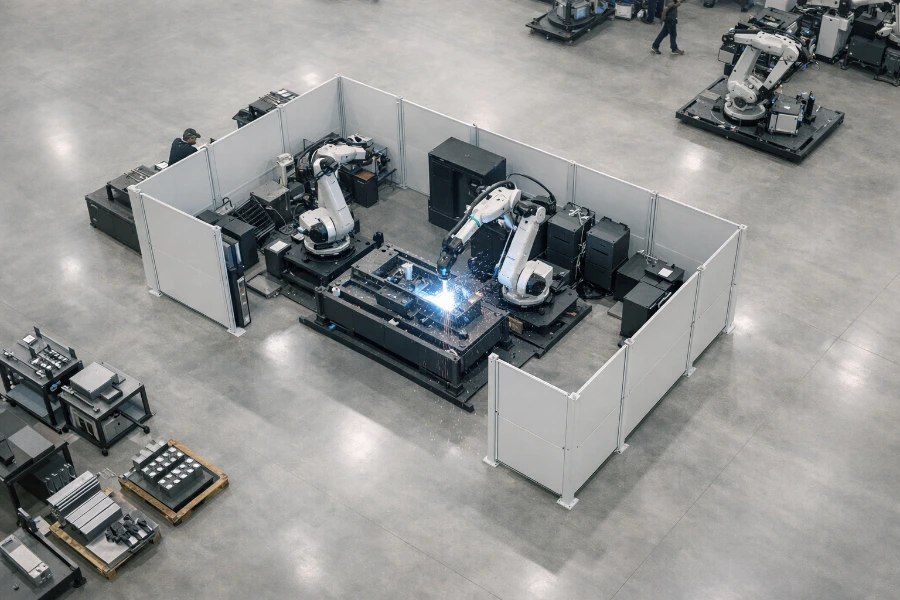
Path Robotics closed a $300M Series E led by Georgian at a $2.45B post-money valuation, funding its push from welding cells into broader factory automation.
Key Takeaways
- Path Robotics raised $300M in a Series E led by Georgian at a $2.45B post-money valuation.
- Annual recurring revenue grew 17-fold in 18 months; total funding now exceeds $610M.
- A $600M performance-based HII agreement anchors demand in U.S. Navy shipbuilding.
Lead
Path Robotics, the Columbus, Ohio, maker of AI-guided welding robots, announced a $300M Series E on November 10, 2026. Georgian, a growth equity firm focused on AI, led the round at a post-money valuation of $2.45B, close to four times the company's previous valuation. Path was founded in 2018 and has now raised more than $610M.
Existing investors Addition, Drive Capital, IronArc Ventures, Tiger Global and Yamaha Motor Ventures returned. D. E. Shaw Ventures and NAVER Ventures joined as new backers. Emily Walsh, a Georgian partner, is joining the board.
What Does Path Robotics Actually Sell?
Path sells robotic welding systems driven by Obsidian, a model trained on real-world welding data. Obsidian uses cameras and lasers to find weld joints, plan the weld and adjust as metal distorts or parts vary from their specifications. Conventional welding robots need rigid fixturing and hand-programmed paths, and Path's pitch is that it removes both.
The company describes itself as a physical AI business. In practice that means a software model sold inside a hardware cell, aimed at a trade where skilled welders are scarce. Its customers span shipbuilding, vehicle parts, power generators, utility poles and heavy equipment. Named customers include HII, Lockheed Martin, Saronic, EK Machine, Millerbernd Manufacturing, TransAmerican Power Products and TYCROP.
How Large Is the Revenue Behind the Valuation?
Path has not disclosed revenue, only a growth rate: annual recurring revenue rose 17-fold over the past 18 months. A multiple that steep says more about a small starting base than about scale, and without a dollar figure the $2.45B price cannot be tested against sales.
The strongest hard number is the HII deal. In August 2026 Path signed a $600M performance-based production agreement to speed deployment across U.S. Navy shipbuilding programs. Performance-based terms mean the headline figure depends on delivery, so it works as a ceiling rather than booked revenue. Headcount grew 97% year over year, and the company is targeting 400 employees by the end of 2026.
Why Are Investors Paying a Near-Fourfold Step-Up?
Investors are paying for a production-data advantage in a field where foundation-model bets on robotics remain mostly unproven. Georgian's Walsh said Path's proprietary models and growing base of real-world production data can create a powerful advantage. Every weld a customer runs adds training data that a competitor without installed machines cannot easily replicate.
The skeptical reading is that welding is a narrow, well-defined task, and that generalizing to other manufacturing steps is a harder problem than the funding round implies. Path itself is betting that it can. CEO Andy Lonsberry said the goal is to automate the entire factory rather than a single step. The round also lands during a broader capital rush into physical AI, which tends to lift valuations ahead of reported revenue.
What Will the $300M Pay For?
Path plans to spend the money on three things: scaling welding deployments, extending into new manufacturing tasks and robot forms, and increasing spending on model training and compute. Lonsberry said the company intends to take on every task before and after welding, such as cutting, grinding and finishing.
The new form factor is already visible. Rove, a mobile four-legged welding platform introduced in 2026, carries the welding system to large workpieces instead of moving the part to a fixed cell. That matters in shipyards, where hulls and blocks are too big to relocate.
Strategic Context
Defense and shipbuilding demand gives Path a customer base with long contracts and a persistent labor shortage. The investor mix reflects the same logic. Yamaha Motor Ventures brings an industrial machinery parent, and NAVER Ventures adds a Korean technology investor from a country with a major shipbuilding sector.
Compute costs are the pressure point. Training models on proprietary data is expensive, and a company that sells hardware-bound software carries both capital intensity and margin risk.
Outlook
Path enters 2027 with more than $610M raised, a $2.45B valuation and a Navy-linked contract that has to convert from ceiling to revenue. The next tests are whether Obsidian transfers to tasks beyond welding, whether Rove finds buyers outside shipyards, and whether Path discloses revenue figures that justify the step-up. A repeat of the 17-fold growth rate is unlikely at current scale, so execution against the HII agreement will probably set the next valuation.