Pomegra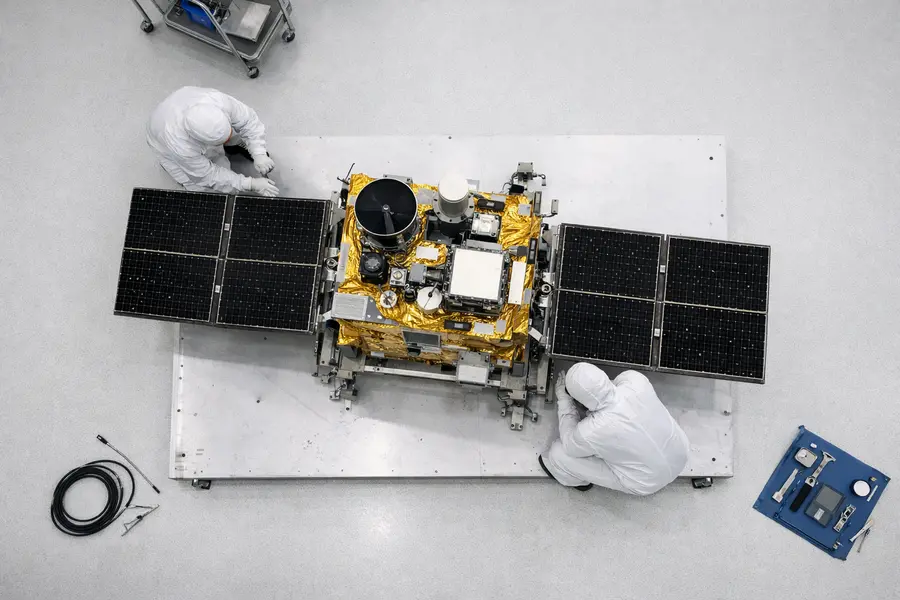
Muon Space closes a $250 million oversubscribed round led by Eclipse Capital at a $1.5B valuation, with Google and Salesforce Ventures participating, as it scales a San Jose factory to 500 satellites per year.
Key Takeaways
- Eclipse Capital led the $250M Series C at a $1.5B valuation; Google, Salesforce Ventures, and Wellington Management participated.
- Muon's San Jose factory is designed to reach 500 satellites per year by 2027 - roughly 10x its previous annual production capacity.
- Eleven satellites are in orbit with a 100% mission success rate; more than 50 are in active development for commercial and defense clients.
Lead
Muon Space, a five-year-old dual-use earth-observation satellite startup, closed a $250 million Series C round on August 20, 2026, at a $1.5 billion valuation. Eclipse Capital led the oversubscribed round. Google and Salesforce Ventures joined Wellington Management, Galvanize, I Squared Capital, and Woven Capital as participants, bringing the company's cumulative equity raised to more than $386 million.
What Muon Space Actually Does
Founded in 2021 by former SpaceX engineers, Muon builds small satellites for earth observation with applications spanning weather monitoring, wildfire detection, and defense intelligence. The dual-use architecture is deliberate - the same sensor hardware that feeds commercial atmospheric data products can serve military reconnaissance networks. That positioning opens two distinct procurement pipelines simultaneously, which is not something most pure-play commercial operators can claim.
Muon has deployed 11 satellites across six launches, all of which completed their missions. More than 50 are in active development for customers, with 13 already booked for launch in the next 12 months. One active program is a low Earth orbit wildfire-monitoring system built with Earth Fire Alliance, a nonprofit, which provides the company with a visible public-interest use case alongside its defense contracts.
Why Did Eclipse Lead This Round?
Eclipse took the lead in a round described as heavily oversubscribed - meaning investor demand exceeded what the company required at the offered price. For Eclipse, a firm with an established hardware and defense-adjacent investment thesis, Muon follows a recognizable pattern: capital-intensive infrastructure businesses with recurring government contract potential.
The strategic investors warrant a closer read. Google's participation most plausibly reflects its cloud infrastructure ambitions - satellite data at scale generates analytics workloads that flow naturally onto cloud platforms. Salesforce Ventures is the less obvious fit, but enterprise data products built on earth-observation feeds are an increasingly active category, and Salesforce has been building its government and industrial portfolio.
The $1.5 billion valuation follows a $146 million round, also labeled Series C, completed in the summer of 2025. Two consecutive financings under the same series designation is unusual; it typically signals that a company hit growth milestones faster than its original financing schedule anticipated.
The San Jose Factory Bet
The clearest use-of-proceeds story is Muon's advanced manufacturing facility in San Jose, opened in June 2026. The plant is designed to produce up to 500 satellites per year by 2027, approximately 10 times the company's previous annual capacity. Reaching that output requires simultaneous investment in supply chain, tooling, and workforce - none of which prior rounds were sized to support.
At 500 units per year, Muon would be among the highest-volume satellite manufacturers outside of SpaceX's Starlink operation. The economics differ sharply: Starlink builds for its own constellation, while Muon manufactures primarily for third-party customers. Contract satellite production at that volume has few established comparables, which makes the market opportunity and execution risk equally hard to benchmark.
What Comes Next for Muon Space?
The immediate operational priority is delivering the 13 satellites already booked for launch while scaling the San Jose facility toward its stated target. The $250 million provides meaningful runway, but hardware businesses with active manufacturing operations consume capital at a fundamentally different rate than software companies.
At $1.5 billion, investors are pricing in either significant contract wins over the next 18 months or a viable path to a public listing. Muon has not disclosed revenue figures publicly, which makes the valuation a forward-looking bet on contract momentum. The oversubscribed nature of the round suggests late-stage private investors are willing to underwrite that uncertainty - but the timeline for proving the thesis shortens once a company crosses the unicorn threshold.
Competitive Context
Earth observation as a sector is crowded at the small-satellite end, with Planet Labs, Spire Global, and European competitors all active in government and commercial contracting. Muon's differentiation is its dual-use sensor architecture and, if the factory targets hold, a cost structure that improves with volume in a way that smaller-constellation operators cannot match. Manufacturing capacity at scale is genuinely difficult to replicate quickly - it requires capital, regulatory approvals, and production expertise together.
The defense angle carries growing weight. U.S. government appetite for commercial satellite intelligence expanded significantly after the war in Ukraine demonstrated how effective commercial earth-observation data could be in active conflict. Muon's positioning ahead of a broader defense procurement cycle is structural, not incidental.
Outlook
Muon Space enters the second half of 2026 with its largest capital raise, a new factory, and a customer pipeline that includes both commercial and government contracts. The $1.5 billion valuation is a bet that dual-use earth observation becomes a high-volume, recurring-revenue business and that Muon's manufacturing scale arrives before a better-capitalized rival closes the gap. Performance at the San Jose plant over the next 12 to 18 months will be the clearest signal of whether this round's price holds.