Pomegra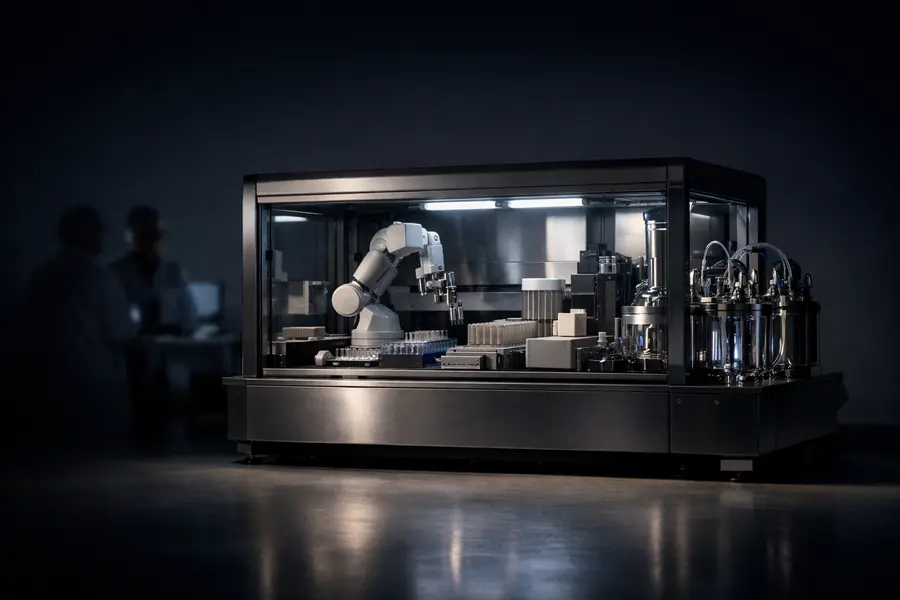
Multiply Labs closed a $75M Series B led by Patrick Soon-Shiong's NantWorks, with AstraZeneca, to put robot clusters inside drug-makers' own GMP plants.
Key Takeaways
- Multiply Labs raised $75M in a Series B announced October 6, 2026, led by NantWorks. Valuation was not disclosed.
- AstraZeneca, Lingotto, Teradyne and Strange Ventures joined as new backers, and Casdin Capital, Lux Capital and Founders Fund returned.
- The company claims a 74% cut in cost per dose and up to 100x the throughput of manual manufacturing.
Lead
Multiply Labs, a San Francisco robotics company founded in 2016, raised $75M in Series B funding, it announced on October 6, 2026. The round was led by Dr. Patrick Soon-Shiong through NantWorks. Total capital raised now exceeds $100M. The company said it will spend the money on manufacturing capacity, its product roadmap, and engineering, regulatory and commercial hiring.
The company describes itself as a "physical AI" business. In practice, it builds clusters of robots that perform the manual, timed steps of drug production inside existing GMP (good manufacturing practice) facilities.
What Does Multiply Labs Actually Sell?
Multiply Labs sells robotic manufacturing clusters that pharmaceutical and biologics companies own and run themselves. It does not operate them as an outsourced service. The robots integrate with equipment a customer already has and perform the repetitive handling steps that technicians do by hand today. Automating those steps is meant to reduce contamination risk and raise batch capacity.
The company began with cell and gene therapy, where each dose is a custom batch and manual handling drives cost. It is now extending the platform to antibodies, viral vectors and mRNA therapies. That move matters commercially, because the addressable base of biologics plants is much larger than the base of cell therapy plants.
Multiply Labs reports a 74% reduction in cost per dose and up to 100 times more throughput than manual manufacturing. Both figures come from the company. It did not name customers in the announcement.
Who Is Backing the Round?
The investor list mixes new strategic money with returning financial backers. New investors are AstraZeneca, Lingotto, Teradyne and Strange Ventures. Returning investors are Casdin Capital, Lux Capital, Fifty Years, Ora Global and Founders Fund.
The strategic names are the signal. AstraZeneca is a drug maker that could become a customer. Teradyne is an industrial automation supplier that could become a hardware partner. Soon-Shiong's NantWorks, which has cell therapy interests of its own, leads the round.
Co-founder and CEO Fred Parietti said robotics is the only way to deliver these therapies to patients at scale. Soon-Shiong said manufacturing cell therapies is extraordinarily complex and that every step must meet GMP standards.
How Does This Compare With the Last Round?
The Series B is almost four times the size of the previous round. Multiply Labs announced a $20M Series A in April 2021, led by Casdin Capital with Lux Capital, Founders Fund's Pathfinder vehicle, Fifty Years and Garage Capital. That round brought total funding to more than $25M.
Roughly five and a half years separated the two rounds. The company has not disclosed a valuation, so the step-up in price cannot be measured. Casdin, Lux, Fifty Years and Founders Fund all returned, which suggests existing backers saw enough progress to commit again. The new lead investor is a strategic-leaning figure rather than a specialist life sciences fund.
What Are the Risks?
The central risk is adoption speed. Pharmaceutical manufacturing is slow to change: processes are validated with regulators, and altering a validated step can trigger new filings. A robot that beats a technician on cost still has to be qualified in each customer's facility. The throughput and cost figures are self-reported and unaudited, and they will matter only once named customers confirm them.
There is also a market question. Cell therapy volumes have grown more slowly than early forecasts, which limits demand for automation that was built for them. The expansion into antibodies, viral vectors and mRNA widens the market. It also puts Multiply Labs against established process-automation vendors and contract manufacturers in categories where it has less history.
What Comes Next for Multiply Labs?
Multiply Labs will use the proceeds to scale production of its robotic clusters and grow its regulatory and commercial teams. The regulatory hiring is a notable line item. Selling into GMP plants depends as much on documentation and validation support as on the hardware.
The next milestones are customer disclosures and evidence from commercial manufacturing sites. Named deployments, especially from AstraZeneca or another large drug maker, would test the company's cost claims. A second likely marker is the first revenue from a non-cell-therapy product line.
Outlook
Multiply Labs enters its next stage with more than $100M raised, a strategic investor base and a broader product scope. The round is large for a robotics company serving a niche manufacturing segment. Whether it justifies the capital will depend on verified deployments, regulatory acceptance and a market that grows into the capacity being built.