Pomegra
Houston's Mechademy closed a $9.5M Series A led by Silverton Partners to take its machinery diagnostics from LNG and oil and gas into power plants.
Key Takeaways
- Mechademy raised a $9.5M Series A led by Silverton Partners, announced Nov. 25, 2026.
- Titanium Innovations Investments and existing backer CSL Ventures also joined. Total funding now exceeds $12.5M.
- The money funds a push from oil, gas and LNG into power generation. Valuation is undisclosed.
Lead
Mechademy, a Houston industrial software company, announced a $9.5M Series A on Nov. 25, 2026. Silverton Partners led the round. Titanium Innovations Investments and existing investor CSL Ventures participated. The company did not disclose a valuation.
The round closed earlier in 2026, and the announcement came months later. Mechademy has now raised more than $12.5M in total. It plans to spend the new capital on moving from oil and gas production facilities into power generation plants, and on growing its U.S. team in 2027. It did not give a headcount target.
What Does Mechademy Actually Sell?
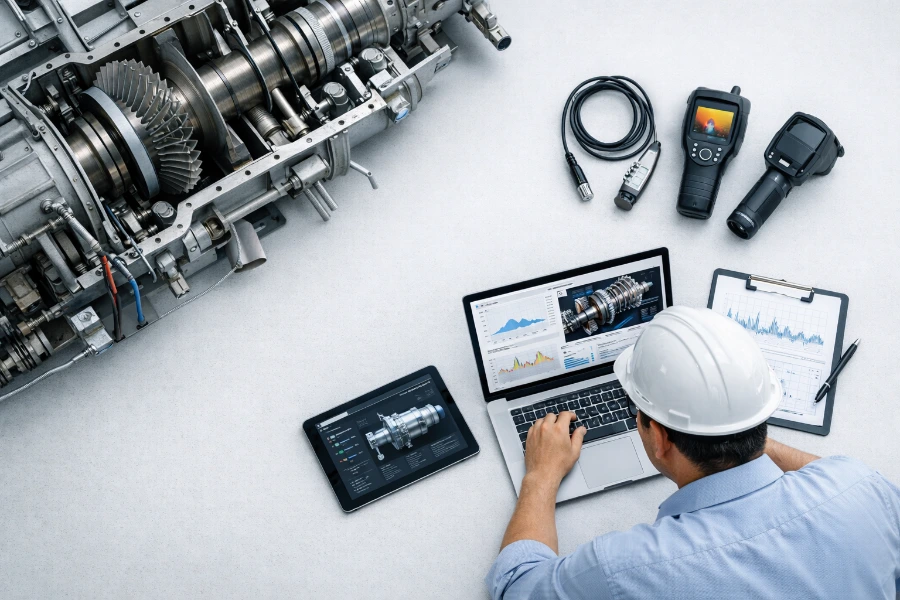
Mechademy sells an AI-native prescriptive analytics platform called Turbomechanica for critical rotating machinery. That covers gas and steam turbines, compressors, expanders, pumps and motors. The platform pairs asset-specific physics models with machine learning on live plant data and remote diagnostics from human specialists. It then issues recommended actions, not just alerts.
The software connects to monitoring systems a plant already runs, so operators do not need new data infrastructure. The company says deployments have flagged degradation, vibration, contamination, and seal or motor-insulation faults, in some cases months before failure. It has not published accuracy figures or a false-alarm rate.
A natural-language tool, Turbomechanica Copilot, lets plant and field staff query their own operating data in plain terms. The architecture limits it to read-only data access. The company also lists a next-generation diagnostics engine, called Diagnostics 2.0, built around agentic AI. Mobile apps run on iOS and Android.
Who Is Behind the Company?
Mechademy was founded in 2017 by machinery specialists with backgrounds at Chevron, GE and Siemens. Ruzbeh Homji is co-founder and CEO. Mark Weatherwax, a former Chevron Fellow with more than 30 years of turbomachinery experience, is chief product officer. His career includes work on Chevron's Wheatstone and Gorgon LNG projects in Australia.
In September 2026, the company hired Madhukar "Duke" Puniani as head of revenue. The hire points to a commercial buildout ahead of the power-sector push. Mechademy also completed SOC 2 Type 2 and ISO/IEC 27001 audits in March 2026. Utility and independent power producer buyers typically require both.
Why Does the Power Generation Pivot Matter?
The pivot matters because it tests whether a model proven in LNG transfers to a different buyer. "We've spent years proving in LNG that physics, machine learning and real turbomachinery expertise together catch failures early," Homji said in the announcement. LNG trains run a small number of very large, very expensive machines. A single compressor outage there can halt production worth far more than the monitoring contract.
Power plants differ in useful ways. Gas and steam turbine fleets are larger, and operating profiles shift with grid demand. Utilities and independent power producers also run on different procurement cycles than energy majors. The company will need to show that models tuned on LNG compressors hold up on peaking turbines that start and stop frequently.
What Does the Round Say About Mechademy's Stage?
The round says Mechademy is early in commercial scaling. A $9.5M Series A is modest next to the nine-figure rounds common in AI infrastructure. It also sits on top of only about $3M in earlier capital, since the total is just above $12.5M. That is a small base for a nine-year-old company, and it suggests slow, customer-funded growth over a rapid venture-backed sprint.
Revenue, customer count and contract sizes were not disclosed. Without them, outsiders cannot gauge how much of the round funds expansion and how much funds runway. The absence of a stated valuation limits any read on investor appetite. Silverton Partners, an Austin-based firm, leading the round adds a Texas-centered investor syndicate to a Houston company.
How Crowded Is Predictive Maintenance for Turbines?
The field is crowded, and Mechademy competes with larger names. Original equipment manufacturers such as GE and Siemens sell their own monitoring services for the turbines they build. Industrial software vendors and horizontal machine-learning platforms also pursue the same plant budgets. Mechademy's argument is that its physics-first approach, plus human diagnosticians, works across vendors' equipment and catches faults that pure data models miss.
That claim is plausible but unverified in public. Many predictive maintenance products have struggled with alert fatigue, where operators ignore warnings because too many prove false. A prescriptive layer that tells operators what to do, backed by specialist review, addresses that problem in design. Whether it does in practice depends on field results that Mechademy has not yet released in quantified form.
What Comes Next?
Over the next year, the milestones to watch are the first named power-generation customers and the size of the 2027 U.S. hiring plan. If the LNG results carry over, the company could widen its addressable base considerably. If power plants demand different models or longer sales cycles, the new capital could stretch thin.
Outlook
Mechademy enters 2027 with fresh funding, security certifications and a new head of revenue. Its case rests on physics models and specialist diagnostics outperforming generic machine learning. The power sector will test that claim with more equipment variety and different buyers than LNG. Published failure-detection data and disclosed customer wins would clarify how much of the thesis holds.