Pomegra
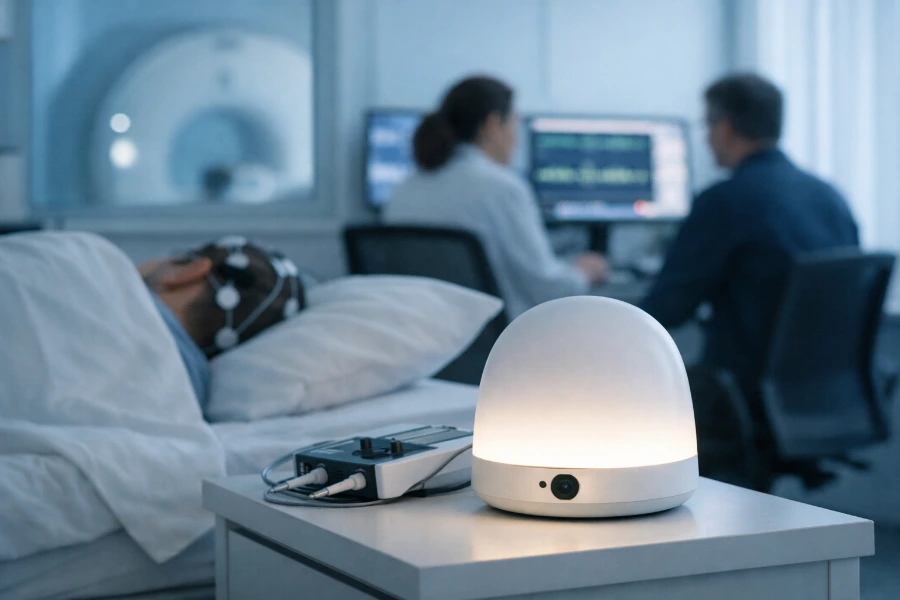
Lisbon's Lampsy Health closed a €1.1M round led by Fundação Ageas and Portugal Ventures to launch its AI bedside lamp across Europe and the UK in Q1 2027.
Key Takeaways
- Lampsy Health raised €1.1M, led by Fundação Ageas and Portugal Ventures; valuation was not disclosed.
- The lamp uses an infrared camera and computer vision, and the company claims over 97% seizure detection accuracy.
- Commercial sales in Europe and the UK start in Q1 2027, backed by a 7,500-person waitlist.
Lead
Lampsy Health, a Lisbon spin-off of Instituto de Telecomunicações and Instituto Superior Técnico, has closed a €1.1M funding round to move its seizure-monitoring bedside lamp from hospital programmes into family homes. Fundação Ageas and Portugal Ventures led the round, announced on 27 November 2026. Angels Way, Phira Ventures and a group of business angels with backgrounds in medicine, logistics, marketing and consumer experience also took part. The company did not disclose valuation, round stage or the split between investors.
The money pays for commercial launch and distribution. Sales in Europe and the UK are scheduled to begin in the first quarter of 2027.
What Does the Lampsy Lamp Actually Do?
The device is a bedside lamp that watches a sleeping person for movement patterns consistent with a seizure and alerts emergency contacts automatically. A small infrared camera captures the footage, and a proprietary computer vision algorithm classifies it. Nothing is worn on the body, which is the main difference from the wrist-worn and under-mattress sensors that dominate home monitoring today.
The company claims detection accuracy above 97% and 18 times fewer false alarms than existing alternatives. The accuracy figure refers to tonic-clonic seizure movements. Validation drew on hospital footage from epilepsy units at Lisbon's Santa Maria and Egas Moniz hospitals, including a published IEEE Access study covering more than 2,200 hours of video. The company also cites more than 9,200 hours of hospital data overall. The device carries EU medical device certification.
Until now, the lamp has been available only to medical teams, through a partnership programme with public hospitals in the Lisbon metropolitan area that treat epilepsy.
Why Do Night-Time Seizures Matter So Much?
Seizures during sleep are the hardest to catch, because no one is watching. The company puts the share of night-time seizures that go undetected at 86%. It cites about 50 million people living with epilepsy worldwide and roughly 300,000 new diagnoses a year in Europe.
The sharper figure is Sudden Unexpected Death in Epilepsy, or SUDEP. The company estimates it kills about 33,000 people a year in Europe and says 40% of those cases are preventable, mainly through fast intervention. It also says people with epilepsy face a risk of premature death three times higher than the general population. These are company-cited figures, and the preventability estimate depends on someone reaching the person in time. That is the gap a bedside alert targets.
How Does This Round Compare With the Last One?
The round is roughly five times the size of the last disclosed cheque. In June 2025, Lampsy raised €230,000, led by Fundação Ageas with business angels Susana de Sousa and Ellie Asgari. That money was earmarked for finishing product development, broader patient validation and EU certification.
Those goals now read as met, which is what a follow-on of this size would be expected to reflect. The lead investor from the first round returned and a state-backed venture investor joined it, which suggests the certification milestone changed the risk profile. The round also drew support from the European Innovation Council's Pre-Accelerator programme.
The cap table shows no large institutional fund from outside Portugal. The €1.1M is also thin for a hardware business that must manufacture, ship and support devices in multiple countries and handle medical-device compliance. A larger round will probably be needed once sales data exists.
Who Is Waiting, and Who Is Competing?
Demand is documented before the product has gone on sale. Lampsy reports a waitlist of more than 7,500 people in 20 countries, with about half in the UK. That explains why the UK sits alongside the EU in the launch plan. A waitlist is not revenue, though, and the company has not disclosed pricing.
Rivals exist. Wearable and sensor-based seizure detection has attracted funding, with BioSerenity reported to have raised about €24M and NextSense a $16M Series A. Those products rely on sensors worn on the head or body. Lampsy's pitch is that people with epilepsy often will not wear devices to bed, and a lamp asks nothing of them. The counterargument is that a camera pointed at a bed raises privacy questions that a wristband does not, and that a single fixed camera sees only what is in frame.
Who Is Behind the Company?
Lampsy was founded in 2024 by Vicente Mayer Garção, who is CEO, Leonor Pereira and Joana Pinto. Garção and Pereira appear on the Forbes 30 Under 30 Portugal 2026 list. Garção said the project began with a request from a medical team at Hospital de Santa Maria, who wanted to know what happens to these patients at night.
"Demand came before we did. This round gives us the means to respond, starting with the countries where families are waiting," Garção said.
What Comes Next for Lampsy?
The next test is the consumer launch in Q1 2027, which moves the device from supervised hospital use to unsupervised bedrooms. Real-world false-alarm rates, price and the share of waitlist sign-ups who actually buy will show whether the clinical results hold in the home. Seizure types other than tonic-clonic, which are less visible on camera, remain the harder detection problem.
Regulatory and reimbursement routes will also shape adoption. Health systems that cover wearable alternatives may need to be persuaded to cover a lamp.
Outlook
Lampsy Health has gone from a €230,000 first round in June 2025 to €1.1M in November 2026, with certification done and a launch date set for early 2027. The valuation is undisclosed, the investor group is regional, and the funding is modest for a multi-country hardware rollout. The company's strengths are hospital validation, a contact-free design and a waitlist already in the thousands. The Q1 2027 launch will show whether demand and accuracy hold outside the clinic.