Pomegra
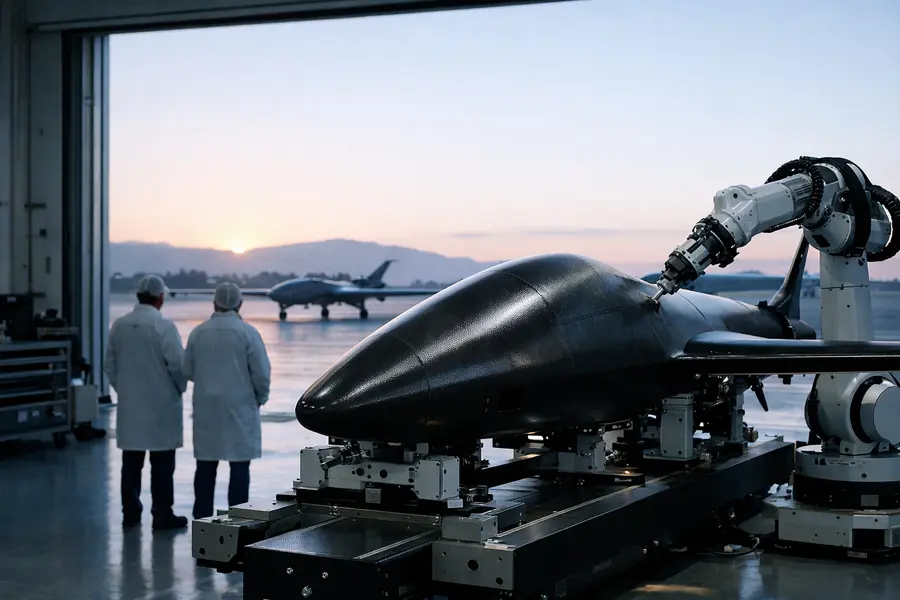
Helicon, a Los Angeles startup, emerged from stealth with a $16.5M seed round led by AlleyCorp to automate carbon fiber drone frame production at scale.
Key Takeaways
- Helicon raised a $16.5M seed round led by AlleyCorp; valuation was not disclosed.
- Its 36,000 sq. ft. Torrance plant targets 5-15 minute cycle times per drone frame.
- The company has fewer than 10 customers, all unnamed, with extremely high volume needs.
Lead
Helicon, a Los Angeles composites manufacturer founded by CEO Alex Niehaus and CTO Edmundo Sanz-Gadea, came out of stealth on October 20, 2026, with $16.5M in seed funding. AlleyCorp led the round. The company will use the money to scale an automated production line for composite structures on Group 1 to Group 3 unmanned aircraft, a range that runs from FPV attack drones up to larger systems in the class of the Army's LUCAS one-way attack drone.
Who Backed Helicon, and at What Valuation?
AlleyCorp led the round, with participation from Buckley Ventures, Mike Chalfen and a group of angels that includes Eileen Tanghal, Gokul Rajaram, Lucas Vaz, Frederik Hjelm, Pablo Palafox and Charlie Songhurst. The company did not disclose a valuation. It also did not disclose headcount.
For a seed round, $16.5M is large. It reflects the capital intensity of the business: Helicon is building a factory, not shipping software. The check size also suggests investors are pricing in hardware execution risk that a typical seed-stage software company does not carry.
What Does Helicon Actually Build?
Helicon makes fiber-reinforced composite drone frames on an automated line, driven by a software platform called Argos that handles engineering, mold design and production planning. Robots handle material placement and trimming. The company says cycle times run from 5 to 15 minutes per frame, against hours for conventional composite processes.
The Torrance facility covers 36,000 square feet and has capacity for more than 1 million Group 1 and Group 2 drone frames a year. Current lead times run 4 to 6 weeks. Helicon wants to cut that to 2 weeks within six months, a sharp contrast to the lead times of months that composite buyers often accept.
Niehaus has framed the constraint as labor rather than materials. In his words, the production bottleneck has nothing to do with the material; the real bottleneck is extremely highly skilled composite engineers. Helicon's pitch is that software can hold that tacit knowledge so each part needs fewer people over time.
Why Is Drone Composite Manufacturing Attracting Capital Now?
Demand for domestically built drones is rising faster than the supply chain behind them. AlleyCorp partner Brannon Jones pointed to a $500M Army contract signed by drone maker Neros in June and to a target of one million drones a year. He also cited recent defense policy provisions and FCC rules that favor U.S. production, and described an 18 to 24 month window before policy conditions could shift.
Jones said Helicon began its investor discussions with tens of millions of dollars in letters of intent, and that the figure nearly doubled within two weeks. Letters of intent are not purchase orders. They do not bind a buyer, and the gap between the two is where early manufacturing startups tend to struggle.
What Are the Risks Behind the Round?
The main risk is execution, and Helicon is early. It disclosed fewer than 10 customers and named none. Its line is new, and a 5-minute cycle time on a pilot run differs from sustained throughput at a million frames a year.
There is also a concentration question. If most of the demand comes from a few drone makers tied to defense procurement, a change in contract timing or policy could leave a large plant underused. Jones said Helicon secured supplier agreements with major carbon fiber producers despite being a pre-factory startup, which addresses one input risk but not the demand side.
Competition is another variable. Established composite fabricators can add automation, and drone makers can bring molding in-house. Helicon's edge depends on whether its software lowers the cost per part enough to make outsourcing the rational choice.
What Comes Next for Helicon?
The next milestone is operational: hitting the 2-week lead time target within six months while growing the team across mechanical and structural engineering, software, robotics, manufacturing and operations. The company has said it will pursue aerospace and defense certifications, and it names robotics, logistics and maritime as adjacent markets for lightweight structures.
A follow-on round would likely hinge on converted letters of intent, named customers and measured throughput. If Helicon shows that the Torrance line produces at the stated rates, a larger Series A is a reasonable next step. If utilization lags, the seed money would stretch only as far as a single plant allows.
Outlook
Helicon enters the market with a funded factory, an automation thesis and a defense-driven demand backdrop. The undisclosed valuation, unnamed customers and untested volume leave the proof still to come. Over the next two quarters, lead times and customer conversions will show whether automated composites can match the pace of U.S. drone production targets.