Pomegra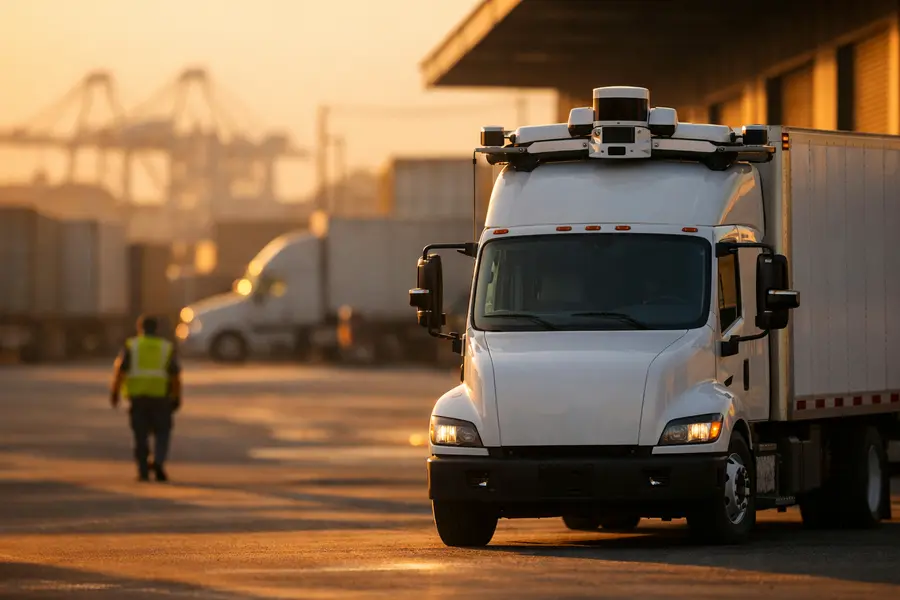
Gatik closes $200M Series D led by Qatar Investment Authority and Koch Disruptive Technologies, citing 85,000 driverless orders and $600M in contracted revenue.
- Gatik has completed 85,000 fully driverless orders for Walmart, Kroger, and PepsiCo with a 99% on-time delivery rate.
- The round was co-led by QIA and Koch Disruptive Technologies, with Millennium Management, ARK Invest, and Intact Private Capital also participating.
- Total capital raised reaches approximately $500M; Gatik targets 100+ driverless trucks in service before year-end 2026.
Lead
Gatik, the Mountain View-based autonomous middle-mile trucking company, closed a $200 million Series D on August 25, 2026, bringing its total funding to roughly $500 million. Qatar Investment Authority (QIA) co-led the round alongside Koch Disruptive Technologies, with Millennium Management, ARK Invest, and Intact Private Capital participating. The raise arrives as Gatik counts more than $600 million in contracted revenue from Fortune 50 customers running fully driverless freight on fixed regional routes.
What Does Gatik Actually Do?
Gatik operates autonomous box trucks on short-to-medium fixed routes - typically between distribution centers and retail stores - covering distances up to 400 miles. It does not attempt coast-to-coast hauls or unpredictable urban last-mile delivery. That deliberate narrowness is the thesis: fixed routes, repeatable conditions, commercial payloads. The company moves ambient, refrigerated, and frozen goods for Walmart, Kroger, and PepsiCo. Walmart was Gatik's first partner to go fully driverless, a milestone reached in November 2021 in Bentonville, Arkansas - one of the earliest commercial removals of a safety driver in North American trucking history.
How Does This Round Compare to Prior Valuations?
At $500 million in total capital with no disclosed valuation, the Series D compresses the margin for easy exits. Earlier rounds were raised when autonomous vehicle optimism priced in timelines that proved too short. Gatik's pitch this cycle is grounded in operational specifics - 85,000 completed driverless orders, not simulated miles or test routes. The $600 million in contracted revenue gives institutional investors a revenue-backlog argument that earlier AV rounds rarely had. Whether that contracted revenue converts to delivered cash at adequate margins remains the core question the company has not publicly answered.
Why Is Qatar's Sovereign Wealth Fund Backing Autonomous Trucks?
QIA has quietly built a transportation and logistics portfolio that spans ports, aviation, and freight infrastructure. An anchor position in a U.S. autonomous trucking company with live commercial operations fits that pattern. The co-lead structure with Koch Disruptive Technologies - the venture arm of Koch Industries, itself a major industrial and logistics conglomerate - pairs financial capital with an investor that has direct supply chain exposure and strategic interest in seeing the technology mature.
Operational Scale and Manufacturing Plans
Gatik currently operates dozens of driverless trucks and has set a target of more than 100 by the end of 2026. The longer-term production plan is more ambitious: the company has partnered with Isuzu to mass-produce purpose-built autonomous trucks at a South Carolina facility expected to come online in late 2027. That plant signals a shift from custom retrofits to volume manufacturing - a threshold no autonomous trucking startup has yet crossed at commercial scale in the United States.
The 99% on-time delivery metric is notable because it competes directly with benchmarks that conventional carriers use to win and retain retail logistics contracts. Walmart and Kroger are famously exacting on service levels; continued contract expansion from those customers is a stronger validator than any internal performance claim.
What Does This Mean for the Broader Autonomous Freight Sector?
The sector has thinned considerably since 2021. Several well-capitalized competitors have shut down or retreated to software-only licensing after failing to make the economics of driverless operation work on open highways. Gatik's constrained-route approach avoided some of that exposure. A $200 million raise at this stage - with named sovereign and institutional investors rather than purely venture capital - reflects a recalibration of where autonomous freight capital flows. Fixed-route, middle-mile operations have replaced the full-autonomy long-haul narrative as the near-term commercial anchor for the industry.
Outlook
Gatik enters the second half of 2026 with a fully funded expansion path, a manufacturing partnership, and customer relationships that include three of the largest retail and CPG supply chains in North America. The critical variables are fleet ramp speed, whether the Isuzu production timeline holds, and how unit economics look as the operation scales beyond dozens of trucks. The $600 million contracted revenue figure is the clearest signal yet that fixed-route driverless freight has moved past proof-of-concept. Execution from here - not technology validation - is the remaining test.