Pomegra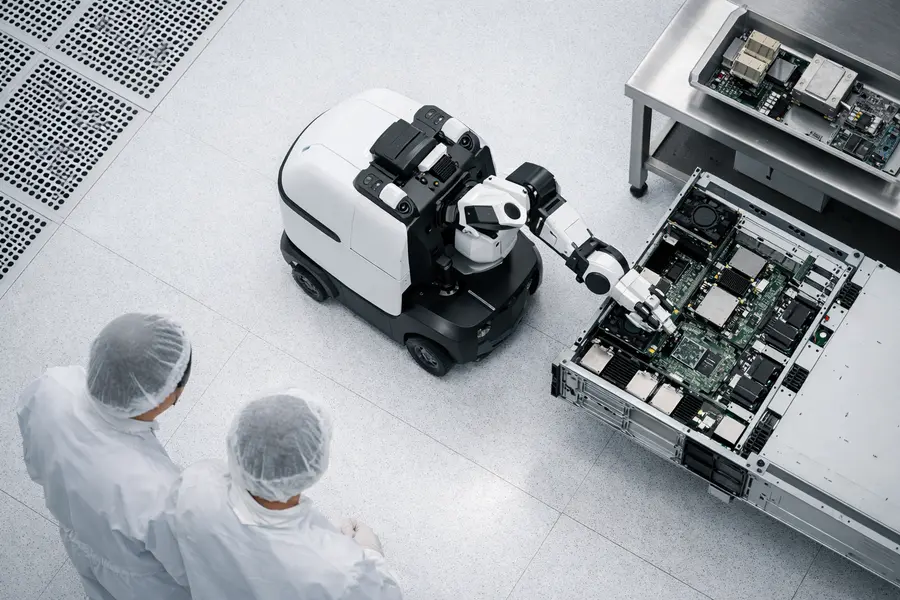
Exclaim Robotics exits stealth with €4.29M in pre-seed funding from Founderful and Playfair Capital to deploy autonomous robots inside AI data centers handling 800-volt DC infrastructure.
Key Takeaways
- Zürich-based Exclaim Robotics raised €4.29M ($4.95M) in a pre-seed round co-led by Founderful and Playfair Capital in August 2026.
- Its robots target live data hall maintenance: replacing failed drives, cleaning fiber optics, managing cabling inside 800V DC environments.
- CEO Helen Oleynikova co-created nvblox, the 3D mapping library now shipped in NVIDIA Isaac ROS, and holds a PhD from ETH Zürich.
Lead
Exclaim Robotics, a Zürich-based startup building autonomous robots for AI data center maintenance, exited stealth in August 2026 with a €4.29 million ($4.95 million) pre-seed round co-led by Founderful and Playfair Capital, with participation from angel investors. Valuation terms were not disclosed. The capital will fund prototype development, hardware procurement, and engineering team expansion as the company moves from concept to field-testable machines.
The company was founded by Helen Oleynikova and Patrick Pfreundschuh, both PhDs from ETH Zürich, whose combined background spans 3D mapping, LiDAR-inertial navigation, and autonomous system deployment in physically demanding environments.
What Does Exclaim Robotics Actually Build?
The robots are designed to navigate data halls without human guidance, locate themselves precisely at server racks, and execute hands-on maintenance tasks that currently require technicians on-site: swapping failed storage drives, replacing and cleaning fiber optic connectors and SFPs, and managing copper cabling. These are not inspection robots. They physically interact with live infrastructure.
The distinction matters because the target environment is changing. Next-generation AI data centers are increasingly built around 800-volt DC power distribution, compared to the 48V or 400V architectures common in older facilities. At 800V DC, routine maintenance carries sharply higher risk for human workers. Exclaim's machines are built to operate in that environment as a matter of design, not adaptation.
Why Is This Problem Getting Harder to Ignore?
The density of AI compute clusters is rising faster than data center operating procedures have adapted. As GPU training clusters scale, so does the volume of routine hardware events - drive failures, dirty connectors, degraded cables - that need human response. At hyperscale, these tasks consume meaningful technician hours inside facilities that are physically more hazardous than those built a decade ago.
Equally relevant: the robotics technology required to do this work is only now viable at the level of precision the job demands. Reliable spatial mapping, accurate 6-DOF pose estimation, and real-time collision avoidance in cluttered rack environments have all matured in recent years. Exclaim's founders have worked at the frontier of each.
Founding Team
Oleynikova spent 15 years in robotics across Willow Garage, Google, Microsoft, and NVIDIA before founding Exclaim. Her PhD from ETH Zürich focused on mapping and planning for unstructured environments. She co-created nvblox, a 3D mapping and collision-avoidance library that ships inside NVIDIA Isaac ROS and is used by robotics teams across the industry - a credential that connects her directly to the kind of spatial intelligence Exclaim's robots require.
Patrick Pfreundschuh, founding engineer, developed the BIEVR-LIO LiDAR-inertial odometry system and was part of the winning team at the DARPA Subterranean Challenge, a competition built around autonomous navigation in difficult, GPS-denied underground environments. The parallels to a dense data hall - constrained geometry, no GPS, high positional accuracy requirements - are not incidental.
What Does This Round Signal for the Sector?
A €4.29 million pre-seed does not fund a commercial product. It funds prototypes and a team. The investor composition, however, is worth reading. Founderful is among the most active pre-seed funds in the DACH region with a track record in technical deep-tech formations. Playfair Capital extends the deal's reach into the UK ecosystem. Neither is a generalist fund writing speculative checks into robotics as a trend.
The funding also enters a market that is not yet crowded at this specific intersection. Physical infrastructure robotics for data centers is a narrower category than general warehouse or logistics automation. Larger robotics platforms with existing distribution have not yet staked out this territory as a priority. Exclaim has a window, though the distance from a funded prototype to a qualified data center deployment is long, and hyperscaler procurement cycles are not short.
Outlook
Exclaim Robotics has the founding credentials and the timing to make a credible early run at autonomous data center maintenance. The immediate questions are about hardware maturity and field reliability - the two variables a pre-seed cannot resolve, only begin testing. If the shift to 800V DC power in next-generation AI facilities proceeds at the pace operators are signaling, the maintenance problem Exclaim targets will sharpen considerably over the next two to three years. Whether €4.29 million is enough runway to reach a field-testable robot, and then a paying customer, is the real test the company faces going forward.