Pomegra
Aachen battery recycler cylib has added Germany's SPRIND as an investor, with terms undisclosed, as it scales lithium-first recovery in Bavaria and Dormagen.
Key Takeaways
- SPRIND, Germany's federal innovation agency, took a stake in cylib on November 17, 2026. The amount was not disclosed.
- cylib has raised more than €90M in equity and grants since 2022, including a €55M Series A in May 2024.
- Its Bavarian plant has run since September 2026 with capacity of up to 10,000 tonnes of batteries a year.
Lead
cylib, the Aachen-based battery recycler spun out of RWTH Aachen University, has gained the Federal Agency for Breakthrough Innovation (SPRIND) as a new investor. The announcement came on November 17, 2026. Neither side disclosed the size of the stake, the round it belongs to or the company's valuation.
Some early coverage framed the deal as a €6M seed round. That figure does not appear in the company's funding history, which includes a seed round of about €11.6M and a €55M Series A. The SPRIND investment is best read as growth capital for a company that is already operating industrial assets.
What Did SPRIND Actually Invest In?
SPRIND is backing the development and industrial scaling of cylib's OLiC process, a water-based method that recovers lithium first from battery black mass. The company says it recovers more than 90% of lithium, graphite, nickel, cobalt and manganese, with a CO2 footprint around 80% lower than virgin extraction.
SPRIND innovation manager Olav Carlsen said cylib has the technological foundation to create a large-scale industrial market for battery materials that stay in circulation in Europe. The agency's stated rationale is supply security: Europe has little domestic access to battery raw materials, while the pool of end-of-life electric vehicle batteries grows each year.
The missing figure matters. A state agency that withholds its ticket size gives little signal on conviction. What the stake does provide is public-sector validation next to a cap table that already includes venture and corporate money.
How Much Has cylib Raised So Far?
cylib has raised more than €90M in equity and grants since its 2022 founding. The seed round started at €3.6M in October 2022 and grew with an €8M extension, led by World Fund with Vsquared Ventures, Speedinvest and 10x Founders participating.
The €55M Series A followed in May 2024, co-led by World Fund and Porsche Ventures. In December 2025, the company secured €63.4M in grant funding for a lithium iron phosphate (LFP) battery recycling facility at the CHEMPARK site in Dormagen. Sparkasse Aachen provided cylib's first bank financing in the week before the SPRIND news.
That mix leans heavily on non-dilutive money. Grants and a regional bank loan reduce the equity needed per tonne of capacity, but they also tie the company to project milestones and public-sector timelines.
Where Does cylib Stand Operationally?
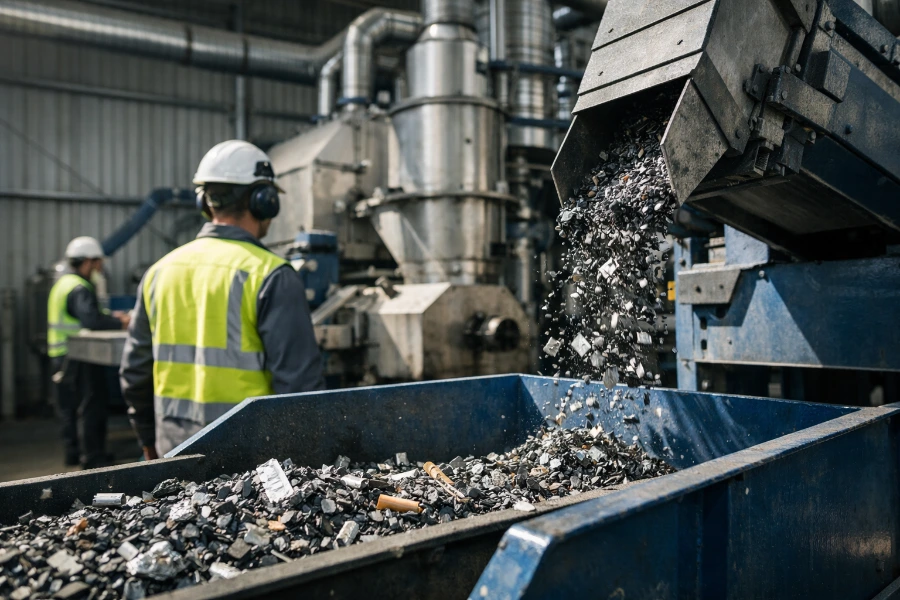
cylib acquired the former Roth International site in Wernberg-Köblitz, in Bavaria's Schwandorf district, in July 2026. The plant began operating in September 2026 and processes end-of-life batteries mechanically into black mass, a powder containing the valuable metals. Capacity is up to 10,000 tonnes of batteries a year.
The chemical stage sits in Dormagen in North Rhine-Westphalia, where a hydrometallurgical facility is under construction. Until it runs, the Bavarian plant produces an intermediate product rather than finished battery materials. The company has about 100 employees and is testing recycled battery cells with Porsche.
Why Does Lithium-First Recovery Matter for Regulation?
The EU Battery Regulation requires recovery of 80% of lithium from end-of-life batteries by the end of 2031. Conventional recycling routes often recover lithium last, or lose it in slag. A process that extracts it early targets that obligation directly and claims higher overall yields and cost advantages.
LFP chemistry adds pressure. LFP cells contain no nickel or cobalt, so recyclers cannot rely on those metals to pay for the process, and the economics depend on lithium and graphite. The Dormagen project is aimed at that problem.
What Are the Risks for cylib?
Scale-up is the main one. The company has proven a process at pilot and early industrial stage, but chemical recovery at commercial volume is still ahead of it. Lithium prices are another exposure, since recycled output competes with mined supply whose cost swings widely.
Feedstock is the third. European volumes of end-of-life EV batteries remain modest compared with the capacity being announced across the continent. Production scrap from gigafactories currently fills much of the demand.
Outlook
The SPRIND stake adds a federal backer to a company that has already assembled venture capital, an automaker's investment arm, EU-linked grants and bank debt. The undisclosed amount limits what can be read into the deal, and the €6M seed framing does not match the record. The next test is Dormagen: commissioning of the chemical plant will show whether lithium-first recovery works at industrial volumes and at a cost that holds without subsidy.