Pomegra
Munich-based Nomadic has raised a $6M seed round led by Foundamental to scale drones that charge from live high-voltage lines and monitor grid conditions across Europe and the US.
Key Takeaways
- Nomadic raised $6M in seed funding led by Foundamental; valuation was not disclosed.
- Its roughly 4 kg NOMAD drones land on live conductors up to 420 kV and charge inductively.
- Remote drone relocation is due in production with customers in 2027.
Lead
Nomadic, a Munich energy technology startup founded in 2024, announced on November 17, 2026, that it has raised $6M in a seed round led by Foundamental. Verve Ventures, Cyan Ventures, Outlander VC, Asia2G Capital and angels from the sdw alumni network also participated. The company did not disclose its valuation.
The money will fund the production version of remote drone relocation, expand fleet deployments in Europe and the US, and add staff in Munich. Nomadic says it has accumulated more than 20,000 operating hours on live lines.
What Does Nomadic Actually Build?
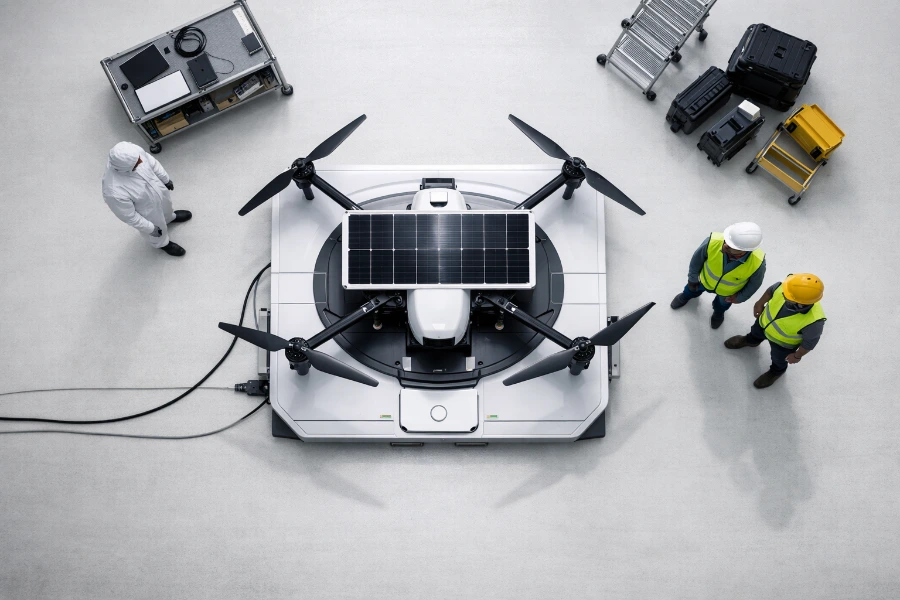
Nomadic builds autonomous drones, called NOMAD, that land on energized high-voltage conductors and recharge from the magnetic field around them. Each unit weighs about four kilograms, works at temperatures down to -25°C and handles lines up to 420 kV. Landing on a live line means operators do not need to schedule an outage.
Each drone is paired with Nomadic OS, a software platform that combines the drone's measurements with weather models, grid data and historical records. CEO Andreas Moldskred describes it as "the physical context layer for the power grid." CTO Lauritz Weil co-founded the company with him.
Why Does Line Monitoring Matter for Grid Operators?
Line monitoring matters because operators often lack direct data on how much current a conductor can safely carry. Dynamic line rating, ice detection and wildfire monitoring all depend on conditions at the conductor, not at a weather station kilometers away. Utilities that can read those conditions can sometimes push more power through existing lines instead of building new ones.
Fixed sensors do this job today, but they are typically installed at intervals of one to five kilometers. Nomadic says a single NOMAD can cover about 25 kilometers of line. That is the core pitch: move one device to where the data is needed instead of bolting a sensor to every span.
How Does the Round Compare With Earlier Funding?
The seed is roughly 3.75 times the company's earlier pre-seed. Nomadic announced a $1.6M pre-seed led by Outlander VC and Asia2G Capital, and both returned for this round. Repeat backing from the first investors is a mild positive signal, though it is also the cheapest kind of support to secure.
Foundamental takes the lead position. The size of the round fits a hardware company that has finished its first pilots and now has to build and field a fleet. It is modest against the capital needed to manufacture drones, certify them and support utilities across two continents.
Where Is the Technology Deployed?
Nomadic drones currently operate on German transmission and distribution grids, with deployments in Norway and the United States. The company has not named its utility customers, and the earlier pre-seed announcement referred only to pilot customers and major utilities. Most of the activity therefore remains at the pilot stage, not in fleet-scale contracts.
The company has said it is working toward production-grade remote relocation, in which a drone moves along the network between sites without a field crew. That feature is scheduled to reach customers in 2027. Until it works reliably, the cost advantage over fixed sensors rests largely on the drone's coverage per unit and the savings from skipping outages.
What Are the Risks?
The main risks are regulatory approval for autonomous flight near energized infrastructure, procurement cycles at utilities, and hardware reliability in winter weather. Utilities buy slowly, and pilots routinely stretch for a year or more before turning into purchase orders. Autonomous operation beyond visual line of sight also faces different rules in Germany, Norway and the US.
Competition comes from fixed line sensors, helicopter and drone inspection services, and other grid-monitoring startups. Nomadic's differentiator is the combination of self-charging and mobility, which few competitors match. Whether utilities will pay for that over cheaper static sensors is the open commercial question.
Outlook
Nomadic has a working product, 20,000 hours of flight on live lines and a seed round that gives it room to reach its 2027 relocation milestone. The unanswered questions are commercial: how many pilots convert, at what price, and how fast. The next evidence will be named utility contracts and the first remote relocations in customer networks.