Pomegra
Arda Industries, founded by ex-OpenAI research chief Bob McGrew, exits stealth with $232M at a $1.5B valuation to automate US assembly lines with AI software.
Key Takeaways
- Arda raised a $160M Series A at a $1.5B valuation, co-led by Altimeter, Accel and Khosla Ventures.
- Total funding reaches $232M, including a $72M seed led by Accel and Founders Fund.
- Anduril is the first customer; robot-programming agents are still at prototype stage.
Lead
Arda Industries emerged from stealth on October 20, 2026, announcing $232 million in total funding to shorten the time it takes manufacturers to turn a new product design into a working assembly line. The San Francisco company was founded by Bob McGrew, who served as OpenAI's chief research officer before leaving to start it. Its $160 million Series A values the business at $1.5 billion, and it follows a $72 million seed round.
What Happened and Who Is Backing Arda?
Arda closed a $160 million Series A co-led by Altimeter, Accel and Khosla Ventures, at a $1.5 billion valuation. The earlier $72 million seed was led by Accel and Founders Fund. Other investors include XYZ Venture Capital, 8VC, SVAngel and Felicis.
The step-up is steep. An earlier report described the company raising about $70 million at a $700 million valuation, which implies the valuation roughly doubled between rounds. Accel appears on both sides of the cap table, a signal that the seed investor chose to defend its position rather than let new money set the price.
The headline number also deserves some scrutiny. A $1.5 billion valuation for a company whose robotic automation is still a prototype prices in a future product, not current revenue. Arda has not disclosed revenue.
What Does Arda Actually Build?
Arda builds AI software that converts a product's CAD design into assembly line specifications, then updates those specifications as the design changes. The current product handles the engineering paperwork that sits between a finished design and a running line. It does not yet program robots.
The company cites customer figures for the effect. Anduril, which says Arda "turns days of work into hours, and hours into minutes," reports that basic work instructions drop from 10 hours to 15 minutes. Complex engineering workflows fall from 30 hours to 2.5 hours.
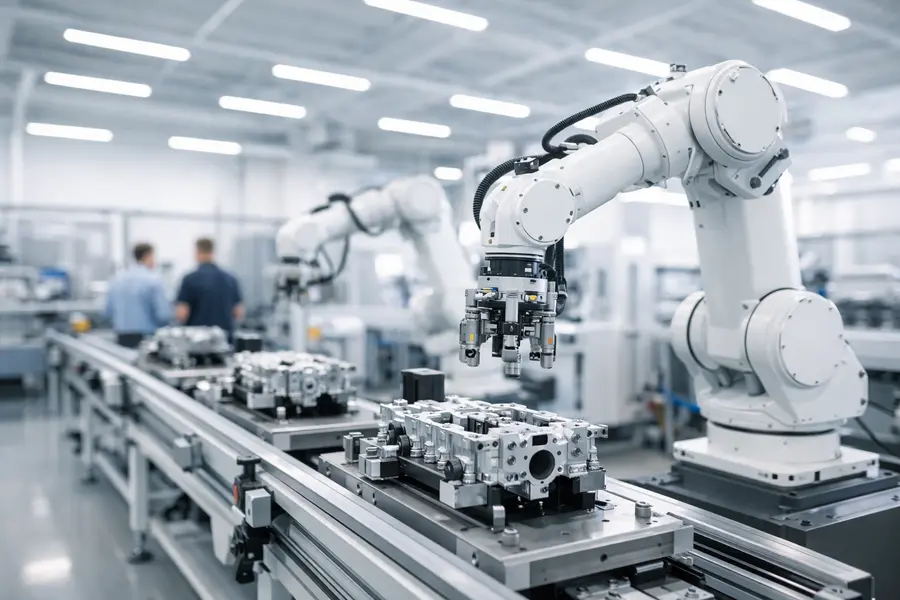
The longer plan is AI agents that program robots directly, so an automated line can be reconfigured in days rather than months. That work is in the prototype phase. If it functions, it would displace the integrators and in-house controls engineers who currently hand-program each line.
Who Is on the Team and Who Uses It?
McGrew is CEO, and he previously held product and engineering leadership roles at Palantir. Augustus Odena, a co-founder of Adept with a background at Google Brain and Meta's TBD Lab, serves as chief AI officer. Alex Mark, a former Palantir engineering leader who also worked on the U.S. Digital Service's IRS Direct File project, is CTO. Jakob Frick, previously at Palantir and SpaceX, is a co-founder.
Anduril Industries was the first design partner and customer, and Arda runs inside Anduril's ArsenalOS manufacturing software. Arda is also deployed with data center supply chain manufacturers. Consumer electronics such as phones and drones are the next target.
McGrew framed the pitch as a question about the gap between design and production. "Why can we design next-generation products in America, but not build them here?" he asked, pointing to products whose designs change every year.
Why Does Fast-Changing Hardware Matter for US Production?
Short product cycles make domestic assembly hard because a line built for one design becomes obsolete when the next one ships. Overseas factories absorb that churn with large, flexible labor pools. A US line staffed with fixed automation cannot, which is why consumer electronics has stayed largely offshore.
Arda's thesis is that software can cut the retooling time enough to close that gap. The claim is testable but unproven. Defense and data center hardware, Arda's first markets, tend to run lower volumes and tolerate higher unit costs than phones. Success there says little about whether the economics hold for a product made in the millions.
Competitive Context
McGrew joins a group of former OpenAI leaders who have started their own companies, including Mira Murati's Thinking Machines Lab and Ilya Sutskever's Safe Superintelligence. Unlike those labs, Arda is aimed at a specific industrial workflow rather than general model research.
Skeptics of AI in manufacturing point to research from MIT suggesting early deployments tend to be additive rather than transformative. Companies that add tools without redesigning how people and machines work together often see friction that limits productivity gains. Arda's bet on owning the design-to-line workflow is partly a response to that problem.
Outlook
Arda enters the market with $232 million, a $1.5 billion valuation and one named anchor customer in Anduril. The documentation product has measurable results. The robot-programming agents, which justify most of the valuation, remain a prototype. The next test is whether the 10-hour-to-15-minute gains carry over to consumer electronics lines, where design churn is highest and margins are thinnest.