Pomegra
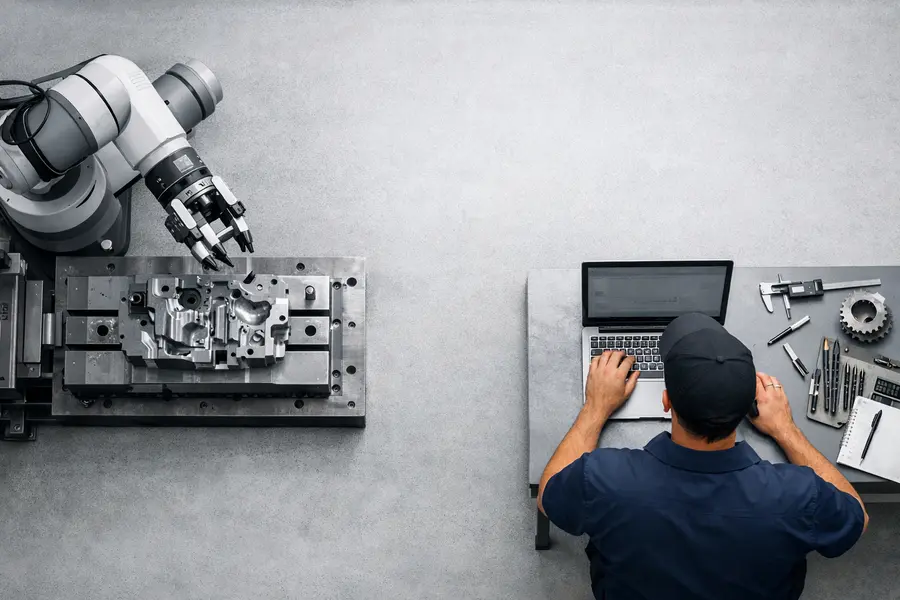
Arda Industries, led by former OpenAI research chief Bob McGrew, exited stealth on October 20, 2026 with $232M in total funding and a $1.5B valuation for AI-driven manufacturing engineering.
Key Takeaways
- Arda raised a $160M Series A at a $1.5B valuation, on top of a $72M seed round, for $232M in total funding.
- Altimeter Capital, Accel and Khosla Ventures led the Series A; Anduril is the first customer.
- Arda's valuation roughly doubled in seven months, from about $700M in March 2026.
Lead
Arda Industries emerged from stealth on October 20, 2026, announcing $232M raised to automate the engineering work that turns a product design into a working assembly line. The company was founded by Bob McGrew, OpenAI's former chief research officer and an earlier Palantir executive. The $160M Series A values the company at $1.5B and was led jointly by Altimeter Capital, Accel and Khosla Ventures. The remaining $72M came from a seed round led by Accel and Founders Fund.
What Does Arda Actually Build?
Arda builds software that works as an integrated development environment for manufacturing engineers. It pulls CAD files, manufacturing bills of materials, work instructions and robot programs into one workspace that updates when a product design changes. From design documents, the system determines assembly sequences, generates work instructions and lays out stations.
McGrew has described the product as an interface and an agent that does for manufacturing engineers what Claude or Cursor does for programmers. The problem he points to is a lag between design and automation. A human worker can be retrained on a revised design in a day, while changing the automation to match takes three to six months.
The company also plans AI agents that reprogram assembly-line robots in days rather than months. Those agents are a stated plan, not a shipped product. Arda charges per task its agentic tools complete, not per user seat.
Who Is Using It, and With What Results?
Anduril is Arda's design partner and first customer. Arda began in 2025 and spent its first year building alongside the defense contractor, and its software is deployed as part of Anduril's ArsenalOS. Anduril has reported that basic work instructions that took 10 hours now take 15 minutes. Complex engineering tasks that took up to 30 hours now take about 2.5 hours.
Those figures come from a single customer that also helped shape the product, so they say little about how the software performs elsewhere. Arda is targeting other defense contractors, data center builders and complex hardware makers, and its customer list beyond Anduril has not been disclosed.
Why Did the Valuation Double in Seven Months?
Investor appetite for AI-native industrial software, plus the credentials of the founding team, explains most of the jump. In March 2026, Arda was raising roughly $70M at a valuation near $700M. By October the same company had a $1.5B price tag, a three-fund lead group and an anonymous customer base of one named account.
The step-up implies the earlier round was priced on team and thesis, while this one is priced on early deployment evidence. It also leaves little room for a disappointing second customer. A $1.5B valuation on a company in its second year requires broad adoption beyond defense hardware.
The team supplies much of the credibility. McGrew is CEO. Augustus Odena, co-founder of Adept and a veteran of Google Brain and Meta, is chief AI officer. Alex Mark, a former Palantir engineering lead, is CTO. Jakob Frick, also from Palantir, is a co-founder. Other investors in the rounds include Felicis, XYZ Venture Capital, 8VC and SV Angel.
How Crowded Is the Field?
The field is more crowded than the launch suggests. Siemens already ships engineering agents inside its TIA Portal automation software, with claimed efficiency gains of up to 50%. Incumbent industrial vendors own the installed base of controllers, simulation tools and factory data that Arda's software must connect to.
Arda's counter is that incumbent tools were built around static designs, while its product treats design change as the default condition. That argument is plausible for fast-iterating hardware makers such as defense and data center suppliers. It is less proven for high-volume industries with long product cycles, where switching costs favor the incumbents.
Strategic Context
McGrew framed the company's ambition in geographic terms: "Imagine a fully automated version of Shenzhen in West Texas." The comparison points to a broader thesis that US manufacturing lags less on capital than on engineering speed. If new designs can be turned into production lines in days, the argument goes, domestic factories can compete on iteration rate rather than labor cost.
That thesis depends on robots being programmable at software speed, which remains the unproven part of Arda's roadmap. Engineering documentation is the easier problem. Reprogramming physical automation reliably across different robot makers is the harder one.
Outlook
Arda enters the market with $232M, a $1.5B valuation and one marquee customer whose reported time savings are large but unverified outside Anduril. The next tests are a second and third named customer, delivery of the robot-reprogramming agents, and evidence that per-task pricing holds up against Siemens and other incumbents. A valuation that doubled in seven months leaves the company a short runway to show those results before the next round.