Pomegra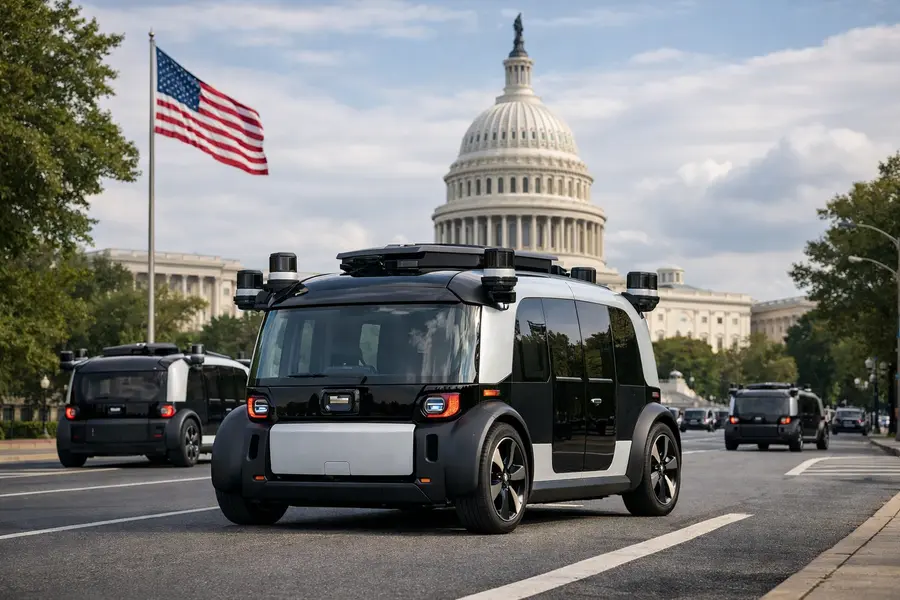
Amazon's Zoox unit secures a landmark NHTSA exemption to deploy up to 5,000 steering-wheel-free autonomous vehicles commercially, beginning in Las Vegas.
- NHTSA granted Zoox a two-year exemption covering up to 2,500 autonomous vehicles annually, the first such federal clearance for a purpose-built robotaxi.
- Zoox's electric carriage-style pod has no steering wheel, pedals, or rearview mirrors, seats four passengers, and reaches 75 mph.
- Paid rides launch first in Las Vegas, with San Francisco, Austin, Miami, Los Angeles, and Atlanta targeted in subsequent phases.
Lead
The National Highway Traffic Safety Administration granted Amazon-owned Zoox a temporary exemption from federal motor vehicle safety standards on July 30, 2026, clearing the company to charge passengers for rides in its purpose-built, fully driverless robotaxi — a first in U.S. regulatory history. The exemption covers up to 2,500 vehicles per year over two years, yielding a fleet ceiling of 5,000 autonomous vehicles across the approval period. Zoox said commercial service in Las Vegas will begin within weeks.
What Happened
NHTSA's exemption waives the safety standards that mandate conventional human controls — steering wheels, brake and accelerator pedals, and rearview mirrors — for vehicles sold or operated on American public roads. Those rules were written for human-operated cars, and Zoox's bidirectional pod, which carries up to four passengers in inward-facing, carriage-style seats, was designed from the outset without them.
NHTSA Administrator Jonathan Morrison stated that the agency determined the Zoox robotaxi to be as safe as an equivalent vehicle meeting the federal standards being waived. The exemption is subject to what regulators described as an "enhanced, adaptable oversight structure," allowing the agency to modify conditions as the technology and deployment data evolve.
The approval is structured as a temporary federal exemption — a legal pathway that allows novel vehicle configurations to operate commercially while full rulemaking catches up to the technology. The two-year time horizon and the annual 2,500-vehicle cap reflect that regulatory calibration.
Strategic Context
For Amazon (AMZN), which acquired Zoox in 2020 for approximately $1.2 billion, the approval represents a long-awaited commercial milestone after years of development and regulatory engagement. The investment thesis behind the acquisition — deploying a proprietary autonomous vehicle network at scale — moves materially closer to execution with federal clearance now in hand.
The Zoox vehicle's unconventional form factor, capable of traveling in both directions without turning around, is designed to optimize urban mobility efficiency in dense corridors. With a top speed of 75 miles per hour and an electric drivetrain, the pod targets both city-center last-mile trips and broader urban routes.
The Las Vegas market, where Zoox has conducted extensive testing and where state-level autonomous vehicle regulations are permissive, serves as the initial commercial proving ground. The company's stated expansion list — San Francisco, Austin, Miami, Los Angeles, and Atlanta — covers six of the ten largest U.S. metropolitan areas, pointing to an aggressive national scaling roadmap.
AI and Technology Angle
The Zoox robotaxi relies on a proprietary sensor fusion stack combining lidar, radar, and cameras, processed by onboard AI systems trained on millions of miles of real-world and simulated driving data. Unlike retrofit autonomous systems layered on top of conventional vehicles, Zoox's hardware and software were developed in parallel, which the company contends improves safety margins and system reliability.
The NHTSA decision signals a broader regulatory shift: federal standards written for human-controlled vehicles are increasingly being adapted — or exempted — to accommodate the commercial realities of autonomous vehicle deployment. That regulatory evolution is critical for the entire sector, as competitors including Waymo (Alphabet), Cruise (General Motors), and international entrants continue to expand their own driverless fleets in U.S. cities.
Competitive Landscape
Waymo currently operates the largest commercial driverless ride-hail service in the United States, with paid rides in San Francisco, Phoenix, and Los Angeles under its existing state and local permits. Zoox's federal exemption, however, establishes a new precedent specifically for vehicles built without any human-control interface — a distinction that could accelerate regulatory pathways for next-generation autonomous vehicle designs across the industry. General Motors' Cruise unit, which suspended robotaxi operations in late 2023 following a safety incident, remains in a recovery phase. Zoox's successful federal clearance effectively widens the competitive gap for active operators and raises the benchmark for re-entry.Outlook
With federal approval secured and state-level clearances advancing in Nevada, Zoox is positioned to begin generating commercial revenue from its robotaxi service for the first time. The pace of fleet expansion to the five additional target markets will depend on the speed of state-by-state regulatory processing and operational ramp-up. NHTSA's adaptable oversight framework introduces an element of ongoing regulatory engagement, meaning the 2,500-unit annual cap and associated conditions remain subject to review as real-world performance data accumulates. For Amazon, the Zoox commercial launch marks the transition of a years-long capital commitment from development asset to operating business.