Pomegra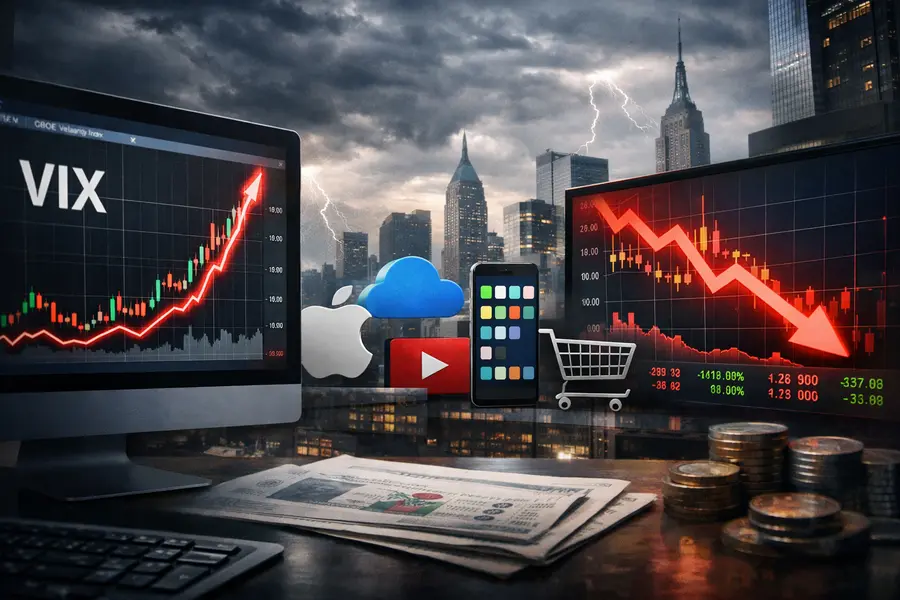
The CBOE Volatility Index climbed sharply in the week through July 24, surging more than 20% as Alphabet and Tesla delivered disappointing results and investors braced for the remaining Magnificent Seven reports still to come.
- The VIX fear index rose more than 20% on a weekly basis to near 18.77, its highest level in several weeks, as Big Tech earnings injected fresh stock market uncertainty.
- Alphabet fell 7% and Tesla shed 14% after their Q2 reports, dragging the S&P 500 down 1.2% and the Nasdaq 2.15% on July 23.
- Microsoft, Meta, Amazon, and Apple still face the market, with investors demanding proof that a combined $725 billion in AI capex is translating into revenue.
---
Lead
The CBOE Volatility Index — Wall Street's primary fear index — climbed as high as 18.77 this week, a weekly jump of more than 20%, as the first wave of Magnificent Seven earnings reports underscored investor anxiety over whether record artificial intelligence investment budgets are generating proportionate returns. The S&P 500 dropped 1.21% to 7,408.30 on July 23, while the Nasdaq Composite fell 2.15% to 25,137.69, its steepest single-session loss in a month, after Alphabet and Tesla released results that fell short of elevated expectations.
---
What Happened
Alphabet (GOOGL) dropped roughly 7% in after-hours trading following its Q2 2026 report, which showed expanding cloud and AI revenue but also triggered concern over the pace of capital expenditure growth. Tesla (TSLA) fared worse, sliding 14% after a quarter in which earnings per share tracked approximately 32% below the year-earlier period, with slowing delivery momentum raising questions about the company's near-term trajectory.The back-to-back disappointments pushed a gauge of megacap technology stocks to its worst session since the tariff-driven market rout of April 2025. The VIX index today reflects that shift in mood: having traded in a relatively calm 16-to-19 band for most of June and early July, the index gapped higher as the earnings scorecard began arriving.
The VIX closed near 16.64 on July 23 but had spiked intraday to above 18 on multiple sessions this week, with the weekly cumulative rise of more than 20% signaling a meaningful evaporation of complacency — even if the index remains well below the 30-plus territory associated with genuine market distress.
---
Market Reaction
Market volatility news this week centered squarely on the AI capital expenditure debate. Alphabet, Meta, Microsoft, and Amazon have collectively committed to approximately $725 billion in infrastructure spending in 2026, an increase of roughly 77% from the approximately $410 billion deployed in 2025. That acceleration has drawn increasing scrutiny from institutional investors who, after absorbing two-plus years of heavy AI outlays, are now asking for demonstrable returns before rewarding additional multiple expansion.Oil prices compounded the risk-off mood, rising sharply amid escalating Middle East tensions and adding an inflationary dimension to what had begun primarily as a technology-sector repricing. The combination — elevated capex expectations and renewed geopolitical pressure on energy costs — left equity markets broadly on the defensive heading into the second half of earnings week.
---
Strategic Context
The week's stock market uncertainty is best understood as a transition in how equity markets price AI infrastructure. Through much of 2025 and early 2026, investors broadly rewarded the largest AI spenders on the expectation that scale would eventually yield outsized returns. That posture has grown more conditional.
The dynamic sets a demanding template for the four reports still outstanding. Microsoft and Meta report July 29; Apple and Amazon report July 30. Consensus revenue estimates ahead of those prints put Apple at approximately $108.9 billion and Amazon at approximately $196 billion — projections that embed meaningful growth expectations at a moment when investor patience for deferred returns is visibly thinner.
---
AI and Technology Angle
The central stress test embedded in this earnings cycle is structural. The Magnificent Seven are not being judged against traditional earnings beats; they are being judged against a novel question: can artificial intelligence capital expenditure be converted into recognizable, near-term financial outcomes at the pace implied by current valuations?
For Meta, that means demonstrating that AI-enhanced advertising algorithms justify a sharply higher infrastructure budget. For Microsoft, it means showing that Azure's AI-driven cloud growth is accelerating fast enough to absorb a step change in depreciation costs. For Amazon, the focus falls on AWS — which has historically operated at industry-leading margins — and whether generative AI workloads are expanding its moat or merely elevating its cost base.
The answers will shape the back half of the equity market's 2026 trajectory. A broadly positive reading from the remaining four could compress the VIX back toward the low teens and restore risk appetite across the technology sector. A second consecutive round of capex-centric disappointments could push the fear index above the 20 threshold for the first time since early in the year.
---
Geopolitical Dimension
Rising oil prices, driven by renewed uncertainty in the Middle East, added a secondary layer of market volatility news this week. Higher energy costs complicate the Federal Reserve's path and raise the prospect of upside inflation surprises at a moment when markets had largely priced in a stable rate environment. Elevated oil also pressures consumer spending projections — a relevant headwind for both Amazon's retail segment and Apple's device upgrade cycle.
---
Outlook
The VIX index is unlikely to settle materially before the July 29-30 reporting window closes. If Microsoft, Meta, Amazon, and Apple deliver results that demonstrate a credible link between AI investment and revenue acceleration, the week's turbulence will likely prove transitory and the S&P 500's year-to-date advance may remain largely intact. Should those reports echo the pattern set by Alphabet and Tesla, stock market uncertainty will deepen, the fear index will test the psychologically significant 20 level, and the broader narrative around AI-driven equity premiums will face its most significant reassessment since late 2024.
---
Mentioned tickers: VIX, GOOGL, TSLA, MSFT, META, AMZN, AAPL, INTC, NVDA