Pomegra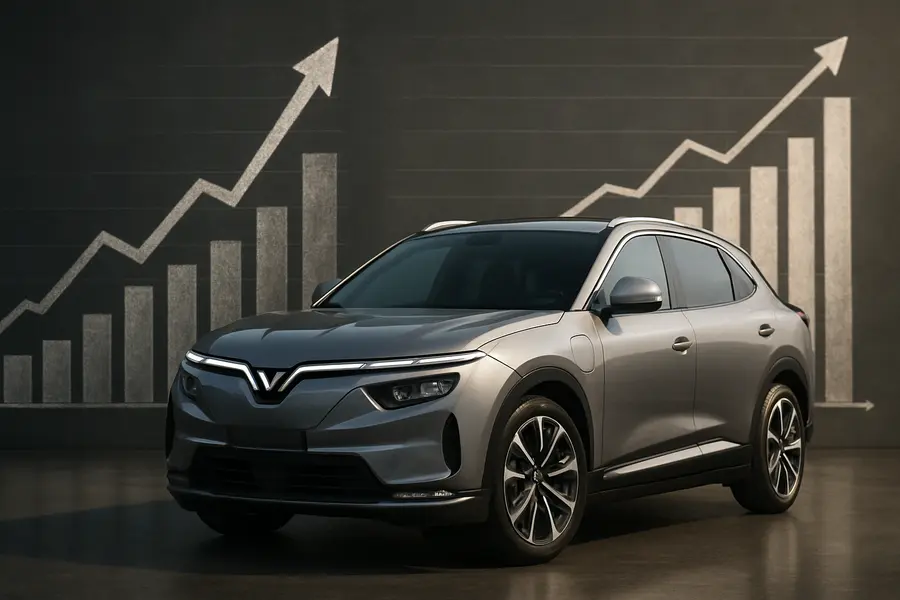
VinFast reported $920.7 million in Q1 2026 revenue, up 42% year-over-year, as EV deliveries jumped 61% to 58,577 units across its expanding global markets.
- VinFast revenue reached $920.7 million in Q1 2026, a 41.7% year-over-year gain, led by Vietnam's 53% EV sales growth.
- Total EV deliveries surged 61% to 58,577 units; e-scooter and e-bike volumes soared 219% to 143,136 units.
- VinFast holds the #1 BEV brand position in the Philippines and has led Vietnam's automotive market for more than 16 consecutive months.
Lead
VinFast Auto (NASDAQ: VFS) reported first-quarter 2026 revenue of $920.7 million — a 41.7% increase from the year-earlier period — as the Vietnamese electric vehicle maker extended its footprint across Southeast Asia, South Asia, and North America. Total electric vehicle deliveries climbed 61% year-over-year to 58,577 units, underscoring accelerating consumer adoption despite a net loss of $1.12 billion for the quarter.What Happened
Global VinFast revenue for the three months ended March 2026 reached VND 23,111.1 billion (US$920.7 million), with vehicle sales accounting for $862.5 million of that figure. The 42% revenue surge reflects both stronger unit volumes and an expanded product lineup anchored by the Limo Green and VF 3 models, which ranked as the company's top sellers with 12,693 and 11,088 units delivered, respectively.
In Vietnam — the company's largest market — EV market growth remained robust, with VinFast deliveries rising 53% year-over-year. The company has held the #1 position among all original equipment manufacturers in Vietnam for more than 16 consecutive months. International markets, while still representing approximately 8% of total deliveries, continue to advance: VinFast ranked #1 in battery-electric vehicles in the Philippines, #4 in India, and #8 in Indonesia.
E-scooter and e-bike deliveries surged 219% year-over-year to 143,136 units, signaling a broadening of the company's electric mobility strategy well beyond four-wheel passenger vehicles.
Financial Position
Despite the top-line momentum, VinFast's cost structure remains under pressure. A gross loss of $677.4 million produced a gross margin of negative 73.6%, driven in part by the launch of a free-charging program in February 2026 and inventory write-downs. The operating loss stood at $910.7 million, while the net loss widened to $1.12 billion — or $0.48 per share. Cash and equivalents at quarter-end stood at $219.3 million against a total interest-bearing debt load of VND 84,718.1 billion, underscoring the heavy financing demands of VinFast's rapid global buildout.
Market Reaction
VinFast stock (VFS) traded between $2.78 and $5.29 over the past 52 weeks, briefly reaching the upper end of that range in April 2026 following the delivery beat before retracing to approximately $3.21 by early June. The company's market capitalization stands near $9.8 billion. Year-to-date, shares have gained roughly 26%, reflecting investor optimism around the delivery trajectory and the 2026 target of at least 300,000 electric vehicle deliveries.Strategic Context
VinFast operates 447 showrooms worldwide and is expanding its service infrastructure to more than 1,100 workshops across North America, Europe, the Middle East, and Asia by year-end. On the product side, the next-generation VF 8 SUV is scheduled for its first deliveries in late July 2026, while the ultra-luxury Lac Hong 800S and Lac Hong 900S were unveiled in March, extending the brand into the premium segment. A strategic collaboration with NVIDIA and Autobrains for autonomous vehicle development in Southeast Asia adds a technology differentiation layer to the longer-term product roadmap.Management has framed the current period as one of disciplined execution. The company targets gross-profit breakeven by late 2027 and EBITDA profitability by 2028 — timelines that require sustained per-unit cost reductions alongside continued volume growth.
Outlook
VinFast enters the second half of 2026 with clear top-line momentum — VinFast revenue up 42%, deliveries up 61% — but a cost curve that has not yet inflected. The path to profitability runs through volume scale, manufacturing automation, and platform rationalization, with the 300,000-unit annual delivery target serving as the key near-term benchmark. Progress in India, Indonesia, and North America, alongside the VF 8 refresh, will determine whether EV market growth can be matched by structural margin improvement through year-end.
Earnings