Pomegra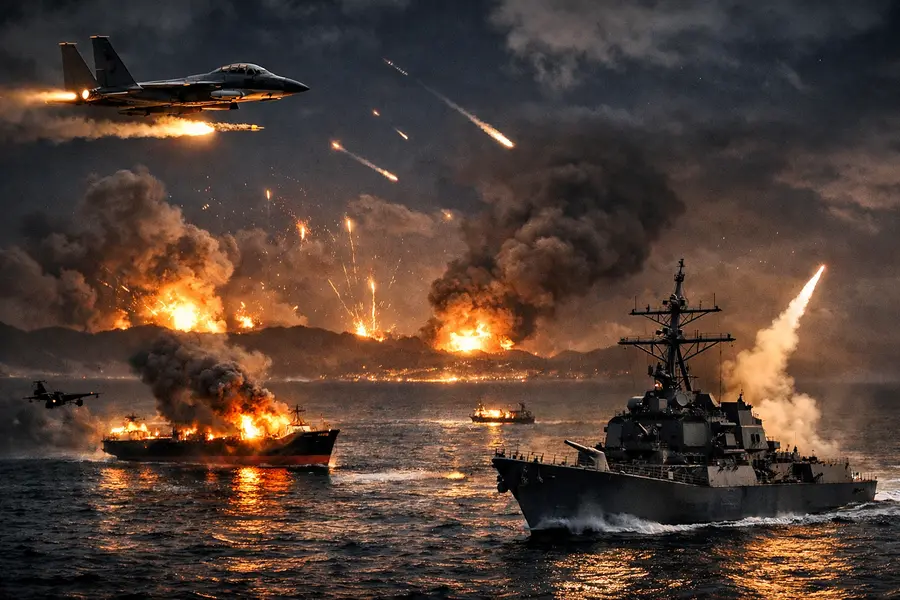
US Central Command completed a twelfth consecutive night of strikes against Iranian military targets on July 22, 2026, as the conflict spread to Red Sea shipping lanes and Strait of Hormuz transit collapsed, pushing Brent crude to its highest level since late June.
- CENTCOM has struck Iranian command centers, air-defense systems, and coastal radar for 12 straight nights since July 11.
- Brent crude reached $78.82/barrel on renewed fighting; Iran-backed Houthis declared a naval blockade on Saudi Arabia July 20.
- A June 2026 peace memorandum is now effectively suspended, with Qatar- and Pakistan-led mediation stalled.
What Happened
US Central Command confirmed the completion of its twelfth straight night of strikes against Iran in the early hours of July 23, 2026, targeting missile and drone launch facilities, coastal radar installations, and command-and-control nodes operated by the Islamic Revolutionary Guard Corps. The campaign, which began July 11 following an Iranian drone strike on a cargo vessel in the Strait of Hormuz, has systematically degraded Iranian maritime and air-defense capabilities along the country's southern coast.The CENTCOM strikes Iran operation represents the most sustained American combat campaign against the Islamic Republic since the countries' hostilities escalated in early July. Four US service members have been killed in action since July 7, with nearly 100 personnel sustaining injuries — 96 percent of whom have returned to duty, according to Pentagon figures. Iranian state media reports at least 50 Iranian fatalities from the strikes.
The US retaliatory strikes began after Iran violated a June 2026 Memorandum of Understanding — intended to formalize a fragile ceasefire — by targeting commercial shipping in the Strait of Hormuz within weeks of signing.
Red Sea Conflict Expands
The Middle East military escalation has entered a new phase with Iran-backed Houthi forces in Yemen resuming attacks on commercial vessels in the Red Sea and declaring a complete naval blockade on Saudi Arabia on July 20. The declaration, coordinated with Tehran's military posture, threatens to choke roughly 12 percent of global seaborne trade that transits the region.
Major container carriers — including Maersk, MSC, CMA CGM, and Hapag-Lloyd — have suspended Strait of Hormuz transits entirely and are rerouting cargo around Africa's Cape of Good Hope, adding 10 to 14 days to voyage times and significantly increasing freight costs. Port operations at Kuwait's Shuaiba facility and Bahrain's Khalifa Bin Salman Port have been suspended. Qatar temporarily halted all maritime navigation as a precautionary measure.
The Strait of Hormuz, through which approximately 20 percent of global oil flows daily, has been effectively closed since within 48 hours of the strikes' onset — a maritime chokepoint disruption without modern precedent in scale or duration.
Market Reaction
Brent crude futures for September delivery surged to $78.82 per barrel on July 22, the highest level since June 22, as the twelfth night of strikes erased a partial diplomatic recovery. Prices gained more than 3 percent in a single session. West Texas Intermediate traded at $72.08 per barrel. Iranian officials have threatened scenarios that could push oil to $200 per barrel if the Strait of Hormuz remains fully blockaded, a level that would represent a structural shock to global energy markets. Defense and energy sector equities have rallied throughout the campaign. Shipping stocks and insurance premiums for vessels transiting the Persian Gulf and Red Sea corridors have climbed sharply, reflecting elevated war-risk pricing from underwriters.Diplomatic Context
The US Iran war news cycle has been shaped as much by diplomatic failure as by military action. A Memorandum of Understanding signed in June 2026 — brokered with the involvement of Qatari and Pakistani intermediaries — was intended to expand a ceasefire and create a pathway to formal negotiations. Iran has declared the agreement effectively suspended, accusing Washington of striking what Tehran characterizes as critical civilian infrastructure.
Tehran has characterized the US strikes as violations of the June MoU's terms and has pointed to damage at agricultural facilities as evidence of targeting civilian infrastructure — a claim CENTCOM disputes, saying all strikes are directed at military assets.
Strategic Context
The geography of the Middle East military escalation places three of the world's most critical energy transit points — the Strait of Hormuz, the Bab el-Mandeb Strait, and the Suez Canal approach — simultaneously under threat. The combination of IRGC maritime pressure in the Strait and Houthi interdiction in the Red Sea creates a dual-front shipping crisis not seen since the 1980s Tanker War.
Iran's strategic calculus involves using maritime chokepoints and proxy forces to impose economic costs on the United States and its Gulf partners without triggering a ground invasion scenario. Washington's campaign, now in its second week, has focused on degrading Iran's ability to sustain those maritime and aerial operations rather than striking population centers or regime leadership.Regional powers — including Saudi Arabia, the UAE, and Israel — have maintained public positions of cautious support for the US campaign while privately expressing concern about the pace of escalation and its impact on Gulf infrastructure and long-term stability.
Outlook
Twelve nights of CENTCOM strikes Iran have significantly degraded Iranian coastal and air-defense infrastructure but have not compelled Tehran to return to negotiations on US terms. The closure of the Strait of Hormuz is now the dominant variable for global energy markets, with Brent crude pricing in sustained disruption. The Houthi naval blockade declaration against Saudi Arabia represents a widening of the conflict that increases the cost of a diplomatic resolution.
Near-term scenarios hinge on whether Qatar and Pakistan mediation can reopen a backchannel before Iranian retaliation escalates to Gulf partner territory or US naval assets. Absent diplomatic re-engagement, market consensus anticipates continued oil price elevation, sustained shipping rerouting around Africa, and further US retaliatory strikes targeting Iranian military capacity through late July.
Mentioned tickers: BNO, USO, MAERSK, HLAG, CMA, XOM, CVX, LMT, RTX, NOC