Pomegra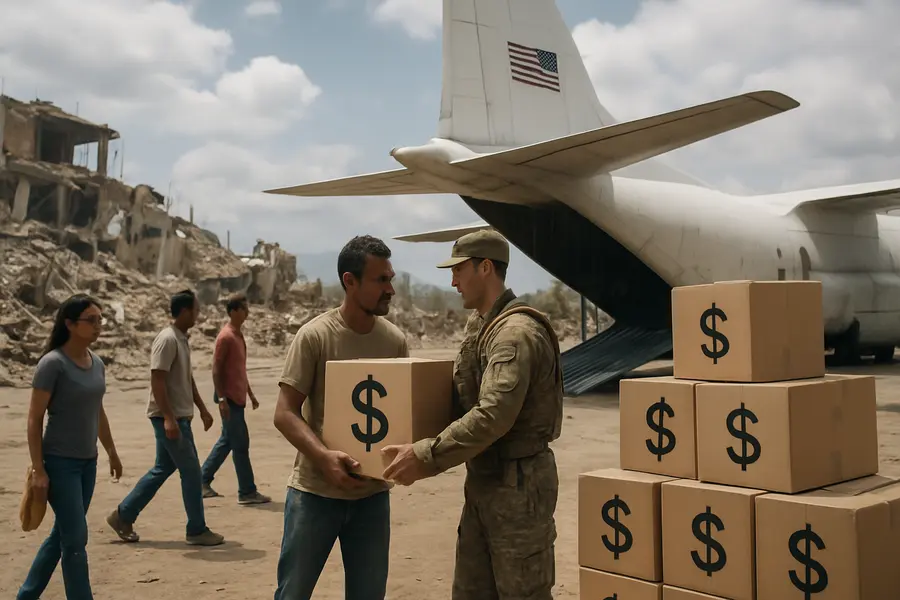
A magnitude-7.5 earthquake — Venezuela's deadliest in over a century — has killed more than 1,400 people, forcing the United States to mount its largest Latin American humanitarian response in years amid deepening South American instability.
- Twin earthquakes struck Venezuela on June 24, 2026, with the 7.5-magnitude mainshock strongest since 1900; death toll exceeds 1,400 with 50,000+ missing.
- The US has pledged $150 million in aid and deployed warships, transport aircraft, and 150 search-and-rescue personnel to Venezuela.
- Economic losses are projected to reach between $10 billion and $100 billion — up to 7% of Venezuela's already-shattered $111 billion GDP.
Lead
Two powerful earthquakes struck Venezuela's northern coast on June 24, 2026, killing more than 1,400 people and injuring at least 4,500 in the worst seismic event the country has recorded since 1900. The first shock registered magnitude 7.2; a second, larger event measuring 7.5 followed just 39 seconds later, collapsing buildings across Caracas and the coastal state of La Guaira. As rescuers worked through rubble sheltering an estimated 50,000 still-missing persons, the United States mounted a rapid humanitarian response — pledging $150 million and deploying naval assets — in a signal of the deepened diplomatic ties that followed the political upheaval of January 2026.
What Happened
The back-to-back quakes — a seismic sequence seismologists have called a "double tap" — struck at 18:04 local time, with the epicenter located offshore to the northwest of Caracas. The United States Geological Survey classified the event as Venezuela's strongest since the 1900 San Narciso earthquake and issued a PAGER alert warning that total economic damage could ultimately surpass $100 billion.
More than 383 buildings sustained major structural damage, along with 13 hospitals, 25 commercial centers, and 1,002 other structures. Landslides and liquefaction compounded destruction in mountainous zones between the capital and the coast. A magnitude-4.9 aftershock struck two days later, impeding ongoing rescue operations and shaking an already traumatized population.
Acting President Delcy Rodríguez declared a national state of emergency within hours and requested immediate international assistance. Rodríguez, who assumed executive authority following the removal of Nicolás Maduro in a US military operation in January 2026, said a $200 million reconstruction fund from the International Monetary Fund would be directed toward hospitals, housing, and infrastructure.US Aid Response
Washington described its response as a "whole-of-government" mobilization. The State Department committed $150 million — channeled through faith-based organizations including Samaritan's Purse and Catholic Relief Services, as well as through the World Food Programme and the UN Office for the Coordination of Humanitarian Affairs.
US Southern Command surged naval assets including the amphibious transport ship USS Fort Lauderdale and the littoral combat ship USS Billings, alongside C-17 Globemaster and C-130 Hercules transport aircraft. Two Disaster Assistance Response Teams were deployed from Virginia and California — 150 personnel in total, supported by 12 search-and-rescue dogs.The scale of US aid to Venezuela marks a stark shift from the bilateral estrangement of recent years. Washington and Caracas restored formal diplomatic relations in February 2026, reopening the US Embassy in Caracas for the first time since 2019. The Trump administration simultaneously lifted key oil-sector sanctions, allowing international companies to resume Venezuelan crude transactions.
Geopolitical Dimension
The earthquake arrives at a moment of accelerating South American instability. Venezuela's institutional capacity was already critically degraded before June 24: GDP contracted by approximately 80% between 2013 and 2025, public hospitals lacked basic supplies, and millions of citizens lived in structurally compromised housing stock — factors that directly amplified the earthquake's human toll.
The humanitarian news has also revived a contested debate over US sanctions policy. Existing restrictions complicate the flow of international funds and goods even for disaster relief, and advocacy groups have renewed calls for a full sanctions suspension. The US Center for Economic and Policy Research noted that financial curbs imposed prior to the January transition remain partially in force, creating logistical friction for relief organizations attempting to move money and equipment into the country.
Multiple regional governments moved quickly to fill gaps. Brazil dispatched a mobile field hospital and 36 firefighters within 48 hours. Colombia, Mexico, El Salvador, and Cuba sent search-and-rescue personnel. The United Nations rapidly deployed teams under its emergency coordination mechanisms. Spain reported five of its nationals killed and 119 missing; citizens from Portugal, Italy, and China were also among the confirmed dead.
The speed and breadth of the international response reflects both the humanitarian urgency and the geopolitical significance of a Venezuelan stabilization. The country controls some of the hemisphere's largest proven oil reserves, and its political condition over the past decade generated an outward migration of more than seven million people — one of the largest displacement crises in modern Latin American history.
Economic Losses Mount
USGS preliminary modeling places probable economic losses in a range of $10 billion to $100 billion, against a baseline GDP estimated at $111 billion. The wide range reflects uncertainty about structural quality across Venezuela's urban building stock, where enforcement of seismic codes had effectively collapsed alongside other state functions.
The IMF's $200 million commitment represents a starting point for reconstruction rather than a comprehensive package. Long-term rebuilding timelines will depend heavily on Venezuela's capacity to attract foreign investment and international financing — which in turn hinges on the new government's ability to consolidate political legitimacy and demonstrate institutional reliability.
Outlook
The immediate humanitarian crisis in Venezuela will keep international attention focused on the country's northern coast for weeks to come, as rescue operations transition to relief distribution and early-stage reconstruction planning. The death toll, which rose past 1,400 as of June 27, is likely to climb further given the scale of reported missing persons. The US aid to Venezuela — unprecedented in scope and speed given the diplomatic backdrop — signals that Washington intends to treat the post-Maduro government as a functional partner, but the longer trajectory of that relationship will depend on whether Caracas can manage a reconstruction effort without the institutional infrastructure that years of South American instability and economic collapse have stripped away.