Pomegra
Ukrainian drones set fire to oil tanks at Russia's Ust-Luga port and hit a missile boat, lifting palladium 4.7% as Russian refining capacity falls about 30%.
- Drones ignited storage tanks at the Novatek-Ust-Luga terminal on the Baltic and struck a Buyan-M class missile boat.
- Ukrainian strikes since late October have cut Russian refining capacity by about 30%.
- Palladium rose about 4.7% on the risk to Russian metal supply.
Lead
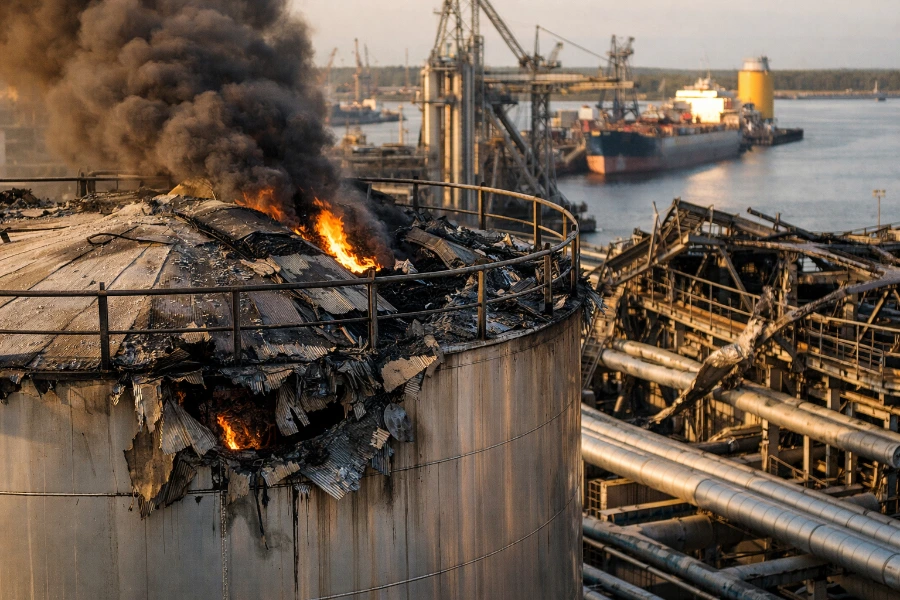
Ukrainian drones struck the Ust-Luga port in Russia's Leningrad region this week, setting fire to petroleum storage tanks and hitting a missile boat. Ust-Luga is the country's main Baltic export outlet for crude, fuels, coal, fertilizer and grain. The attack came as Kyiv's renewed campaign against Russian energy infrastructure has taken out roughly 30% of the country's refining capacity. Palladium jumped about 4.7% as traders priced in the risk to supply of a metal Russia dominates.
What Happened at Ust-Luga?
Drones hit several storage tanks, each with a capacity of about 30,000 tons, at the Novatek-Ust-Luga terminal, and a large fire broke out. Three workers were injured. Ukraine's General Staff confirmed the strike on the port.
Ukraine's Security Service also said the attack hit the Naro-Fominsk, a Buyan-M class missile boat armed with Onyx and Kalibr missiles. Kalibr cruise missiles are used in Russian strikes on Ukrainian cities and infrastructure. A hit on a vessel carrying them extends the operation beyond economic targets into Russia's naval strike capability in the Baltic.
Ust-Luga has been targeted repeatedly this year. The port handles volumes that Russia cannot easily reroute, which makes it one of the most exposed nodes in the export system.
How Much Refining Capacity Has Russia Lost?
Russia has lost about 30% of its refining capacity since drone attacks resumed in late October. The facilities affected have a combined processing capacity of roughly 300,000 metric tons a day, or about 2.2 million barrels. Russia's total primary refining capacity is about 930,000 tons a day.
Actual crude processing has fallen by about 200,000 tons a day, to roughly 700,000 tons a day. Capacity offline is not the same as output lost, because remaining plants can run harder and some units restart after repairs. The cumulative effect is still a tighter domestic fuel balance and less refined product available for export.
Why Did Palladium Jump 4.7%?
Palladium rose about 4.7% because Russia is one of the world's largest producers, with roughly 40% of mined supply, and the market is already tight. Nornickel (MOEX: GMKN), the dominant Russian producer, ships through logistics chains that depend on Russian ports and rail. Any escalation that threatens those chains raises the risk of interruptions or tighter sanctions enforcement.
The move shows how a war that has mostly been priced through oil and gas now reaches industrial metals. Palladium is used mainly in catalytic converters for gasoline vehicles, so supply scares pass quickly into automaker costs.
Energy Market Dimension
The crude oil price reaction has been restrained. Brent has traded in the low $90s a barrel, with a modest risk premium. Global crude supply is ample, and the Russian disruption falls mainly on refined products such as diesel and gasoline rather than on crude itself.
Strikes on refineries cut Russia's ability to turn crude into higher-value fuels. Crude that cannot be refined at home must be exported, which can pressure Russian crude discounts while tightening product markets in the regions that rely on Russian diesel. Strikes on export terminals such as Ust-Luga work the other way and constrain the physical volumes that can leave the country.
Strategic Context
Ukraine's approach has shifted toward the revenue base that funds the Russian war effort. Refineries, terminals and ports generate export income and supply the military. Hitting them forces Moscow to divert air defenses to the Baltic and the interior, areas that were once considered remote from the front.
The Baltic location raises the stakes for neighboring NATO states, which share the sea and its shipping lanes. Fires at a major terminal on that coast carry environmental and security implications beyond Russia's borders.
What Comes Next for Oil and Metals Markets?
Near-term price direction depends on how quickly Russia repairs refineries and restores terminal operations at Ust-Luga. If the damage proves short-lived, the palladium rally may fade, as past supply scares have. If strikes continue at the current tempo through the winter heating and driving seasons, domestic fuel shortages in Russia and tighter diesel markets abroad become more likely.
Russia's response will also matter. Retaliation against Ukrainian energy infrastructure, air defense reinforcement around Baltic ports and any rerouting of exports toward Black Sea and Pacific outlets will shape the three-to-twelve-month picture.
Outlook
The Ust-Luga attack combines a blow to Russia's export infrastructure with a hit on its naval strike capacity. With about 30% of refining capacity offline, Russia's energy system is under its heaviest pressure of the war. Palladium's 4.7% jump signals that markets are starting to price the conflict's effect on commodities beyond oil.
Mentioned tickers: GMKN, NVTK