Pomegra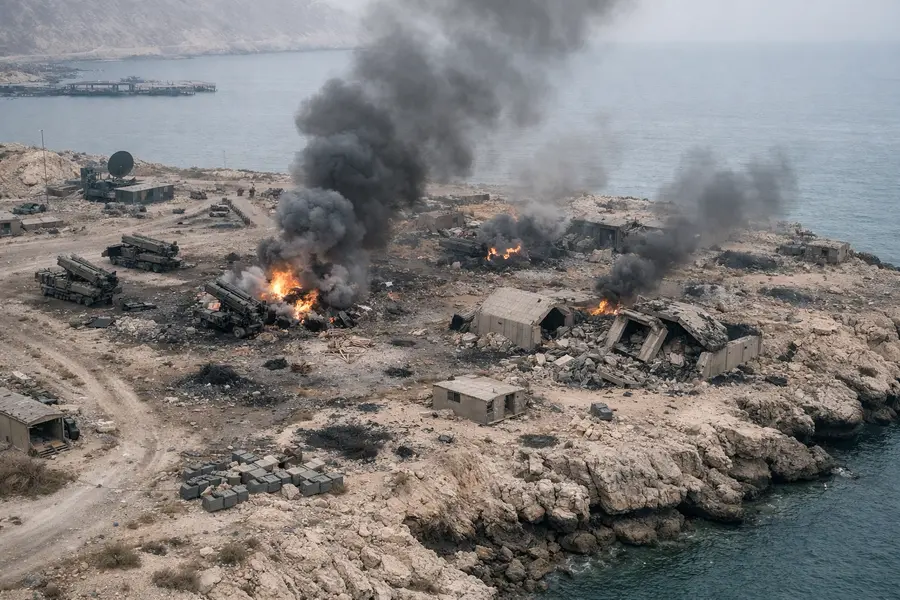
CENTCOM confirmed Sunday-night airstrikes destroyed Iranian rocket launchers on Larak Island before sea-mine-equipped missiles could enter the Strait of Hormuz, pushing Brent crude up 1.5%.
- CENTCOM confirmed U.S. forces destroyed IRGC rocket-launcher positions on Larak Island late Sunday, pre-empting a sea-mine attack on Hormuz tanker lanes.
- Brent crude jumped 1.5% to $89.46/barrel at Monday's open, its sharpest single-session gain in three months, on supply-disruption fears.
- Iran issued a formal retaliation warning, raising escalation risk across a chokepoint handling roughly 20% of globally traded oil.
Lead
U.S. Central Command confirmed on Monday that American forces struck Islamic Revolutionary Guard Corps (IRGC) rocket-launcher positions on Larak Island in the southern Persian Gulf late Sunday, destroying equipment configured to fire sea-mine-laden rockets into the Strait of Hormuz. The strikes sent Brent crude surging 1.5% to $89.46 per barrel at Monday's open as shipping operators began rerouting tanker traffic away from the narrow waterway. Iran's government issued a formal retaliation warning within hours, keeping risk premiums elevated across energy and freight markets heading into the trading week.
What Triggered the Strikes?
CENTCOM stated that U.S. intelligence detected IRGC units staging rocket-launch equipment on Larak Island with "imminent deployment indicators" -- specifically, the positioning of rockets carrying sea-mine payloads capable of targeting tanker traffic transiting the strait. Larak Island sits at the eastern mouth of the Strait of Hormuz, less than 30 kilometers from the deep-water shipping channel, and has served for decades as a forward operating base for IRGC naval assets including fast-attack craft, coastal-defense missiles, and drone infrastructure. The Sunday-night operation destroyed launcher batteries and associated command nodes. Pentagon officials described the action as "pre-emptive and limited," framing it as a defense of freedom of navigation under international maritime law.
Why Did Crude Oil Price Marketwatch Data Show an Immediate Spike?
The crude oil price reaction was instant because the Strait of Hormuz is the world's single most critical maritime energy chokepoint: roughly 17-21 million barrels of crude oil, petroleum products, and liquefied natural gas transit the strait daily. Even a partial disruption lasting days would ripple across refined-product supply chains in Europe, Asia, and North America. ExxonMobil (XOM) and Chevron (CVX) each posted pre-market gains of 0.8%-1.2% as higher crude lifted expected realizations, while Shell (SHEL) followed suit. Tanker operators faced a more complex calculus: Frontline (FRO) and Scorpio Tankers (STNG) advanced on expectations that re-routing via the Cape of Good Hope would tighten effective vessel supply and lift day rates, even as war-risk insurance premiums on Hormuz-adjacent voyages surged, compressing voyage economics.
Iran's Retaliation Warning
Iran's government issued a statement within hours of the CENTCOM announcement, vowing "a response proportionate to the aggression" and warning that "all options remain open" in the Persian Gulf. The IRGC has historically responded to foreign strikes through a combination of direct military action, proxy operations, and economic pressure via shipping disruptions. The 2019-2020 Hormuz crisis -- encompassing tanker seizures, mine attacks, and drone strikes on Saudi oil infrastructure -- temporarily removed roughly 5% of global oil supply from markets at its peak. The U.S. Navy's Fifth Fleet, headquartered in Bahrain, has reportedly repositioned additional assets into the region. Gulf Cooperation Council (GCC) member states issued measured public statements while privately consulting Washington.
Strategic Context: Why Larak Island Matters
Larak Island's position makes it one of Iran's most consequential forward military outposts. Striking it marks a significant escalation beyond the drone engagements and proxy confrontations that have characterized recent U.S.-Iran friction -- representing a direct strike on Iranian territory rather than allied assets or intermediary forces, a threshold not crossed since the January 2020 operation that killed IRGC Quds Force commander Qasem Soleimani. That precedent produced sharp short-term oil market volatility before diplomatic de-escalation contained further damage. The current action signals Washington's readiness to strike Iranian military infrastructure directly when it perceives imminent threat to international shipping -- a posture with significant implications for Tehran's calculus on future Hormuz operations.
What Comes Next for Oil Prices?
The trajectory of Brent crude over coming sessions depends almost entirely on Tehran's next move. If Iran confines its response to diplomatic channels and low-intensity naval harassment, markets may retrace 40%-60% of Monday's gains within five to seven sessions -- the historical pattern when geopolitical spikes do not produce physical supply loss. However, any confirmed interference with tanker movement -- a seizure, a successful mine detonation, or a rocket strike on a vessel -- would remove the ceiling from crude prices and trigger emergency consultations among International Energy Agency (IEA) member states on strategic petroleum reserve releases. The U.S. Energy Information Administration (EIA) reported global above-ground crude inventories near five-year lows entering August, leaving markets with limited buffer against a sustained supply shock.
Outlook
The Larak Island airstrikes represent the most direct U.S. military action on Iranian soil in six years, resetting near-term risk pricing across energy markets, Gulf shipping, and regional security frameworks. Brent crude's 1.5% move to $89.46/barrel reflects an initial risk premium that markets will revise sharply in either direction based on Iran's response and the physical status of Hormuz transit over the next 72 hours. Sustained crude above $90/barrel would inject fresh inflation pressure at a moment when major central banks have only recently paused rate cycles. For freight markets, tanker operators face a bifurcated outlook: surging day rates on re-routing demand offset by materially higher operating costs. The situation remains acutely fluid.
Mentioned tickers: XOM, CVX, SHEL, FRO, STNG