Pomegra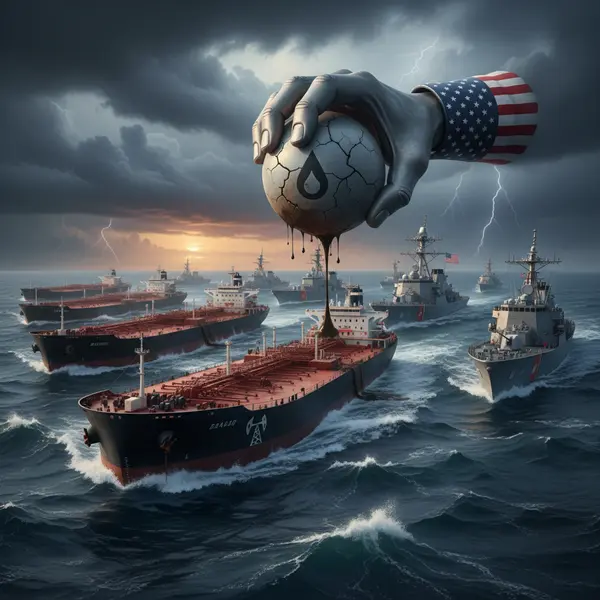
The White House's Operation Southern Spear has seized at least seven sanctioned oil tankers linked to Venezuela since December 2025, straining global oil supply chains and escalating geopolitical tensions with China and Russia.
- The U.S. enacted a quarantine of sanctioned Venezuelan oil tankers on Dec. 17, 2025, under Operation Southern Spear.
- At least seven vessels have been boarded and seized; ~75 tankers remain idled off Venezuela's coast holding 11 million barrels.
- Venezuela's oil exports fell to 19 million barrels in December 2025, down from 27.2 million in November.
Lead
Washington deployed elite maritime interdiction forces to the Caribbean beginning December 10, 2025, seizing the sanctioned tanker Skipper in the first of at least seven oil tanker seizures carried out under Operation Southern Spear. The White House formally announced a quarantine of all sanctioned oil tankers traveling to and from Venezuela on December 17, 2025, backed by the USS Gerald R. Ford carrier strike group. The action has paralyzed Venezuelan crude exports, stranded roughly 11 million barrels in Venezuelan waters, and injected a risk premium into global oil supply markets stretching from the Caribbean to the South Atlantic to the Arctic edge of Iceland.
What Happened
The first interdiction began at approximately 6 a.m. on December 10 when two helicopters launched from the USS Gerald R. Ford, inserting a ten-member Coast Guard Maritime Security and Response Team alongside Marines and special operations personnel onto the deck of the Skipper — a Guyanese-flagged vessel previously known as Adisa and sanctioned by the U.S. Treasury.
Subsequent operations expanded the geographic scope dramatically. On January 7, 2026, U.S. forces boarded the Russian-flagged tanker Marinera (formerly Bella 1) in the North Atlantic near Iceland and simultaneously seized the Panama-flagged M Sophia in the Caribbean. By January 21, the count had reached seven vessels, with operations stretching across multiple ocean zones and targeting ships flying false flags of nations including Timor-Leste.
The seizure of the Skipper drew immediate attention when Attorney General Pam Bondi posted footage showing operatives fast-roping from helicopters to the tanker's deck, weapons drawn — a visual declaration of intent that circulated widely in energy and diplomatic circles.
Geopolitical Dimension
The geopolitical oil impact of the blockade extends well beyond Venezuela's borders. China purchases an estimated 76% of Venezuela's crude output, making Beijing the primary economic target of the interdictions. Chinese officials formally condemned the seizures as a violation of international law — a position aligned with Russia, whose foreign ministry described the capture of the Marinera as a "gross violation" of international maritime norms and demanded the immediate release of the crew.
The United Nations Office of the High Commissioner for Human Rights added its voice, stating that Washington's quarantine violated "fundamental rules of international law." Venezuela under Nicolás Maduro — who was captured by U.S. forces on January 3, 2026, in what the Pentagon designated Operation Absolute Resolve — had already passed emergency "anti-piracy" legislation in late December 2025 to criminalize support for the seizures, a move that carried no practical enforcement weight but underscored the political severity of Caracas's response.
The operation also lands within the broader friction over the Panama Canal, as the seizure of Panama-flagged vessels amplifies existing U.S.-China-Panama Canal tensions that had been building throughout late 2025.
Oil Market and Supply Impact
Despite the scale of the interdiction campaign, the immediate impact on global oil supply benchmarks has been contained. Brent crude futures stood at $60.99 per barrel on January 3, 2026 — a modest uptick rather than the sharp move that a full supply shock would normally produce. Analysts point to an oversupplied global market, with total world consumption running at approximately 106 million barrels per day, against which Venezuela's roughly 1.1 million barrels per day represents less than 1% of global throughput.
Nonetheless, the structural risks are building. Approximately 75 tankers are currently idled off Venezuela's coast, of which roughly half appear on U.S. sanctions lists. Venezuelan oil exports collapsed to 19 million barrels in December 2025 from 27.2 million in November — a 30% decline in a single month. If storage constraints force Venezuelan production shut-ins, analysts estimate the effective loss to global markets could reach 500,000 barrels per day.
A secondary consequence concerns the broader shadow tanker fleet that moves sanctioned oil for both Venezuela and Iran. A reduction in tanker availability off Venezuela could paradoxically benefit Iran by freeing up shadow fleet capacity to service Tehran's exports to China — a dynamic that complicates the White House's calculus around enforcing maximum pressure on both sanctioned producers simultaneously.
Strategic Context
Operation Southern Spear represents a significant escalation in the use of maritime interdiction as an economic coercion tool. Historically, the U.S. has relied on secondary sanctions and asset freezes to enforce energy embargoes. Physical seizure of vessels on the high seas introduces a new layer of direct enforcement — and a new set of legal, diplomatic, and commercial risks.
International maritime law, the U.N. Convention on the Law of the Sea, and standard shipping norms all provide frameworks that adversaries are now invoking. Each seizure is being characterized in Beijing and Moscow not as sanctions enforcement but as piracy, a framing designed to build a coalition of nations resistant to U.S. extraterritorial reach.
Within Venezuela, the political situation is in flux following Maduro's capture. Trump met with senior U.S. oil industry executives on January 9, 2026, signaling that additional airstrikes against Venezuelan infrastructure were temporarily suspended, conditioned on the transitional Rodríguez government cooperating on energy exports and regional security.
Outlook
The oil tanker seizure campaign has achieved its immediate tactical objective: Venezuelan crude exports have effectively halted, depriving a revenue-dependent regime of its primary income stream. The White House has demonstrated a willingness to use naval and special operations assets not merely for interdiction but for physical geopolitical oil pressure at sea.
The medium-term variables are the durability of Venezuela's transitional government, the legal and diplomatic counter-campaign being mounted by China and Russia, and whether sustained supply disruption eventually translates into a meaningful shift in global oil supply balances. With OPEC+ maintaining production discipline and U.S. shale output near record highs, the market's current ability to absorb Venezuelan shortfalls provides Washington with a tactical window — one that may narrow if the interdiction campaign broadens to other sanctioned producers.
Mentioned tickers: USO, BNO, XLE, CVX, XOM