Pomegra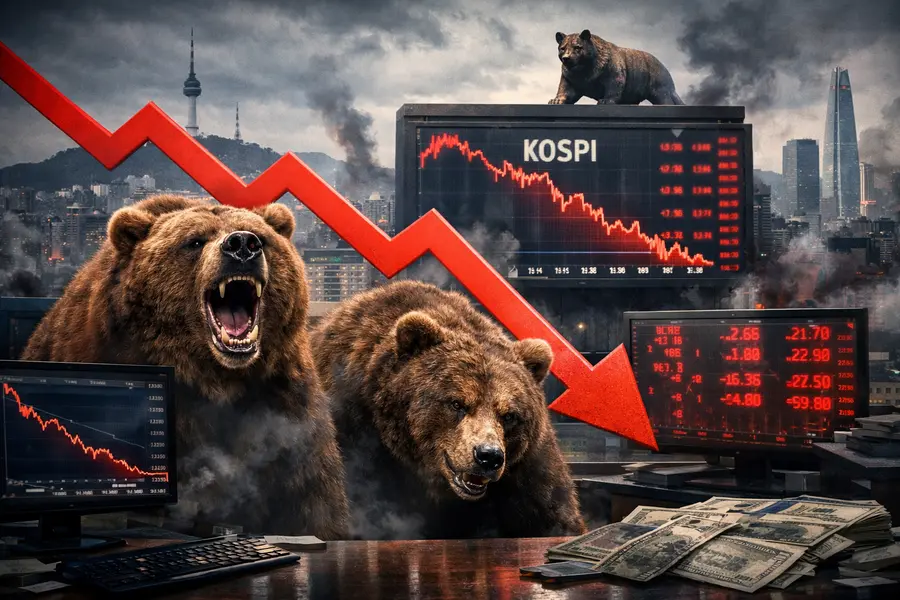
South Korea's Kospi index has shed more than 20% from its June record, wiping hundreds of billions from chipmakers Samsung and SK Hynix as global AI bubble fears escalate.
- The Kospi plunged 9.99% on June 23, triggering a circuit breaker, after hitting a record 9,114.55 the prior session.
- Samsung Electronics and SK Hynix together erased roughly $290 billion in market value during the South Korea AI stock crash.
- Despite entering bear territory, the Kospi remains up approximately 76% year-to-date, reflecting the scale of the preceding AI-driven rally.
Lead
Seoul, July 16 — South Korea's benchmark Kospi index has fallen more than 20% from its all-time high, entering bear market territory in one of the steepest reversals any major equity market has experienced in 2026. What began as a profit-taking episode on June 23 — when the index tumbled 910.71 points, or 9.99%, to close at 8,203.84 and triggered a 20-minute market-wide circuit breaker — has widened into a sustained South Korea AI stock crash as global investors reassess the durability of artificial intelligence demand and the concentration risk embedded in Korean equities.
What Happened
The Kospi reached a record close of 9,114.55 on June 22, capping a rally that had made South Korea the world's best-performing major stock market in 2026, with gains exceeding 120% from January levels. The following session brought a sharp reversal. Foreign investors sold 5.79 trillion won (approximately $3.8 billion) of Korean shares in a single day — an unprecedented single-session outflow — driving Samsung Electronics down 12.3% and SK Hynix down 12.5%.
Subsequent weeks compounded the damage. By early July, the Kospi had shed a further 8% in a single session, with SK Hynix losing nearly 15% and Samsung declining 9.1%, erasing a combined $290 billion in market capitalization between them. On July 16, SK Hynix shed an additional 10.95% and Samsung fell 7.33% as Asian chip stocks declined alongside a fresh overnight slide in U.S. semiconductor equities. The Kospi has now triggered its 37th trading sidecar of 2026 — a statistic that encapsulates the extraordinary volatility gripping the market.
Market Reaction
The South Korea correction rippled through global markets with unusual speed. Japan's Nikkei 225 dropped 3.6% during the initial June selloff, and SoftBank Group fell 15% in a single session. In the United States, the tech-heavy Nasdaq shed 2.21% and the S&P 500 declined 1.44% as semiconductor and AI-adjacent equities came under sustained pressure.
The AI bubble burst narrative gained traction as valuations came under scrutiny. The Shiller cyclically adjusted price-to-earnings ratio for U.S. equities exceeded 40 for the first time since the dot-com era, amplifying concerns that the artificial intelligence-driven rally had outpaced any realistic earnings trajectory. Total projected AI infrastructure spending between 2026 and 2029 stands above $1.6 trillion, including more than $1.1 trillion from U.S. mega-cap technology companies, yet evidence of commensurate revenue generation across the ecosystem remains limited.
Strategic Context
The Kospi index selloff is inseparable from a structural concentration problem that built quietly during the preceding rally. Samsung Electronics and SK Hynix, both dominant producers of high-bandwidth memory (HBM) chips essential to AI training systems, have grown from roughly a quarter of the Kospi's total weighting at end-2025 to nearly half by mid-2026. That concentration amplified gains on the way up and is now amplifying losses on the way down.
The positioning dynamic matters: the Korean AI trade had become, by mid-June, one of the most crowded global equity positions. When sentiment shifted, forced liquidations among international hedge funds and momentum-driven institutional accounts accelerated the move. The correction has been driven more by positioning unwinds than by any deterioration in Samsung's or SK Hynix's underlying order books, which remain supported by sustained HBM demand from U.S. cloud hyperscalers.
AI and Technology Angle
The AI bubble burst framing, while prominent in market commentary, masks a more granular picture at the company level. SK Hynix Chief Executive Kwak Noh-jung reaffirmed during the turbulence that the company will invest 100 trillion won (approximately $64.37 billion) in South Korean semiconductor infrastructure, with construction of the M17 fabrication plant scheduled to begin in 2027 and production targeted for the first half of 2029. That investment commitment signals management conviction that structural demand for advanced memory — particularly HBM3E and next-generation variants — remains intact regardless of near-term equity volatility.
Samsung, meanwhile, faces independent challenges around yield rates on its most advanced HBM products, a factor that has complicated its competitive positioning relative to SK Hynix even as market prices for both stocks have converged in the selloff.
Geopolitical Dimension
South Korea's chip sector sits at the intersection of the U.S.-China technology competition, and trade policy uncertainty has added an additional layer of risk. Export control regimes governing advanced semiconductor equipment and chip architectures have tightened progressively, affecting the addressable market Korean chipmakers can serve. Any further escalation — including restrictions on HBM exports to Chinese AI developers — would constrain revenue diversification at a moment when investor confidence is already fragile.
The Korean won's performance against the U.S. dollar has also introduced a currency dimension for foreign investors, compounding dollar-denominated losses beyond the headline index decline.
What Comes Next
The immediate question for market participants is whether the Kospi's remaining year-to-date gains — still approximately 76% as of mid-July — provide a buffer or a floor. Historical analogues suggest that markets emerging from extreme concentration-driven selloffs tend to stabilize once institutional rebalancing is complete, but the timeline is difficult to predict when the underlying narrative (AI monetization skepticism) remains unresolved.
A partial recovery has already occurred: the Kospi bounced 5% on at least one session following the bear-market designation, and Samsung recovered 7% in a single day after the June 23 crash. However, each subsequent leg lower has undercut those recoveries, suggesting that the South Korea AI stock crash has not yet found a durable technical base.
Outlook
South Korea's equity market faces a transition from a period of extraordinary AI-fueled appreciation to a more volatile consolidation phase defined by elevated concentration risk, global AI spending scrutiny, and geopolitical headwinds around semiconductor trade. The structural case for Samsung and SK Hynix as HBM suppliers to U.S. AI infrastructure projects remains substantively intact, but the valuation premium the market assigned at peak levels has been substantially eroded. The path forward depends on whether corporate earnings in the second half of 2026 can validate the capital expenditure commitments that drove the initial rally.
Mentioned tickers: 005930.KS, 000660.KS, ^KS11, NDX, SPX, N225