Pomegra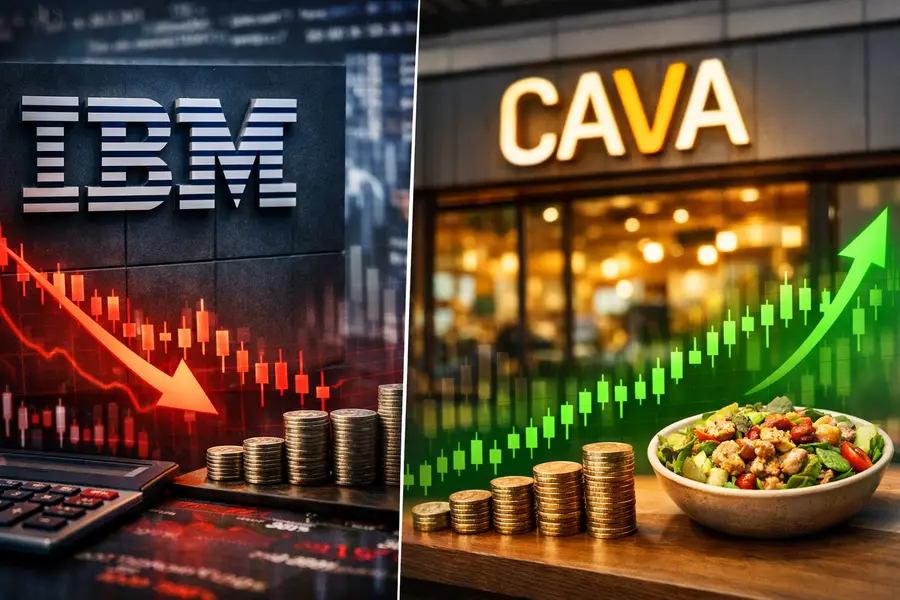
Wall Street's July 15 analyst calls repositioned IBM and Cava Group as opposing signals in a broader rotation away from legacy tech toward high-growth consumer brands.
- IBM stock collapsed 25% — its worst single-day drop on record — after a Q2 revenue miss of $700 million, triggering multiple downgrades.
- Morgan Stanley and UBS upgraded Cava Group to Overweight and Buy, respectively, citing durable traffic growth and margin visibility.
- The IBM downgrade and Cava stock upgrade on the same session illustrated a sharpening divergence between legacy tech and consumer discretionary growth stories.
Lead
A wave of Wall Street analyst calls on July 15 crystallized a sector divide that has been building through the summer. IBM (IBM) suffered its worst single-session decline on record — a 25% collapse — after reporting second-quarter revenue of $17.2 billion, roughly $700 million below the consensus estimate of $17.86 billion. Adjusted earnings per share of $2.93 also fell short of the $3.02 expected. Within hours, HSBC cut its rating on IBM from Hold to Reduce, slashing its price target to $191 from $231. On the opposite end of the day's ledger, Morgan Stanley upgraded Cava Group (CAVA) from Equalweight to Overweight — with UBS following the same direction, moving from Neutral to Buy — sending shares of the Mediterranean fast-casual chain 3% higher.
What Happened
IBM's revenue shortfall carried a pointed explanation: the company's chief executive noted that enterprise clients were pulling back on IBM software and infrastructure spending in order to redirect capital toward building proprietary AI hardware. That disclosure put the market on notice that the wave of AI investment reshaping corporate budgets is not flowing uniformly to established enterprise vendors — some of it is bypassing them entirely.
HSBC's downgrade to Reduce on July 15 reinforced concerns that had been accumulating. The firm cited IBM's stretched valuation — at 22.0 times calendar year 2027 non-GAAP earnings, versus a sector median of 16.9 times — against an expected earnings-per-share compound annual growth rate of just 10.7% through 2028, well below the sector median of 19.2%. Oppenheimer also downgraded IBM following the earnings miss, adding institutional weight to the bearish pivot. BofA Securities held its Buy rating but trimmed its price target to $280 from $330 and cut its 2026 revenue forecast to $69.6 billion.
The Cava moves arrived in sharper contrast. Morgan Stanley analyst Brian Harbour lifted his rating, acknowledging that while Cava "is not a cheap stock," a period of share price weakness had created an entry point justified by the chain's underlying performance metrics. The firm raised its price target to $90 from $86. UBS followed with its own upgrade to Buy at a $90 target, up from $85, citing strong same-store sales data and unit growth momentum validated through proprietary consumer research.
Market Reaction
IBM's 25% single-day decline was historic by any measure — the steepest the company had recorded. Trading volumes surged as institutional holders reassessed positions built on the thesis that IBM's hybrid cloud and AI consulting franchises would capture enterprise AI infrastructure spend. The earnings miss invalidated a central assumption of that thesis: that legacy enterprise vendors would be natural beneficiaries of the AI buildout rather than potential casualties of client insourcing.
Cava's 3% gain was more measured but notable given a broader market environment that remained cautious. The stock's resilience on a day when tech vs consumer discretionary dynamics dominated analyst commentary underscored a growing investor preference for companies with tangible consumer demand drivers over those reliant on enterprise IT budget cycles.
Strategic Context
The July 15 IBM stock downgrade arrived at a moment when the artificial intelligence trade is undergoing visible stress testing. Capital has been rotating away from high-valuation technology stocks throughout the summer, with the VanEck Semiconductor ETF logging a 5.1% single-session decline earlier in July and mega-cap technology names broadly under pressure from stretched multiples and concerns about AI infrastructure overcapacity.
IBM's predicament illustrates a specific sub-risk within the AI theme: the enterprise vendor squeeze. As large corporates build internal AI capabilities — standing up their own data centers, training proprietary models, and deploying custom inference infrastructure — the demand signal for third-party software and managed services providers weakens. IBM, positioned as a hybrid cloud and AI services partner to Fortune 500 clients, faces this pressure directly.
Cava Group, by contrast, operates in an entirely different demand regime. Its growth is driven by unit expansion, traffic gains at existing locations, and a value-versus-premium positioning that has demonstrated resilience across shifting consumer sentiment readings. Morgan Stanley's upgrade explicitly identified strong key performance indicators — including new store performance and margin visibility — as factors that justify the multiple even at current price levels. The Cava stock upgrade from two major Wall Street firms in a single session signals confidence that the company's fundamentals remain intact regardless of macro headwinds.Geopolitical and Macro Dimension
Broader capital allocation trends are amplifying the sector divergence. The rotation away from the technology complex that has dominated markets since late 2023 is now reaching into the enterprise software layer — not just semiconductors and hardware. Macro pressure on corporate IT budgets, particularly in markets where clients are reassessing vendor relationships in light of geopolitical supply chain considerations, compounds the fundamental challenge for legacy tech vendors.
Consumer-facing businesses like Cava, by contrast, are less exposed to these cross-border capital and technology policy dynamics. Their growth math centers on domestic unit economics and brand penetration, insulating them from the enterprise spending recalibration underway across the technology sector.
Outlook
The July 15 Wall Street analyst calls on IBM and Cava represent more than stock-specific calls — they mark a visible articulation of a sector preference shift. IBM faces a multi-quarter challenge in demonstrating that its AI strategy can offset the client insourcing trend the company's own management identified. Further earnings guidance revisions remain the near-term risk. Cava enters the second half of the year with analyst consensus shifting constructively, supported by operational metrics that have thus far held through a cautious consumer environment. The divergence between legacy enterprise tech stocks and consumer growth names with proven unit economics is likely to remain a defining market narrative through the balance of 2026.
Mentioned tickers: IBM, CAVA, XLY