Pomegra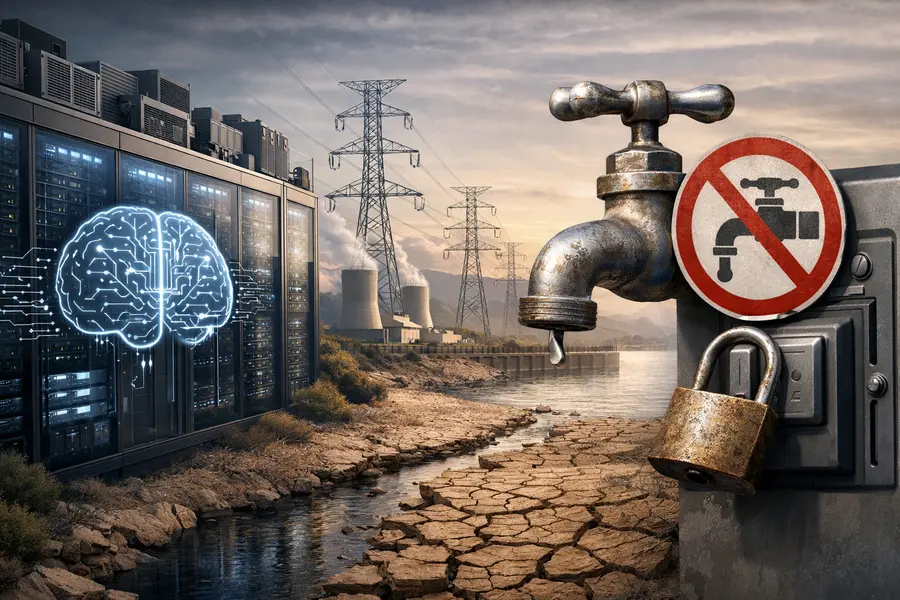
U.S. states are imposing the first taxes, water caps, and construction pauses on AI-driven data centers as global electricity demand from the sector approaches 1,000 TWh in 2026.
- Virginia enacted the first U.S. data center electricity consumption tax at $0.011 per kWh, effective July 1, 2026.
- Michigan proposed capping hyperscale data center water use at 2 million gallons per day, with 90% clean-energy procurement mandates under consideration.
- Global data center power demand is on track to exceed 1,000 TWh by year-end — equivalent to Japan's entire annual electricity consumption.
Lead
WASHINGTON — An unprecedented wave of data center restrictions is sweeping U.S. state capitals in mid-2026, driven by mounting alarm over the AI infrastructure power strain that threatens residential electricity bills, freshwater supplies, and regional grid stability. Virginia became the first state in the country to levy a tax on data center electricity consumption, effective July 1, while Michigan's governor unveiled a sweeping affordability pledge and lawmakers advanced legislation to cap water withdrawals at hyperscale campuses. With 27 states now moving legislation targeting data center energy costs, the era of largely uncontested build-out for cloud and AI infrastructure appears to be closing.
What Happened
Virginia's biennial budget, approved June 22 by the state legislature, introduced a $0.011-per-kilowatt-hour tax on electricity consumed by qualifying data centers each month. The levy, the first of its kind in the United States, runs from July 1, 2026, through July 1, 2028, when it is scheduled to sunset. Virginia — home to the densest concentration of data centers on earth — framed the measure as a two-year mechanism to recapture infrastructure costs borne by ratepayers as the sector's load growth outstrips grid expansion.
On July 15, Michigan Governor Gretchen Whitmer unveiled the Michigan Affordability and Responsible Growth Pledge, a package of 10 commitments requiring data center developers to cover the full cost of power, water, and construction before breaking ground. Simultaneously, Michigan Senate Democrats advanced legislation to cap hyperscale data center water use at 2 million gallons per day, mandate annual water-use reporting beginning in 2027, and create a new permitting process for any facility drawing more than 550,000 gallons daily. A competing energy bill in the Michigan Senate would require operators to procure 90% of their power from clean sources and sign 20-year utility contracts.
The Water Constraint
Water has emerged as the second-binding constraint on new data center development, trailing only power availability. A single hyperscale campus now evaporates more water daily than a municipality of 10,000 residents. Indirect water consumption — the water used to generate the electricity powering U.S. data centers — stood at roughly 211 billion gallons in 2023, more than 10 times direct on-site cooling demand.
An ongoing July 2026 heatwave across the United States intensified pressure on both dimensions simultaneously, straining transmission capacity while driving cooling loads to seasonal peaks. Drought declarations in several states are fueling calls to subject data centers to the same emergency-curtailment protocols applied to other large industrial water users. Regulators in California, where a January 2026 Berkeley Law report detailed the environmental impact of data centers, have proposed automatic interim restrictions on high-volume withdrawals when drought thresholds are triggered.
State Legislative Wave and Moratorium Push
Twenty-seven states are advancing legislation requiring data center operators to cover energy infrastructure costs and disclose consumption figures. Moratorium proposals have been introduced in 11 states, though most face significant resistance from economic development and technology lobbies.
Maine came closest to enacting a construction pause. Legislation that would have barred new facilities larger than 20 megawatts until November 2027 — the first such moratorium in the nation — passed the legislature before Governor Janet Mills vetoed it in April. Mills acknowledged the measure was "appropriate given the impacts of massive data centers in other states on the environment and on electricity rates," but objected to specific language blocking a locally supported project. That project was subsequently abandoned.
California, Ohio, and Utah have already enacted laws requiring cost coverage from developers that go beyond the federal government's voluntary framework. Virginia, Georgia, Indiana, and Washington have mandated or proposed legislation tying data center interconnection permits to infrastructure contributions proportional to electricity consumption.
Federal-State Friction
The federal government's approach remains largely voluntary. On March 4, 2026, major data center developers signed the White House-backed Ratepayer Protection Pledge, committing to fund the full cost of new electricity generation required by their operations. The pledge carries no legal enforcement mechanism and applies only to facilities requiring more than 100 megawatts of new load — leaving a significant regulatory gap for mid-size deployments that state laws are beginning to fill.
The divergence has created compliance complexity for operators running portfolios across multiple jurisdictions, as state thresholds can be as low as 10 megawatts, a fraction of the federal trigger.
AI and Technology Angle
The AI infrastructure power strain underpinning these restrictions is structural, not cyclical. The International Energy Agency now projects that global data center electricity consumption will exceed 1,000 TWh by year-end 2026 — a level equivalent to Japan's annual power demand and roughly double 2022 consumption. The acceleration is driven by the inference workloads of large language models, which require sustained, round-the-clock compute far more energy-intensive than traditional cloud services.
Technology suppliers are responding. Newer hyperscale designs increasingly adopt zero-water or low-water cooling architectures. Hybrid systems combining air cooling on moderate days with evaporative towers during heat stress can reduce annual water losses by as much as 75%. EPA rules taking full effect in 2026 further require individual discharge permits for cooling-tower blowdown, imposing strict limits on temperature, dissolved solids, PFAS compounds, and legionella — adding regulatory friction to legacy wet-cooling installations.
The broader regulatory dynamic reflects a shifting political calculus: the economic benefits of data center investment, long marketed as job creation and tax revenue, are increasingly weighed against rate hikes for residential customers and environmental stress on local water systems.
Outlook
The legislative trajectory points toward a more fragmented and costly operating environment for data center operators through 2027 and beyond. Virginia's two-year electricity tax is the first enforceable cost-recovery mechanism, but similar instruments are under active discussion in several other high-density states. Michigan's water-cap and clean-energy proposals, if enacted, would establish the most prescriptive resource-use framework in the country. Federal policymakers face growing pressure to set uniform national standards before state-level divergence compounds compliance costs. Meanwhile, the IEA's 1,000-TWh threshold — if reached — is likely to intensify the global tech regulation debate and accelerate timelines for mandatory efficiency and disclosure standards worldwide.