Pomegra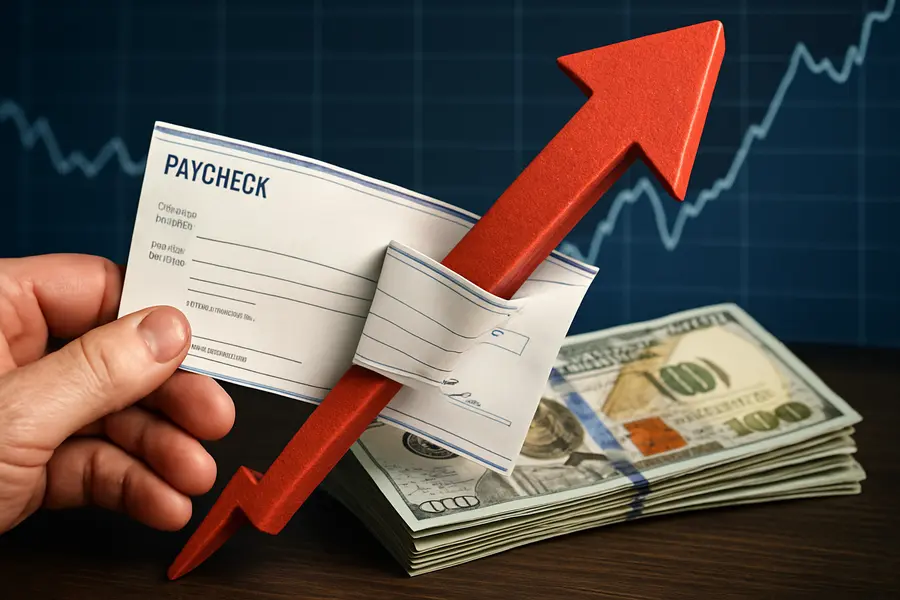
The U.S. consumer price index jumped 4.2% in May 2026, a three-year high, as energy costs outpaced nominal wage growth for a second consecutive month.
- May 2026 CPI rose 4.2% year-over-year, the highest since April 2023, driven by a 23.5% surge in energy prices over the past twelve months.
- Hourly earnings rose 3.4% annually while inflation hit 4.2%, pushing real wages down 0.8% for a second straight month.
- The Federal Reserve held rates at 3.50%–3.75% for a fourth meeting, with a June 17 hold widely seen as near-certain.
Lead
The Bureau of Labor Statistics on June 10 reported that the consumer price index rose 0.5% in May on a seasonally adjusted basis, lifting the twelve-month rate to 4.2%—the highest mark since April 2023 and the second straight month that US inflation news has darkened the income outlook for American workers. Energy prices, stoked by disruptions to Middle Eastern oil supply stemming from the Iran conflict, surged 3.9% in May and 23.5% over the prior year, accounting for more than 60% of the overall monthly CPI increase. Core CPI, which strips out food and energy, rose a more contained 0.2% for the month and 2.9% annually.
The Wage-Price Gap
The month's real wage growth figures underscore how a period of genuine earnings recovery has reversed. Average hourly earnings climbed 3.4% over the twelve months through May—a respectable nominal figure in isolation—but with consumer prices rising 4.2% over the same period, purchasing power contracted by 0.8%. That marks the second consecutive month in which workers have absorbed a real-terms pay cut, ending a roughly three-year stretch in which wage gains had outrun the consumer price index.
For lower-income households, the compression is more acute. Non-discretionary expenses—shelter, food, and energy—have each accelerated, leaving little room to offset higher costs through reduced discretionary spending. Rents of primary residences rose 4.3% year-over-year in May; owners' equivalent rent climbed 4.1%. Grocery prices edged up 0.1% on the month; food away from home rose 0.3%. The squeeze on cost of living 2026 is concentrated in exactly the categories that lower-wage earners cannot substitute away from. Consumers in previously low-cost metro areas—including parts of Atlanta, Nashville, and central Florida—are reporting the same cost escalation that had been confined to gateway cities in prior cycles.
Energy as the Primary Driver
The 23.5% twelve-month increase in energy prices reflects a geopolitical premium that had been largely absent from U.S. consumer price index readings since 2022. Oil supply disruptions tied to the Iran conflict have pushed crude benchmarks materially higher, simultaneously inflating gasoline costs, utility bills, and freight rates. Shelter costs, which had been decelerating and were closely watched as a harbinger of broader disinflation, rose just 0.3% in May—half of April's gain—offering one of the few moderating signals in an otherwise firm report.
Market Reaction
Equity markets absorbed the inflation print with relative composure. The S&P 500 extended its run to a record 7,599.96, buoyed by signals that U.S.–Iran diplomacy is advancing toward a durable resolution that could bring energy prices lower. Investors appear to be pricing the end of the geopolitical supply shock as the dominant macro force over the next six to twelve months, while treating the current CPI acceleration as transitory rather than entrenched. Technology stocks have led the rally, with Big Tech earnings expectations and declining rate-cut odds failing to dent the sector's momentum.The Federal Reserve's Dilemma
The Federal Reserve holds its benchmark rate at 3.50%–3.75%, and market pricing assigns a 97% probability that the June 17 Federal Open Market Committee meeting ends without a change—a fourth consecutive hold. New Chair Kevin Warsh has signaled a preference for patience, committing to a data-dependent approach while the central bank monitors whether the energy-driven inflation spike feeds into core services. The Fed now projects 2026 headline inflation at approximately 2.7%—above its 2% target but well below the May reading—an implicit forecast that the energy premium dissipates as geopolitical conditions normalize.
The risk to that view is self-reinforcing: elevated cost of living 2026 pressures that embed higher wage expectations in the next round of labor negotiations could generate a secondary inflation impulse independent of oil prices. Shelter costs, while slowing in May, remain elevated at 3.8%–4.3% annually and are unlikely to retreat quickly given still-constrained housing supply across major metros.
Outlook
The May 2026 consumer price index report presents a bifurcated picture: equity markets discounting the current price acceleration on geopolitical optimism while workers contend with a measurable erosion in living standards. Real wage growth has turned negative for the second month running, and US inflation news shows that cost pressures in essentials show limited signs of abating near-term. Whether inflation concedes once the Iran geopolitical premium fades—as investors broadly expect—or becomes embedded in shelter and services remains the central question for the Federal Reserve's higher-for-longer posture and for household budgets through the remainder of 2026.