Pomegra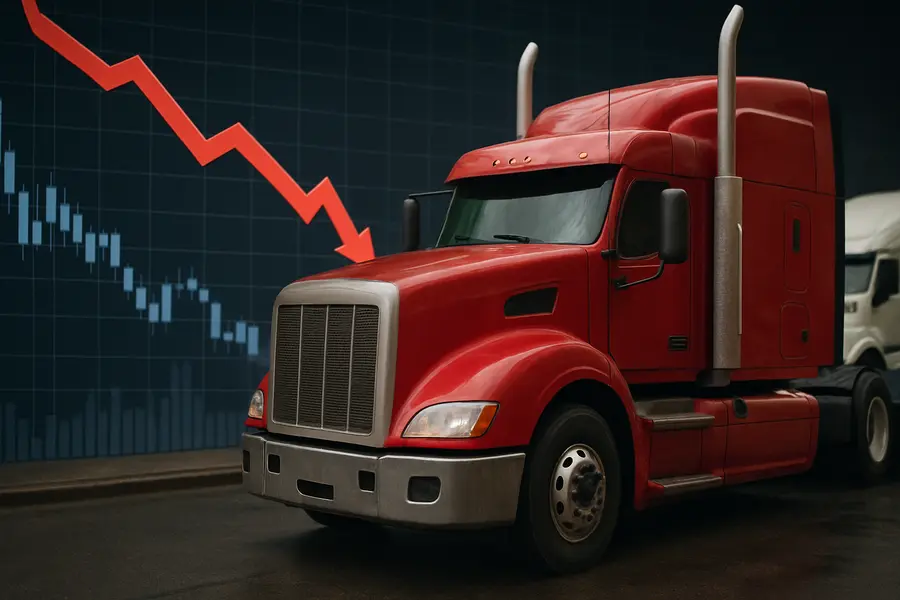
U.S. commercial truck sales fell 13.6% in 2025, reviving a closely watched recession signal that has preceded every American economic downturn since 1973.
- Commercial truck sales declined 13.6% in 2025, with heavy-duty volumes down 13.3% and medium-duty down 13.9% year over year
- Class 8 retail deliveries hit a post-pandemic low in January 2026, falling 24% to 12,287 units from 16,175 a year earlier
- Since 1973, heavy truck sales have fallen ahead of every U.S. recession; PACCAR reported a 36.1% drop in Q4 2025 net income
Lead
U.S. heavy truck sales posted a full-year decline of 13.6% in 2025, with Class 8 volumes sinking to 12,287 retail units in January 2026 — down 24% year over year and among the weakest monthly readings since the onset of the COVID-19 pandemic — reigniting debate over one of the most durable US recession signals in macroeconomic analysis. The nearly three-year downturn has strained manufacturers, hollowed out fleet profitability, and raised questions about the resilience of goods-driven growth in the broader U.S. economy.
What Happened
Commercial truck sales deteriorated across every segment in 2025. Heavy-duty vehicles fell 13.3% for the year, while medium-duty volumes declined 13.9%, for a combined commercial decline of 13.6%, based on American Truck Dealers data published through the National Automobile Dealers Association. The steepest month was September 2025, when heavy-duty truck sales fell 25.6% year over year.
January 2026 offered no immediate reprieve. Combined U.S. and Canada Class 8 retail sales reached just 13,781 units — one of the lowest monthly tallies recorded since May 2020. McKinsey projected a 10% to 25% year-over-year contraction in North American Class 8 deliveries through the first half of 2026, while ACT Research forecast full-year 2026 volumes of approximately 171,000 units, an 18% retreat from 2025 levels.
The Cass Freight Shipments Index, a broad proxy for North American goods movement, declined year over year for 23 consecutive months through January 2026, a run not recorded since the early pandemic period.
Why Trucking Predicts Recessions
Heavy truck sales function as a sensitive economic indicator because fleets commit to new capacity only when operators believe freight demand will sustain high utilization rates. When order books contract, fleet managers are signaling an expectation of lower shipments — a judgment that frequently reflects real conditions on factory floors and in distribution networks before those pressures materialize in official output statistics.Federal Reserve Bank of St. Louis data show that heavy truck sales declined ahead of all seven U.S. recessions recorded since 1973, with an average lead time of roughly 13 months. Historical downturns illustrate the magnitude of such cycles: Class 8 sales collapsed more than 67% from their 2006 peak to a 2009 trough during the Global Financial Crisis, and fell approximately 50% between 1999 and 2002 during the dot-com recession.
Economists note, however, that three prior episodes produced sharp declines in heavy truck sales without a subsequent recession. In each case, excess capacity accumulated during demand surges corrected through attrition rather than through outright demand destruction — a dynamic that is also partially at work in the current cycle, following the aggressive fleet expansion of 2021 and 2022.
Manufacturers Under Pressure
The prolonged slump has produced measurable damage across the transportation industry's manufacturing base. PACCAR (PCAR), maker of Kenworth and Peterbilt trucks, reported 2025 annual revenue of $28.44 billion, a decline of 15.5% from $33.66 billion in 2024. Fourth-quarter 2025 net income fell 36.1% year over year to $556.9 million, reflecting weak freight demand and lower truck volumes. Revenue in the first quarter of 2026 came in at $6.78 billion, down from $7.44 billion in the equivalent quarter of 2025.
Daimler Truck and Volvo Group reported comparable deterioration, each citing weak North American freight conditions, elevated financing costs, and tariff-related cost pressures. New truck pricing has risen structurally because of embedded Section 232 tariff impacts on steel and aluminum, higher input costs, and compliance investments tied to EPA 2027 emissions standards — compressing margins for manufacturers and fleet operators simultaneously.Structural Complexity
The recession signal from heavy truck sales is historically unambiguous, but the post-pandemic U.S. economy introduces meaningful complexity. Services and technology now account for a larger share of GDP than in earlier cycles, partially insulating growth from industrial downturns. Real GDP growth averaged 2.7% across the 24 months during which truck sales growth was predominantly negative — an unusual divergence relative to past episodes.
Tariff-driven uncertainty, elevated borrowing costs, cautious consumer spending, and a construction slowdown from higher interest rates are all contributors to weak freight volumes, but each operates differently from the demand collapse that typically precedes a broad recession. The composition of the weakness matters as much as its severity.
Outlook
North American Class 8 order activity began recovering sharply in the latter part of 2025. March 2026 preliminary orders surged 130% year over year, and May 2026 preliminary orders rose 103%, driven by improving spot and contract freight rates, tightening fleet capacity, an aging equipment base, and growing urgency around pre-buying ahead of EPA 2027 emissions rules. Whether order strength translates into retail deliveries — and whether freight fundamentals can sustain the momentum — will determine whether 2025's sharp contraction in the transportation industry joins the historical record as a confirmed recession precursor or proves, once again, to be a mid-cycle correction. The answer is likely to emerge within the next two to three quarters.
Mentioned tickers: PCAR, DTRUY