Pomegra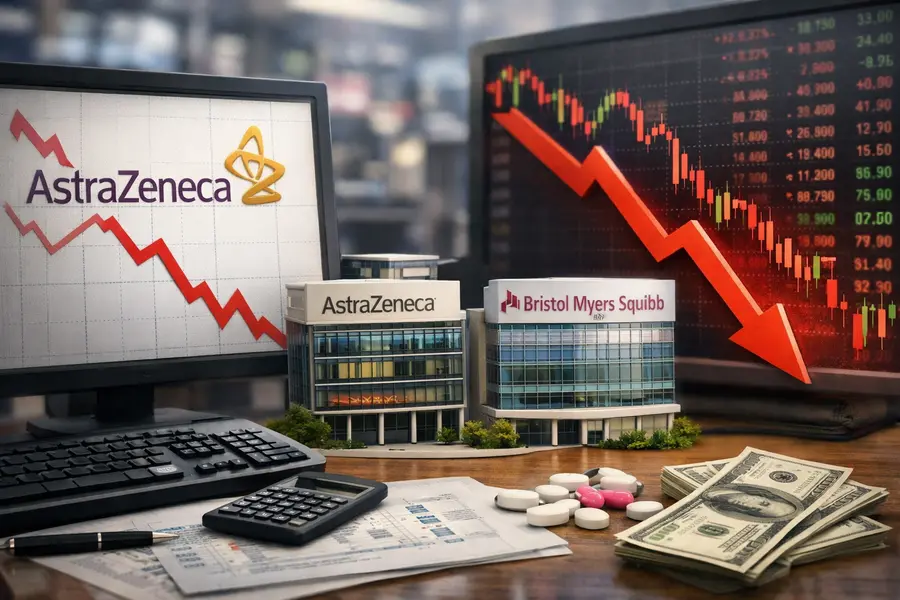
AstraZeneca shares fell sharply in premarket trading after the Financial Times reported early-stage merger talks with Bristol Myers Squibb, raising concerns over deal economics and regulatory complexity.
- AZN slid 7.3% premarket while BMY gained 3% on reports of a potential $400 billion mega-merger.
- The deal, if completed, would create one of the broadest oncology portfolios in the global pharmaceutical industry.
- Both companies face patent cliffs by 2030 affecting combined revenues of roughly $50 billion, adding urgency to the strategic review.
Lead
AstraZeneca shares tumbled 7.3% in U.S. premarket trading Monday after the Financial Times reported that the British-Swedish drugmaker had held early-stage talks with Bristol Myers Squibb about a potential merger that would create a combined pharmaceutical entity valued at approximately $400 billion. Bristol Myers Squibb rose 3% on the news. Neither company has confirmed the discussions, and sources familiar with the matter indicated a deal may never be finalized.What Happened
The Financial Times reported on August 2, 2026 that AstraZeneca and Bristol Myers Squibb explored a combination over recent months, with talks described as preliminary and without a formal mandate. The prospective tie-up would rank among the largest pharmaceutical mergers in history, pairing AstraZeneca's market capitalization of roughly $264 billion with Bristol Myers Squibb's approximately $133 billion.
The divergent market reaction was immediate. Investors in AstraZeneca sold shares, treating the prospect of a complex, cross-border acquisition as value-destructive for the acquirer. Bristol Myers Squibb shareholders responded positively, anticipating a potential premium exit at a moment when the company had just delivered a strong quarterly beat — Q2 2026 earnings per share of $2.04 against a consensus of $1.61, with revenue of $12.97 billion exceeding expectations of $11.71 billion.
Market Reaction
The asymmetric price response reflects a well-established pattern in pharmaceutical M&A: acquiring companies typically bear the near-term risk of integration costs, regulatory friction, and dilution. AstraZeneca had been trading near multi-month highs before the report surfaced, and the premarket sell-off erased a meaningful portion of recent gains.
Bristol Myers Squibb had already reached a 52-week high of $68.10 in the days preceding the report, benefiting from its strong earnings print. The merger speculation added a deal premium layer on top of an already elevated valuation.
Strategic Context
Two structural forces are pushing large pharma companies toward consolidation.
First, revenue exposure. AstraZeneca sourced just 42% of first-half 2026 revenues from the United States — the world's most profitable pharmaceutical market — compared with 69% for Bristol Myers Squibb. A merger would immediately rebalance AstraZeneca's geographic mix and reduce its relative dependence on European and emerging-market pricing environments, where regulatory and reimbursement pressures are intensifying.
Second, the patent cliff. Both companies face the expiration of key commercial franchises by 2030 on products that together generated approximately $50 billion in 2025 revenues. Combining pipelines would spread the replacement burden and accelerate access to each firm's late-stage development assets.
The therapeutic logic is also significant. AstraZeneca's strength lies in solid tumor oncology, while Bristol Myers Squibb has built a leading position in blood cancers and cell therapies. Analysts at Jefferies described the combined oncology portfolio as potentially the broadest in the industry. Overlap in cardiovascular disease and immunology adds complementary breadth beyond cancer.
Regulatory Dimension
Any transaction would face layered antitrust scrutiny. A cross-border deal of this scale would require clearance from the U.S. Federal Trade Commission, the U.K. Competition and Markets Authority, and the European Commission simultaneously — a process that has grown considerably more demanding since 2022. The FTC's review of large pharmaceutical combinations has become more rigorous, particularly where pipelines overlap in oncology and immunology, which is precisely the case here.
Analysts described themselves as "perplexed" by the reports, citing the severity of the regulatory obstacles alongside deal economics that, at current valuations, would require either a material premium or an all-stock structure to avoid immediate earnings dilution for AstraZeneca shareholders.
Pharma Industry Context
The reported talks arrive during a period of elevated M&A activity across the pharmaceutical sector, as companies scramble to offset pharma pills-level pipeline attrition — the steady erosion of exclusivity on blockbuster drugs — through external acquisition rather than organic R&D. The broader industry is also reacting to shifts in U.S. drug pricing policy and the Inflation Reduction Act's Medicare negotiation provisions, which are reshaping the commercial calculus for high-revenue brands.
AstraZeneca's campus expansion strategy — the company has invested heavily in manufacturing and research infrastructure in the U.K., U.S., and China — reflects a long-term bet on internal capability. A mega-merger would represent a significant strategic pivot toward consolidation rather than organic build-out.
Outlook
The immediate reaction in both stocks encapsulates the market's skepticism that a deal of this complexity can be executed cleanly. For AstraZeneca, any transaction would need to demonstrate a credible path to value creation that offsets integration risk and regulatory uncertainty. For Bristol Myers Squibb, the strategic case is simpler: a combination would extend the company's oncology franchise and provide geographic diversification at a moment when its domestic revenue base faces its own patent pressures. Whether early-stage talks advance to a formal offer will depend on resolution of the valuation gap, board alignment, and the regulatory outlook in Washington and Brussels. Both companies are expected to address the reports in investor communications in the days ahead.