Pomegra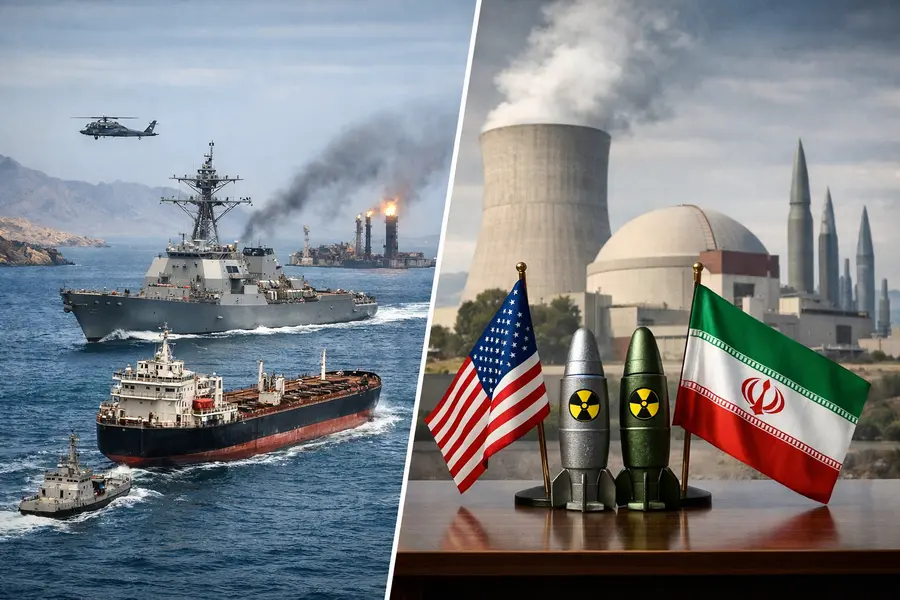
Trump declared a two-phase agreement with Iran covering the Strait of Hormuz and future denuclearization, but Iranian officials acknowledged only indirect Oman-mediated talks at the negotiation table.
- Brent crude fell 4.6% to $83.87/barrel; U.S. crude dropped 5% to $80.79 after Trump announced a Hormuz deal and halted new strikes.
- Iran's foreign ministry said no direct U.S.-Iran negotiations are occurring — only Oman-mediated Strait of Hormuz passage discussions.
- Trump's two-phase framework envisions a Hormuz reopening first, with denuclearization talks to follow.
Lead
President Donald Trump announced Sunday that the United States and Iran had reached a deal to reopen the Strait of Hormuz, adding that denuclearization of Iran would be addressed in a subsequent phase of negotiations — a claim that sent oil prices sharply lower even as Iranian officials flatly denied that any direct talks with Washington were underway. Trump said he called off planned U.S. and Israeli strikes after Saudi Arabia, the United Arab Emirates, Qatar, and Iran asked him to stand down, though Iranian state media carried no such request.
What Trump Said
Speaking publicly on August 3, 2026 — Day 157 of the U.S.-Israel military campaign against Iran — Trump described the diplomatic breakthrough in sequential terms: "a deal on Hormuz, and then there will be a deal on the nuclear." He characterized Phase One as potentially complete by Tuesday and acknowledged that denuclearization "will take a little while." He credited allied Gulf states for persuading him to pause military operations and projected the strait of hormuz could be fully operational for commercial shipping within days.
The announcement produced an immediate commodity response. Brent crude dropped approximately 4.6% to $83.87 per barrel, and U.S. crude fell 5% to $80.79 per barrel, as markets priced in the prospect that tankers trapped in the Persian Gulf since the onset of major combat operations could finally transit freely.
Iran's Contradicting Position
Tehran's account diverged sharply from Trump's characterization. Foreign Ministry spokesperson Esmail Baghaei told reporters that the sole diplomatic channel Iran is maintaining involves Oman — and solely over "an understanding on a route that would ensure the safe passage of shipping" through the strait, not a comprehensive reopening. Foreign Minister Abbas Araghchi described those Oman-mediated negotiation table discussions as being in their "final stages," specifying that talks concern a rerouted middle passage through Hormuz, portions of which Iran mined during the conflict.
Crucially, Iranian state media published no account of Tehran asking Trump to stand down from planned strikes. The Islamic Republic's official narrative positions it as pursuing a limited, Oman-brokered maritime arrangement — not a U.S.-brokered strategic settlement encompassing the strait's status, let alone nuclear capabilities.
Trump Fires Back
Within hours of his optimistic announcement, Trump reversed tone on social media, calling Iranian leadership "unbelievably duplicitous," accusing Iranian officials of privately requesting meetings and then publicly denying any dialogue exists. The outburst reinforced a pattern that has characterized the conflict's diplomatic track: episodic White House optimism, followed by Iranian denials, followed by renewed threats.
Strategic Context
The current standoff traces to February 28, 2026, when Trump authorized massive joint U.S.-Israeli strikes against Iranian military and nuclear infrastructure. A two-week ceasefire with safe passage provisions followed on April 8. In June, delegations entered formal negotiations aimed at a war-ending framework anchored to a memorandum of understanding, but progress stalled.
The Strait of Hormuz remains the world's most critical petroleum chokepoint, accounting for roughly 20% of global oil trade. Iran's mining of the middle passage — the commercially viable route through the strait — has effectively blockaded dozens of tankers in the Persian Gulf, contributing to a sustained energy supply shock that has kept crude prices elevated for months.
Iran's willingness to engage Oman as a mediator, rather than sit directly across from American officials at the negotiation table, reflects a calculated posture: preserve domestic legitimacy by avoiding the optics of direct U.S. capitulation while quietly pursuing a de-escalation track that could ease economic pressure.
Geopolitical Dimension
The dual narrative — Trump's deal proclamation versus Tehran's denial — places Gulf states in an uncomfortable position. Saudi Arabia, the UAE, and Qatar, which Trump says urged him to halt strikes, have strong economic interests in reopening Hormuz but cannot openly appear to be brokering a U.S. victory over Iran. Oman's traditional role as a back-channel intermediary, used in prior rounds of nuclear diplomacy, makes it the preferred vehicle for Tehran's carefully worded engagement.
For global shipping and energy markets, the distinction between a real deal and a proclaimed one is material. Vessel operators and insurers remain cautious; Lloyd's market war-risk premiums for Persian Gulf transits have not meaningfully declined despite Trump's announcement, reflecting market skepticism that a durable corridor will materialize on the timeline he described.
Outlook
The gap between Trump's announced Hormuz deal and Tehran's framing of limited Oman-brokered passage talks leaves the conflict's diplomatic status genuinely unresolved. Oil markets have partially priced in a de-escalation scenario, but a breakdown in indirect talks — or a resumption of U.S.-Israeli strikes — could rapidly reverse those price moves. Denuclearization, Trump's stated Phase Two objective, involves verification, enrichment limits, and sanctions architecture that typically require months of technical negotiation even under favorable political conditions. The most likely near-term path runs through Muscat, not Washington: a narrow Oman-mediated agreement on maritime passage that neither side is forced to publicly characterize as a concession.