Pomegra
S&P 500 futures edge higher Friday as May's blowout payrolls report steadies investor nerves amid the ongoing U.S.-Iran conflict and Strait of Hormuz uncertainty.
- May nonfarm payrolls surged 172,000 — more than double the 80,000 consensus — with the unemployment rate steady at 4.3%.
- Dow futures +0.08%, S&P 500 futures +0.24%, and Nasdaq 100 futures +0.45% in early Friday premarket trade after Thursday's broad 930-point Dow recovery.
- Brent crude eased to ~$89 per barrel as Trump signaled a potential Iran peace deal, easing Strait of Hormuz supply fears.
Lead
U.S. equity stock futures held modest gains in early Friday trade on June 12, as a stronger-than-expected May labor market report counterbalanced persistent geopolitical anxiety from the U.S.-Iran conflict. S&P 500 futures advanced 0.24%, Nasdaq 100 futures climbed 0.45%, and Dow futures edged up 0.08%, consolidating Thursday's sharp recovery in which the S&P 500 rose 1.8% and the Dow Jones Industrial Average gained 930 points after President Trump signaled that Iran strikes had been cancelled following direct diplomatic talks.
The Jobs Report That Changed the Calculus
The May jobs report, released June 5, delivered an upside surprise that continues to anchor market sentiment a full week after publication. The U.S. economy added 172,000 positions last month, more than double Wall Street's consensus of 80,000 and modestly below April's upwardly revised 179,000. March payrolls were simultaneously revised higher by 29,000 to 214,000, lifting the two-month revision total to 93,000 — a signal that prior months substantially understated labor demand.
The unemployment rate held at 4.3%, matching forecasts, while average hourly earnings rose 0.3% month-on-month and 3.4% year-on-year, both in line with estimates. Leisure and hospitality led sectoral gains with 70,000 new hires — five times its twelve-month average — followed by local government at 55,000 and health care at 35,000. The breadth and magnitude of the jobs report reflect an economy absorbing the Iran conflict's inflationary shock with more durability than many had anticipated.
The strong print has effectively locked in a hold at the Federal Reserve's June 16–17 meeting — the first chaired by Kevin Warsh since he succeeded Jerome Powell in May. Job creation running well above the Fed's estimated breakeven pace, alongside inflation still above target, leaves the central bank little room to ease policy. Futures markets have correspondingly scaled back rate-cut expectations for the remainder of the year.
Iran Conflict and the Oil Channel
The primary risk overhanging stock futures remains the U.S.-Iran war, which has kept the Strait of Hormuz — the choke point for roughly 20% of global seaborne oil trade — effectively closed since hostilities escalated in late February. The three-month disruption roiled energy markets, lifting Brent crude well above $100 per barrel and injecting an inflationary pulse that compounded equity market pressure.
A sharp crude reversal on Friday reflects a new diplomatic signal: Trump indicated that strikes planned against Iran were cancelled following talks with Iranian leadership, and that a peace agreement — which would reopen Hormuz shipping lanes and include Iranian commitments to abandon nuclear weapons development — could be finalized as early as the coming weekend. Brent crude dropped to approximately $89 per barrel, its lowest in nearly two months, as traders began pricing normalized supply flows.
The de-escalation signal follows a week of violent market sentiment swings. On June 10, the Dow shed 953 points as Trump threatened further strikes following Iran's downing of a U.S. Apache helicopter patrolling Hormuz. Thursday's 930-point recovery illustrated just how tightly stock futures and broader equities are tracking geopolitical signals in real time.
Geopolitical Dimension
Even with a ceasefire in prospect, commodity traders remain cautious. Restoring full Hormuz transit will require demining operations, restart of idled production fields, and repair of energy infrastructure damaged by sustained drone and missile exchanges — a process likely spanning months even under a best-case diplomatic scenario. Fitch Ratings has already downgraded its global sovereign sector outlook, citing the conflict's expected drag on growth and its upward pressure on inflation and bond yields.
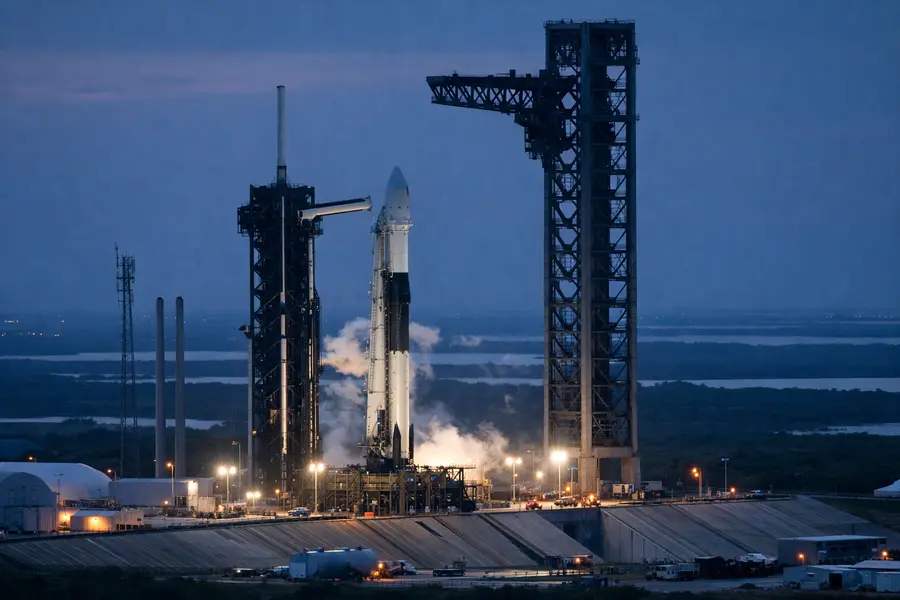
Market sentiment is further complicated by the fact that a resilient jobs report simultaneously reduces the probability of near-term Fed rate cuts — a structural headwind for high-valuation growth equities — even as it signals economic durability. The duality is keeping stock futures range-bound rather than decisively directional.The SpaceX IPO, also scheduled for June 12, is drawing significant institutional attention and may contribute additional equity market activity through the session.
Outlook
U.S. markets enter Friday's session supported by a labor market that has materially outperformed forecasts and underscored economic resilience. A confirmed Iran ceasefire and Hormuz reopening represent the most consequential near-term upside catalyst — removing the dominant market sentiment depressant of the past three months and unlocking recovery potential across energy, shipping, and consumer sectors. The Federal Reserve meeting on June 16–17 is the next scheduled inflection point, with the strong jobs report having already narrowed the policy options available to Chair Warsh. Until the Hormuz situation reaches a definitive resolution, stock futures are likely to remain sensitive to geopolitical headlines above all other variables.
Mentioned tickers: SPY, QQQ, DIA, USO, BNO, XLE, XOM, CVX