Pomegra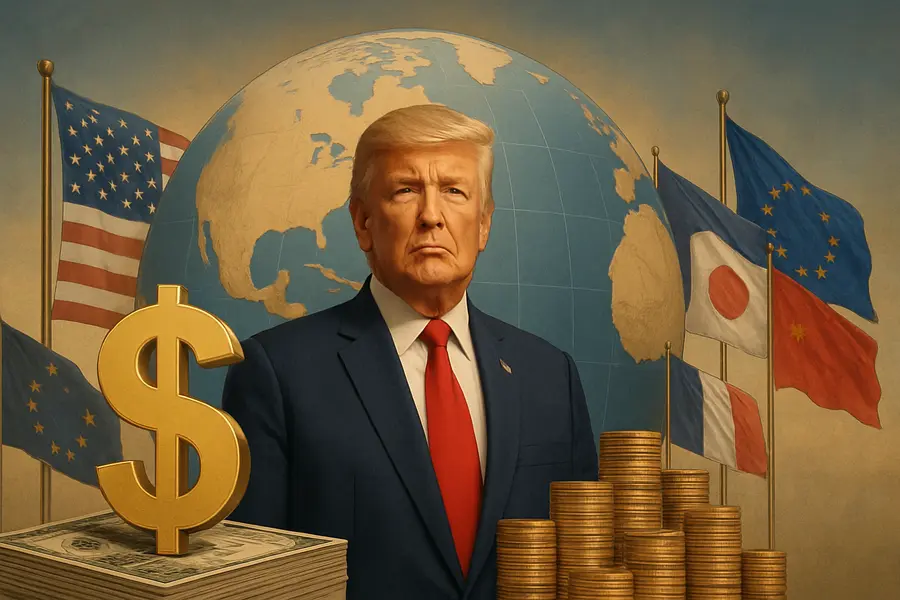
Trump's tariff agenda tests American economic power in 2026 as global trade backlash, a Supreme Court rebuke, and de-dollarization challenge U.S. dominance.
- The Supreme Court struck down IEEPA-based tariffs in February 2026, exposing up to $175 billion in potential refunds and forcing the administration to seek new legislative authority.
- JPMorgan estimates Trump tariffs and foreign retaliation could cut US GDP by 2 percentage points through 2026, adding $1,500 in annual costs per U.S. household.
- The dollar's share of central bank reserves has fallen to approximately 57%, while BRICS nations advance a blockchain-based alternative to SWIFT.
Lead
The contest over American economic power has entered a decisive phase in 2026. President Donald Trump's sweeping tariff regime—the largest U.S. tax increase as a share of GDP since 1993—has generated $160 billion in federal revenue, provoked retaliatory blocs spanning three continents, and been partially struck down by a 6-3 Supreme Court vote. The US economic future now turns on whether Washington can convert protectionist ambition into durable leverage, or whether the global trade backlash it has unleashed permanently erodes the institutional foundations of American dominance.
What Happened
Trump economic policy in its second term rested on an aggressive tariff architecture. A universal 10 percent levy on nearly all trading partners, announced in April 2025, was paired with higher country-specific rates—triggering a stock market crash and the emergence of a "Sell America" investment trend among institutional portfolios.On February 20, 2026, the Supreme Court delivered a structural blow. In Learning Resources, Inc. v. Trump, a 6-3 majority ruled that the International Emergency Economic Powers Act (IEEPA) does not authorize the president to unilaterally impose tariffs. Chief Justice John Roberts, writing for the majority, found that Congress has consistently used explicit language when delegating tariff authority—and IEEPA contains none. The ruling voided the legal basis for tariffs that had raised $160 billion through that date, creating a potential refund liability of up to $175 billion.
The administration has since pivoted to seeking congressional tariff authorization, a process that prolongs uncertainty across global supply chains.
Economic Fallout
The macroeconomic damage is measurable. JPMorgan estimates that the combination of U.S. tariffs and foreign retaliation—led by China and the European Union—could reduce U.S. GDP by 2 percentage points and global GDP by 1 percentage point through 2026. The IMF's April 2026 World Economic Outlook projects global growth at 3.1 percent this year, with trade tensions compounding shocks from the Middle East conflict.
U.S. GDP growth holds at approximately 2.5 percent in 2026—resilient by international comparison but trimmed by 0.62 percentage points directly attributable to tariff drag. Household costs tell a sharper story: Trump tariffs represent an average annual tax increase of $1,500 per U.S. household.
China's 2026 growth forecast has been marked down to 4.4 percent from a pre-trade war projection of 5.6 percent. At the global level, Bloomberg estimates the cumulative trade war impact at $2 trillion in lost world GDP.Dollar Under Pressure
The global trade backlash has accelerated structural challenges to dollar hegemony. The greenback's share of central bank reserves has declined to approximately 57 percent—down from 71 percent in 1999. Foreign investors' ownership of U.S. Treasuries has fallen to 30 percent, against a peak above 50 percent during the 2008-2009 financial crisis.
Treasury Secretary Scott Bessent has countered with a "crypto superpower" strategy, positioning U.S. cryptocurrency dominance as a new vector of financial statecraft. The administration has also taken equity stakes in domestic critical-mineral producers and brokered strategic mining acquisitions in Brazil, seeking to anchor supply-chain control outside the tariff framework.
Global Realignment
The EU has been caught between U.S. tariff pressure and Chinese manufacturing overcapacity. Brussels has doubled steel import tariffs, launched an economic security doctrine, and is preparing new anti-overcapacity tools by September 2026. Washington has conditioned tariff relief for the bloc on digital-regulation concessions and industrial tariff cuts—negotiations that have produced framework agreements but no final settlement.
The strategic vacuum left by U.S. disengagement from multilateral trade has been filled by competing architectures. The Comprehensive and Progressive Agreement for Trans-Pacific Partnership (CPTPP) continues to expand without U.S. participation. Africa's Continental Free Trade Area is deepening intra-continental linkages. Between April and December 2025, the Trump administration published 12 joint-statement framework agreements with partners including Japan, South Korea, the United Kingdom, and Switzerland—a bilateral scaffolding that has yet to replace the rule-based multilateral system it has displaced.
AI and State Capacity
The Carnegie Endowment's June 2026 assessment identifies a third determinant of the US economic future beyond tariffs and monetary policy: advances in artificial intelligence. U.S. AI leadership—measured in model capability, compute investment, and enterprise deployment—remains the most asymmetric economic advantage Washington holds. It operates largely outside the tariff framework and carries no judicial exposure to IEEPA-style challenges.
At the same time, the downsizing of federal agencies has reduced the state's operational capacity to deploy economic power tools—sanctions enforcement, export-control administration, trade negotiations, and critical-mineral strategy—at the required scale. This erosion compounds the structural decline in U.S. institutional credibility that underlies pressure on dollar hegemony.
Public sentiment reflects the tension: most Americans believe the United States is declining in global power and influence, and nearly two-thirds consider China's power to now equal or exceed that of the United States.