Pomegra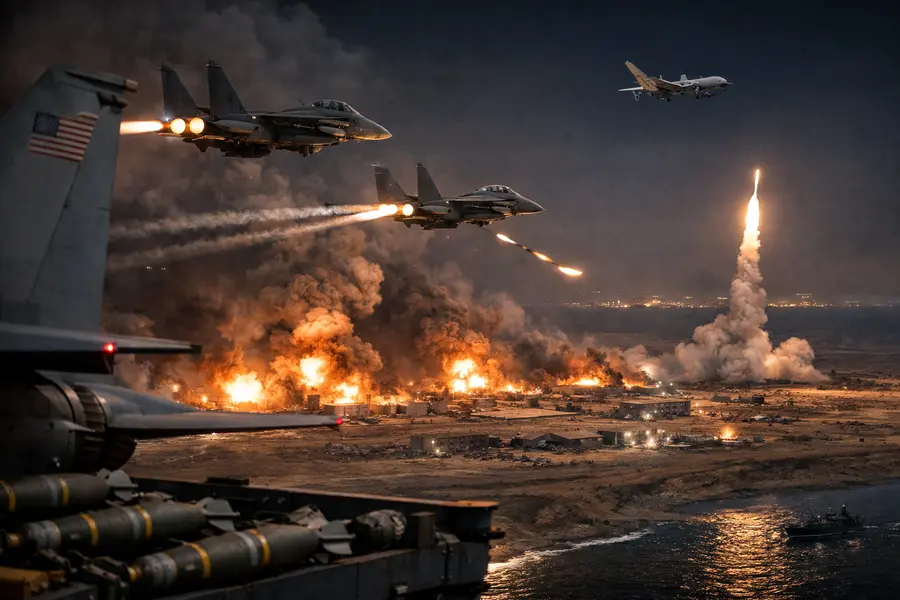
The United States military has struck more than 140 Iranian military targets across seven consecutive nights of operations, pushing Brent crude above $85 a barrel and shattering a June ceasefire agreement that had briefly calmed regional tensions.
- CENTCOM completed its 7th straight night of strikes July 17–18, hitting surveillance, logistics, weapons storage, and maritime sites.
- Brent crude rose to $85.92 a barrel, up 19% from pre-conflict levels; Strait of Hormuz transits fell more than 50% in one week.
- The June memorandum of understanding between Washington and Tehran collapsed July 8; Iran declared the peace deal voided and halted further negotiations.
Lead
Washington / Manama — U.S. Central Command completed a seventh consecutive night of strikes against Iran on July 17–18, 2026, employing fighter aircraft, aerial drones, and warships to strike more than 140 Iranian military targets in a single major operation earlier this week, with cumulative strikes across the campaign exceeding 300 discrete targets. The overnight operation, concluding at 9:30 p.m. Eastern Time on July 17, targeted surveillance sites, military logistics infrastructure, underground weapons storage, and maritime capabilities at locations including Jask, Sirik, Bushehr, Bandar Abbas, Qeshm Island, Ahvaz, and Yazd.What Happened
The US Iran war escalation reached a new intensity as CENTCOM Iran targets expanded to include coastal radar installations, drone and missile production sites, naval assets, ammunition storage, and communication networks. The strikes are being conducted at President Donald Trump's direction and are designed, in CENTCOM's characterization, to continue degrading Iranian military capabilities.
Iran's Health Ministry reported at least 50 people killed in the renewed US bombing campaign this month, including 12 in the 24 hours ending July 18. Iran's national water company said roughly 10,000 people across 20 villages lost access to water following overnight strikes on desalination infrastructure. A tower at Iran's Chabahar port on the Gulf of Oman — a critical trade corridor for landlocked Afghanistan — collapsed after an earlier strike wave.
Tehran has expanded its own strike package in response. Iran struck three commercial vessels in the Strait of Hormuz, and Iranian drones and missiles have targeted U.S. military installations and regional partners, triggering air defense intercepts in Kuwait. Bahrain and Saudi Arabia issued shelter-in-place advisories for civilian populations.
Ceasefire Collapse
The current hostilities follow the disintegration of a memorandum of understanding reached in late June. The ceasefire framework, which had briefly eased oil prices toward pre-war levels, fell apart on July 8 after Iran launched a drone strike against a vessel in the Strait of Hormuz. President Trump declared the ceasefire "OVER" and directed the reimposition of oil sanctions on Iranian exports. Iran's foreign ministry subsequently declared the memorandum voided, citing what it described as U.S. violations of the agreement's terms, and announced that Tehran had no plans to resume negotiations — though a further round of diplomatic talks in Switzerland remains under discussion.
Market Reaction
Energy markets have absorbed successive shocks throughout the US strikes Iran July 18 period. Brent crude September futures reached $85.92 a barrel as of early July 18 trading — a 19 percent premium over pre-conflict levels and the highest closing since mid-June. An initial 9.6 percent single-day surge following the ceasefire collapse was extended by further daily gains of 3 to 4 percent as each new strike night confirmed ongoing hostilities.
The Middle East military infrastructure campaign has had a direct effect on global energy logistics. Strait of Hormuz transits fell to 57 recorded passages across a three-day window, a decline of more than 50 percent week-on-week. The strait handles roughly 20 percent of global seaborne crude and liquefied natural gas flows. Tanker operators have sharply elevated war-risk insurance premiums, and several major charterers have suspended bookings on routes through the Persian Gulf.
Strategic Context
The US Iran war escalation is unfolding across a strategically concentrated geography. CENTCOM strikes on Jask and Sirik — Iran's southernmost naval installations on the Gulf of Oman — reflect a U.S. effort to degrade Iranian capability to project maritime force beyond the Strait of Hormuz. Strikes on Qeshm Island and Bandar Abbas target the Islamic Revolutionary Guard Corps Navy's primary Persian Gulf command infrastructure.
Iran's countermeasures, targeting commercial shipping and U.S. partner-nation military facilities, reflect Tehran's doctrine of asymmetric escalation — inflicting economic cost on Washington and its allies without directly engaging U.S. carrier strike groups. Iran's leadership has characterized the campaign as an "existential war," signaling an intent to absorb strikes rather than sue for terms under battlefield pressure.
Regional states face growing exposure. Gulf Cooperation Council members hosting U.S. forces — Bahrain, Qatar, the UAE, and Kuwait — have activated emergency protocols, while Saudi Arabia has accelerated preparations for potential infrastructure strikes on its own energy facilities.
Geopolitical Dimension
The collapse of the June memorandum of understanding has effectively reset diplomatic space to near zero. Proposals for a Switzerland-hosted negotiating session remain on the table, but Iran has publicly disavowed any commitment to attend. The trajectory of strikes suggests U.S. objectives have broadened from initial retaliatory aims — following Iranian harassment of Hormuz shipping in early 2026 — toward a sustained degradation campaign targeting the full spectrum of Iranian conventional military capability.
Global powers are reassessing energy security assumptions in real time. European governments have accelerated LNG import diversification, while Asian buyers dependent on Gulf crude have begun rotating toward alternative suppliers in West Africa and the Americas.
Outlook
Seven nights of strikes have materially degraded Iranian maritime and missile infrastructure, but have not produced a halt to Iranian attacks on regional shipping or U.S.-partner military targets. Brent crude above $85 a barrel and Hormuz transit volumes down by half represent the clearest near-term economic signal of the conflict's structural impact on global energy markets. Whether a diplomatic off-ramp in Switzerland materializes, or whether the campaign extends into a second week of strikes, will determine whether the 19 percent oil-price premium embedded since late June becomes a floor or a ceiling for markets navigating the most significant Middle East military confrontation in a generation.
Mentioned tickers: USO, XOM, CVX, SLB, FRO, STNG