Pomegra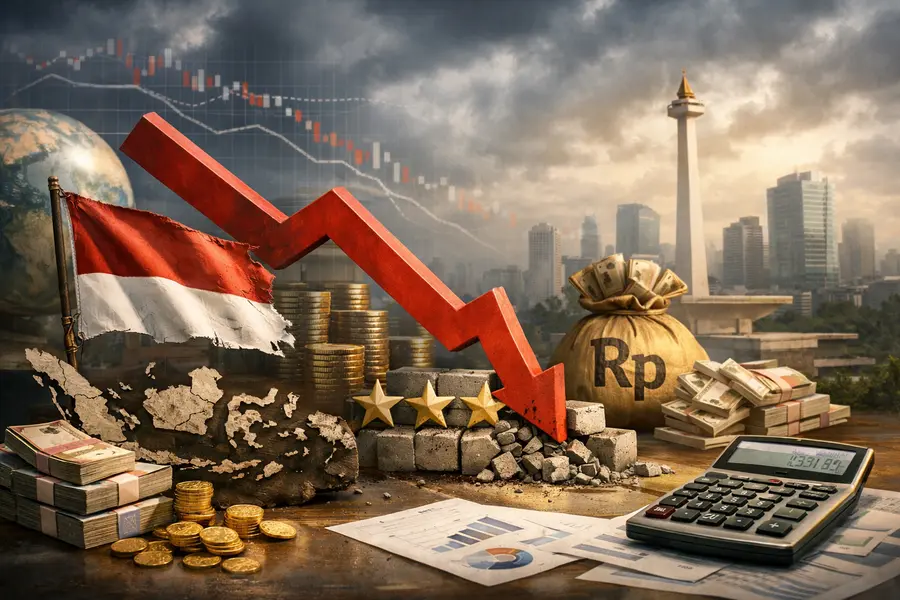
Indonesia's widening fiscal gap and President Prabowo's ambitious spending programs have drawn twin negative outlooks from Moody's and Fitch, rattling markets and raising questions about long-term fiscal health.
- Moody's and Fitch moved Indonesia's sovereign outlook to negative in early 2026, the first such action since the 1998 Asian financial crisis.
- The Jakarta Composite Index shed roughly 34% from its January 2026 peak, erasing an estimated $360 billion in market capitalization.
- Government debt has reached IDR 10,269 trillion, or roughly 40% of GDP, while the tax ratio stagnates at 9–10%.
Lead
Jakarta — Indonesia's fiscal health faces its most severe stress test since the Asian financial crisis, as President Prabowo Subianto's sweeping spending agenda pushes the budget deficit toward its constitutional ceiling of 3% of GDP. Both Moody's and Fitch revised their sovereign outlooks to negative in early 2026 — a first since 1998 — while the rupiah sank past IDR 18,000 per US dollar and foreign investors pulled more than $4 billion from Indonesian equities. The convergence of deteriorating market signals and rising emerging debt levels has put Indonesia's investment-grade status under sustained scrutiny.What Happened
Indonesia's 2025 fiscal deficit came in at 2.92% of GDP — IDR 695.1 trillion ($41.4 billion) — after government revenue fell 8% short of target, the highest shortfall outside pandemic years in at least two decades. The 2026 budget, approved by parliament, targets a marginally lower deficit of 2.68% of GDP, but analysts flag structural revenue weaknesses that make that projection optimistic.
The most contentious element of President Prabowo's spending agenda is the Makan Bergizi Gratis (Free Nutritious Meals) program, originally budgeted at IDR 335 trillion to feed 82.9 million school children, students, and pregnant women — accounting for roughly 11% of the central government's total expenditure. The government trimmed that allocation to IDR 268 trillion for 2026, but projections show that if coverage reaches 100% by 2029, the deficit could breach the constitutional 3% cap, reaching an estimated 3.34% of GDP. Defense spending is simultaneously climbing 37% to IDR 335.3 trillion in 2026.
Market Reaction
Financial markets have delivered a harsh verdict on the Prabowo spending trajectory. The Jakarta Composite Index (JCI), which set a record of 9,134 in January 2026, plunged approximately 34% to around 5,744 by mid-year, erasing roughly IDR 6.5 quadrillion ($360 billion) in market capitalization and costing Indonesia its place as Southeast Asia's largest equity market to Singapore. The rupiah breached the IDR 18,000 per dollar threshold in June — a psychologically significant level — after depreciating roughly 14% since Prabowo took office. Indonesia's balance of payments swung from surplus to a $9 billion deficit over the same period.
The bond market has also repriced risk, forcing up government borrowing costs as foreign capital exits. Close to a quarter of all tax receipts in 2026 are now directed toward debt interest payments, a ratio more than double the threshold recommended by the International Monetary Fund.
The Downgrade Risk
Rating agency actions have crystallized the Indonesia economy downgrade risk. Moody's moved first in February 2026, lowering its outlook on Indonesia's Baa2 rating to negative. Fitch followed in March with an identical move on its BBB rating. Both agencies cited concerns about governance trajectory and the long-term sustainability of the government's spending path. On July 13, 2026, S&P provided a partial reprieve, affirming Indonesia's BBB rating with a stable outlook — a decision that temporarily eased pressure on Prabowo's fiscal credibility after a bond market selloff in June.
Yet the dual negative outlooks from Moody's and Fitch represent the first coordinated downward signal on Indonesia's sovereign credit since the catastrophic 1998 crisis, and they reflect a view that the current fiscal path is not self-correcting. The Indonesia fiscal health challenge is compounded by a structurally low tax-to-GDP ratio — persistently in the 9–10% range — leaving the government with limited revenue capacity to absorb rising expenditure commitments.
Strategic Context
The political economy underpinning Indonesia economy risk is straightforward: Prabowo campaigned on welfare populism and has prioritized delivery on flagship social programs, even as market signals demand restraint. Analysts note that the government has cut overall ministry budgets — slashing a combined IDR 750 trillion from planned 2025 expenditures — while simultaneously protecting and expanding signature programs, creating a structural mismatch between headline deficit targets and the spending composition that markets actually observe.
A persistently low tax ratio, combined with ambitious social commitments and elevated defense outlays, leaves Indonesia's fiscal accounts vulnerable to any further shortfall in commodity revenues or global risk-off episodes. Emerging debt dynamics reinforce the concern: with government debt at IDR 10,269 trillion and interest costs consuming an outsized share of revenues, the fiscal space available to respond to external shocks is narrowing.
Fiscal and monetary policy have also moved in conflicting directions — a combination of emergency budget cuts and central bank liquidity injections has unsettled investor confidence in policy coherence at a moment when consistency is most required.
Outlook
Indonesia enters the second half of 2026 with credit outlooks negative at two of three major rating agencies, equity markets sharply below their highs, and a sovereign deficit that leaves little room for further slippage. S&P's affirmation of the BBB rating provides a temporary floor, but the durability of that assessment depends on whether the Prabowo administration can demonstrate credible fiscal consolidation — particularly through revenue-side improvements — rather than expenditure compression alone. Structural reforms to close the tax gap represent the clearest route back to stable outlooks; without them, the Indonesia economy downgrade risk shifts from conditional to probable over the medium term.
Mentioned tickers: EIDO, IDR