Pomegra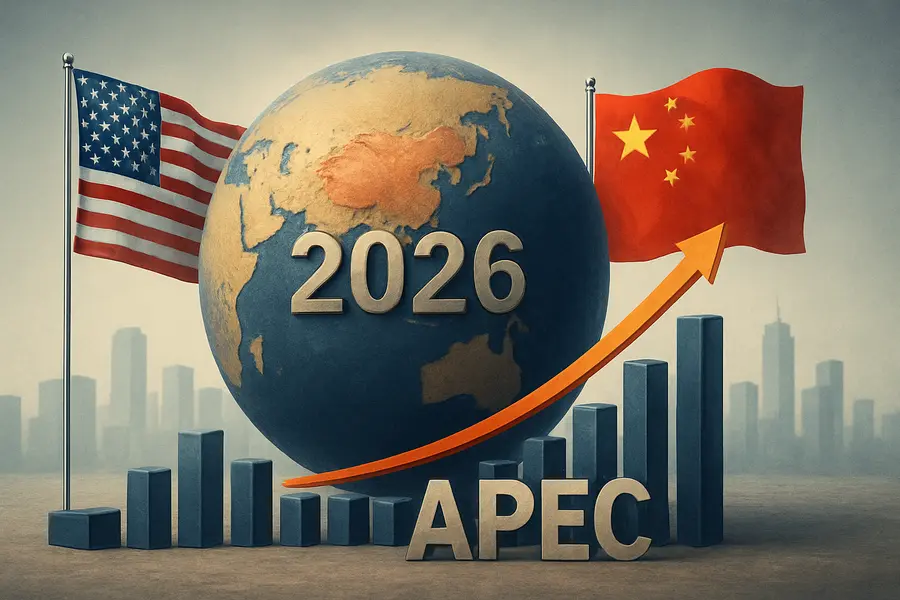
US-China strategic stability from the May Beijing summit faces new friction as APEC 2026 preparations in Shenzhen accelerate toward November's leaders' meeting.
- Trump and Xi's May 2026 Beijing summit secured $17B in annual US agriculture deals and 200 Boeing orders, but structural tensions remain.
- The Busan trade truce suspending reciprocal tariffs expires November 10, 2026, coinciding with APEC Leaders' Week in Shenzhen.
- Washington boycotted a June APEC Tourism Ministerial in Macau, citing Chinese visa restrictions on US diplomatic personnel.
Lead
Beijing and Washington are navigating the second half of 2026 in a condition both sides call "strategic stability" but define in fundamentally different terms. Dominating geopolitical news today, the US-China relationship is simultaneously producing diplomatic milestones and generating new points of friction — all against the backdrop of a November deadline that will test whether the year's most consequential bilateral framework holds. With China hosting the APEC Economic Leaders' Meeting in Shenzhen, the Asia-Pacific multilateral calendar is compressing that pressure into a span of weeks.
The Beijing Summit: What Was Agreed
When President Donald Trump landed in Beijing on May 14 — his first visit to China since 2017 — the symbolism was deliberate. Trump and President Xi Jinping committed to a "constructive China-US relationship of strategic stability," a phrase that has since become the operating language of US-China relations 2026 and the reference framework guiding both sides toward Shenzhen.
The economic deliverables were concrete. China agreed to purchase at least $17 billion in US agricultural products annually through 2028, reinstating listings for more than 400 US beef plants and resuming American poultry imports. Chinese airlines received approval to take an initial order of 200 Boeing aircraft, providing a significant revenue channel for a manufacturer that has faced persistent production constraints. Washington, in parallel, cleared the way for Nvidia to sell its H200 chips to major Chinese companies, partially reopening a market access channel restricted under prior export-control rulings. Both governments also agreed to negotiate a reciprocal tariff reduction framework covering goods valued at $30 billion or more.
Trump and Xi agreed to meet again on US soil in September — an arrangement that has since been read as evidence that Beijing views the May summit as the opening act of a longer diplomatic sequence rather than a self-contained event, with Xi unlikely to arrive in the United States without substantive progress to show.
Diverging Definitions of Stability
The summit's apparent success obscures a fundamental asymmetry in how each government reads the agreement. Beijing's interpretation of "strategic stability" is expansive: it encompasses managing core interests, respecting historical joint communiqués, and above all handling Taiwan in a manner acceptable to China. Washington's reading is narrower — focused on crisis communication, preventing military miscalculation, and establishing guardrails against unintended escalation.
Xi placed Taiwan at the center of Beijing's summit narrative, describing it as "the most important issue" between the two powers and warning that divergences over the island could produce direct conflict between the world's two largest economies. On the matters analysts consider structurally decisive for long-term competition — artificial intelligence governance, cyber operations, semiconductor controls, and digital sovereignty — the May summit produced little movement. The architecture of US-China rivalry remains intact beneath its diplomatic surface.
APEC Preparation and the Macau Friction
China's role as APEC summit host has amplified both the opportunities and the pressure points in the relationship. Xi chose Shenzhen — the Pearl River Delta technology hub — as the site for the 33rd APEC Economic Leaders' Meeting, a selection that doubles as an advertisement for China's innovation credentials. The host-year theme, "Building an Asia-Pacific Community to Prosper Together," and its three stated priorities — openness, innovation, cooperation — are calibrated for a year in which Beijing holds the chair and the agenda.
The APEC China 2026 calendar has distributed ministerial-level gatherings across Chinese cities. The APEC Digital and AI Ministerial Meeting is scheduled for July 16–28 in Chengdu, where US technology companies are participating in workshops — a signal that commercial engagement can function in a partially compartmentalized track even when political friction is elevated.
That compartmentalization has limits. Topping the world news bulletin in late June, Washington boycotted the 13th APEC Tourism Ministerial Meeting, held in Macau from June 24–28, after Beijing refused to relax visa requirements imposed on US diplomatic personnel operating in the special administrative region. China requires US government officials — including those responding to consular emergencies — to secure visas at least five to seven business days in advance. Washington had repeatedly asked Beijing to address what it termed "arbitrary and targeted" restrictions and proposed a compromise. Beijing rejected the proposal outright, and the US delegation's absence was widely noted, arriving just weeks after Trump's visit to Beijing and underscoring the persistent friction beneath the diplomatic momentum.
The Busan Truce: A November Deadline
Underpinning the entire relationship is the Busan trade truce, brokered at Trump and Xi's October 2025 meeting in South Korea. The agreement suspended escalating reciprocal tariffs, trimmed levies on fentanyl-related imports by 10 percentage points, paused new export-control measures, and extended certain Section 301 exemptions — all through November 10, 2026.
That expiration date arrives almost simultaneously with APEC Leaders' Week in Shenzhen, creating a convergence: the forum designed to demonstrate Asia-Pacific economic openness will convene as the most tangible legal architecture of the US-China trade relationship reaches its sunset. Talks on an extension are underway, but no public agreement has been announced as of July 2026, leaving the trade truce — and the market stability it has underwritten — in a state of managed uncertainty.
Outlook
Two overlapping timelines will define the remainder of 2026: the diplomatic sequence running from the September Trump-Xi meeting to the November APEC summit in Shenzhen, and the legal deadline imposed by the November 10 Busan truce expiration. Whether Washington and Beijing can align sufficiently on tariff architecture, technology access, and Taiwan management to produce durable institutional outcomes — rather than a framework of deferred conflict — is the central question in US-China relations 2026. The Macau episode demonstrates that even within an active diplomatic season, tactical friction can surface rapidly, testing the boundary between managed competition and open confrontation. APEC preparation in Shenzhen will serve as both stage and stress test.
Mentioned tickers: BA, NVDA