Pomegra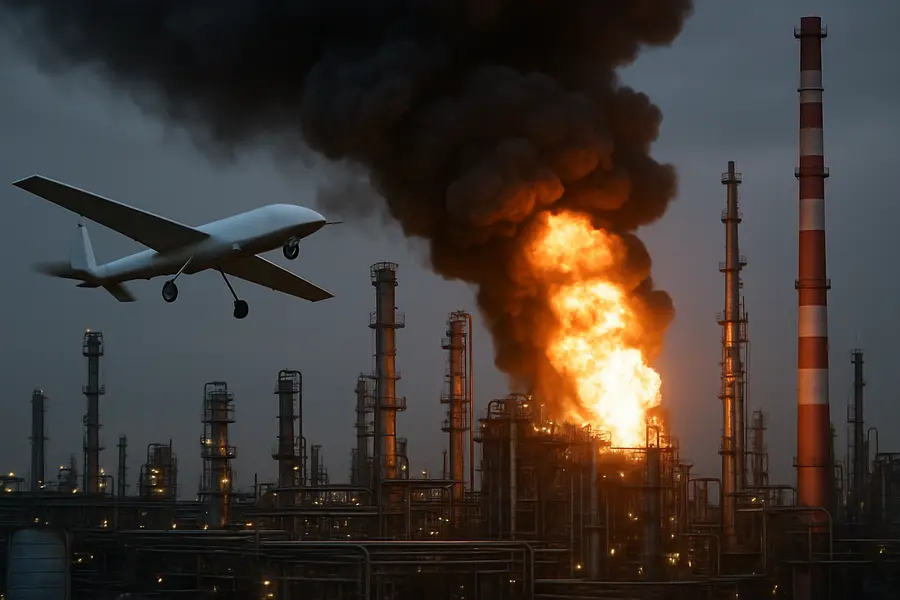
Ukraine launches its biggest strike on Moscow since 2022, sending 194 drones into the capital, igniting the Kapotnya oil refinery, and raising the stakes in an already volatile war.
- Ukraine intercepted 194 drones over Moscow alone, the highest count in the war, marking a decisive escalation in long-range drone warfare.
- The Kapotnya refinery — a Gazprom Neft facility processing 11 million tons of oil annually — was set ablaze for the second time in a single week.
- Seventeen people were injured in Moscow, airports were temporarily shut, and Kyiv framed the assault as retaliation for a Russian strike on a UNESCO-listed monastery.
Lead
Ukraine struck Moscow with its largest-ever drone barrage on Thursday, June 18, 2026, deploying a wave of nearly 200 unmanned aerial vehicles against the Russian capital in an operation that set one of the country's most strategic oil refineries ablaze, wounded 17 people, and temporarily suspended civilian air traffic across all major Moscow airports. The attack marks a significant intensification of the Russia-Ukraine war, extending Ukraine's long-range campaign deeper into Russian territory and with unprecedented scale.
What Happened
Russian authorities reported that air defense systems intercepted 194 drones in the Moscow region alone during the predawn assault, making it the single largest drone raid on the capital since Russia launched its full-scale invasion more than four years ago. Across a broader swath of Russian territory struck overnight, the Russian Ministry of Defense claimed to have downed nearly 1,000 Ukrainian drones in total.
The primary target was the Kapotnya Oil Refinery, a sprawling Gazprom Neft-operated complex situated in the southeast of Moscow, approximately nine miles from the Kremlin. Video verified by multiple international broadcasters showed violent explosions at the facility, with a large fuel tank's roof blown into the air and at least five simultaneous fires burning across the complex. It was the second direct hit on Kapotnya within seven days, compounding damage from a strike earlier in the week that had already forced the refinery to halt operations.
Two children were among the 17 injured reported by Russian city authorities, while the Moscow public prosecutor's office confirmed additional casualties without providing a full accounting.
Strategic Context
The Kapotnya facility is the largest fuel-producing plant in the Moscow metropolitan region, processing over 11 million tons of crude oil per year. Its repeated targeting reflects a deliberate Ukrainian strategy, active since late 2023, of dismantling the Russian energy infrastructure that funds and fuels the Kremlin's war machine. Ukrainian drone strikes have cumulatively crippled an estimated 17–20% of Russia's total refining capacity over that period, introducing sustained supply-side pressure on Moscow's domestic fuel market and defense logistics.
Thursday's assault represents an escalation in both ambition and execution. The simultaneous deployment of hundreds of drones across multiple attack vectors demonstrated a level of operational sophistication and asset volume that defense analysts have described as a meaningful shift in Ukraine's offensive posture, moving beyond harassment raids toward systematic infrastructure warfare.
Geopolitical Dimension
Ukrainian President Volodymyr Zelenskyy framed the assault as both punitive and strategic. He described the strike as a "justified" response to a Russian missile attack earlier in the week that damaged a historic UNESCO-listed Orthodox monastery complex in central Kyiv — a target whose cultural significance drew widespread international condemnation. Zelenskyy also issued a pointed warning to Moscow, stating that "the war must end" and signaling Kyiv's willingness to sustain pressure on Russian civilian and economic infrastructure until a settlement is reached.
Russia, in turn, continued its nightly long-range strike campaign against Ukraine, launching at least seven ballistic missiles and 239 additional drones at Ukrainian territory in the hours surrounding the Moscow attack. A Ukrainian drone strike also killed eight people when it struck a passenger bus in Russian-controlled territory in the Donetsk region, while additional Ukrainian strikes hit infrastructure in St. Petersburg, spreading the geographic scope of the campaign beyond Moscow.
The simultaneous pressure on multiple Russian urban centers signals a deliberate effort to stretch Russian air defense resources and force prioritization decisions across a wider front.
Energy and Economic Impact
The repeated disabling of Kapotnya adds acute pressure to Moscow's fuel supply chain at a strategically sensitive moment. The refinery accounts for more than a third of the capital region's fuel market, and its sustained disruption ripples into military logistics, agricultural operations, and urban transport. Ukrainian drone attacks on Russian refineries reportedly doubled in frequency through the first half of 2026 compared to the prior year, collectively pushing Russian domestic oil output metrics to levels not seen in 15 years.
For global energy markets, the pattern of drone warfare targeting core Russian energy assets introduces a structural risk premium that traders and hedgers have increasingly priced into forward contracts. The Baker Institute for Public Policy has estimated that cumulative strike damage has materially impaired Russia's ability to export refined products, a channel through which Moscow has partially offset broader sanctions pressure on crude revenues.
Outlook
The June 18 attack is unlikely to represent a ceiling. Ukraine's expanding drone production capacity — built with Western component supply chains and domestically scaled manufacturing — provides Kyiv with the means to sustain and potentially intensify strikes on Russian economic targets. The Kapotnya refinery, now hit twice in a week, faces an uncertain timeline to restore full capacity, with operational shutdowns cascading into regional fuel supply shortfalls.
The broader trajectory of the Russia-Ukraine war points toward continued geopolitical escalation through the summer. Russia shows no sign of halting its missile and drone campaign against Ukrainian cities; Ukraine is demonstrating both the capability and political will to impose symmetric costs deep inside Russian territory. The destruction of energy infrastructure, once a secondary theater, has moved to the center of both countries' operational strategies.